
Recordings › Why are homosexual activities forbidden? | Mufti Abu Layth · 2 Aug 2019 › Segment 2 of 3
How did classical scholars treat intersex people (khuntha) and their right to marry?
shari'ah shariat sharee'ah muftis ulama ulema ulamaaThe khuntha: how classical scholars failed intersex people
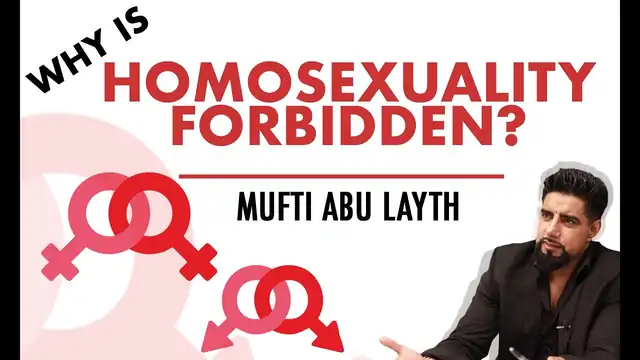 Play from 5:12
The video loads from YouTube only when you press play. Click a time in the transcript to seek.
Watch this part
Open on YouTube at 5:12The player starts at 5:12, the beginning of this part.
This segment5:12 to 11:42 · 6 min 30 sGeneral teaching
What this part covers
machinesummary, machine-writtenClassical scholars ruled that a khuntha, an intersex person, can neither marry nor be married, which Mufti Abu Layth calls cruel, absurd and a failure of scholarship to give a truly Islamic answer.
In more detail
Continuing the answer, Mufti Abu Layth describes a third layer he calls utterly cruel: the treatment of hermaphrodites, called khuntha in Arabic and in the Sharia. He explains that in the past this was usually biological rather than chosen: a person born with both sets of genitals, with neither, or with the organs of one sex who developed the features of the other at puberty, and he adds that today such conditions are usually corrected medically at a young age or at puberty. He also describes eunuchs, whose numbers rose because royalty and the aristocracy wanted castrated men who could still do a man's work. He says the scholars of the past wrote very clearly that a khuntha cannot marry and cannot be married, which he calls outright oppression: because some of them would have been like women with a penis, and any intercourse would have been anal, the scholars did not want to deal with the situation and simply said the khuntha could never marry. He calls this ridiculous and absurd and a perfect case study of the failure of scholarship to provide a truly Islamic answer to a challenge of its age.
Position stated
Mufti Abu Layth says the classical ruling that a khuntha can never marry was ridiculous and absurd, and a case study of scholarship failing to provide a truly Islamic answer to a challenge of its age.
“that's a perfect case study to show the failing of scholarship in a particular IRRI that they that the scholars failed in providing a truly Islamic answer to the challenge”
Category: method
Kind: general teachingTranscript
machine5:12 to 11:42 · click a time to seek · dotted terms open the glossary
utterly cruel is gonna be honest was Humaira Deitz okay which in the Arabic language and in the Sharia were referred to were referred to as Hansa so in Arabic you have the term Hansa now alpha is a sometimes they called Han thermo-skin right but confer is in Arabic a a hermaphrodite so it's a person either a mmm I mean I suppose in some ways may be
like like transgender to some extent but there were people that were usually it was biological so it wasn't kind of usually done by choice in the past it was more biological so it could have been somebody born with both genitals it could have mean somebody born with neither as in proportionately or accurately as in their genitals were just completely distorted or it could have been somebody who was kind of in-between so maybe he had male that you know yet he had the male private parts but however he developed as a woman so
he started to develop breasts and things like this later on in life and so or vice versa he could have been you know Oh apparently a girl but as she started to age and go through puberty she started to develop like a boy sty too you know maybe had an Adam's apple and voice and beard and things like this so these people are called Kwanzaa in Arabic okay now the they say that common nowadays because I think nowadays there's a lot of medication to kind of to deal with these situations so they
will either try to do that at a young age all as they hit puberty they will then do correction they will correct the procedure so if let's say for example this person was like a boy but then kind of grew into a woman so as he went through puberty he developed breasts and didn't have an Adam's apple and he felt like a woman and except he had a penis in that case the doctors or the medical procedure would correct that and likewise with the opposite so I think
today it isn't really that common but in the past these things were very common and you had then eunuchs as well so in the past people sometimes castrated you know you know it's like when you mentioned every guy in the room will just be like just the thought of it isn't it's like everybody's like hey like wait just kill me instead just get it over and done with you know what why don't you take the blade a bit higher
and disclose it damn right so so there were people that were castrated and I think what actually boomed that market right what really boosted that market was that a lot of royalty and the aristocracy felt comfortable and were really had a demand for eunuchs because what they felt was the eunuch didn't have a penis and therefore he couldn't screw their women but
the bright side he was still a man so he was as strong as a man so he could still do the work like a man like he could get stuff done and carry things and do all this and so there was a huge kind of seems to be a rise in the number of eunuchs as well but my point of saying this was the scholars of the past very clearly write very clearly that Al Unser Latin key well a tonka that a hunter cannot do any car and cannot have any car done to them they cannot partake in
the car and I think that seriously is just outright them that is utter them that so I'm not and the whole thought wasn't necessarily just the eunuch say I mean it was initially and it generally was hermaphrodites now but they just said no because why you just because they didn't know how to answer the question because some of them would have been like women except they just had a
penis so in that case if they did get married the sexual intercourse would have been I suppose unless and unless they were the driving force in the relationship well it would have been and it would have been an anal relationship they would have been like listen don't be so anal about this but the point is that because the scholars didn't want to deal with the situation they just out just said that a once I can never get
married that was the that was the Islamic solution which is ridiculous it is absurd so that goes to show that's a perfect case study to show the failing of scholarship in a particular IRRI that they that the scholars failed in providing a truly Islamic answer to the challenge so that's so that's I
think these layers when you look at them it demonstrates hmm so there's been these issues right so I hope that you know I mean the somebody said I mean the Ottomans weren't Caleb's then all the scholars say that yeah unfortunately yet I mean I'll I'll still continue my research I've not so extensively researched on Thurs hermaphrodite but wherever I have read about them in the fake books throughout the years they've always just said Latin Carol a tonka cannot marry
Paragraphs overlapping 5:12 to 11:42. Full text on the recording page.
Cite this segment
Stable id, transcript version and tier are part of the citation. Every change to a transcript is logged.Mufti Abu Layth Archive, segment 2019-08-02b-S02, auto-transcribed, may contain errors. https://muftiabulayth.org/r/ejs0ibhhpg0/s/2/ (accessed 1 November 2026)
- APA 7
Mufti Abu Layth. (2019, August 2). How did classical scholars treat intersex people (khuntha) and their right to marry? [Video, segment 2019-08-02b-S02, auto-transcribed, may contain errors]. Mufti Abu Layth Archive. Retrieved November 1, 2026, from https://muftiabulayth.org/r/ejs0ibhhpg0/s/2/
- Chicago author-date
Mufti Abu Layth. 2019. "How did classical scholars treat intersex people (khuntha) and their right to marry?" Video, segment 2019-08-02b-S02, auto-transcribed, may contain errors. Mufti Abu Layth Archive. Recorded August 2, 2019. Accessed November 1, 2026. https://muftiabulayth.org/r/ejs0ibhhpg0/s/2/
- BibTeX
@misc{abulayth-2019-08-02b-S02,
  author = {Mufti Abu Layth},
  title = {{How did classical scholars treat intersex people (khuntha) and their right to marry?}},
  year = {2019},
  month = {8},
  date = {2019-08-02},
  howpublished = {\url{https://muftiabulayth.org/r/ejs0ibhhpg0/s/2/}},
  url = {https://muftiabulayth.org/r/ejs0ibhhpg0/s/2/},
  organization = {Mufti Abu Layth Archive},
  urldate = {2026-11-01},
  note = {Segment 2019-08-02b-S02, auto-transcribed, may contain errors}
}
Something wrong here?
Tell us what is wrong and it will be checked against the recording. Nothing changes until a person has reviewed it.
Sending a note needs JavaScript, which is off or unavailable in this browser. Nothing has been sent.
No name, email address or account is asked for or stored, and the inbox does not store your IP address. For rate limiting it keeps an unreadable fingerprint of your connection for 48 hours, and our database provider's own logs record connections as every website's do. Only your note, its kind, the page and the moment in the recording are kept, for review.