
Recordings › Monday Nights with Mufti #197 | Q&A Unscripted & Unrestricted! 😉 | Mufti Abu Layth · 12 Jan 2021 › Segment 27 of 43
Why do you call yourself a Maliki?
hadeeth ahadith ahaadeeth hadis hadees ahaadith malik ibn anas malik bin anas imam maalik imam malik ibn anas imaam imams prayer leader shariat sharee'ah maaliki malikite malikiyyah maliki school maqasid al-shariah maqasid al-sharia maqaasid maqasid ash-shariah aims of the law fatwah fatwaa fataawa legal opinion muftis hukm ahkam hukum hukam ahkaam halaal permitted lawful haraam forbidden 'ayn al-ayn nazar koran quraan al-quran sahabah sahaba sahabi sahabiyyah sahabiyat madinah madina al-madinah madeenah yathrib ulama ulema ulamaa sheikh shaikh sheik shuyukh shaykhsWhy he calls himself Maliki: the lens of the school of Medina
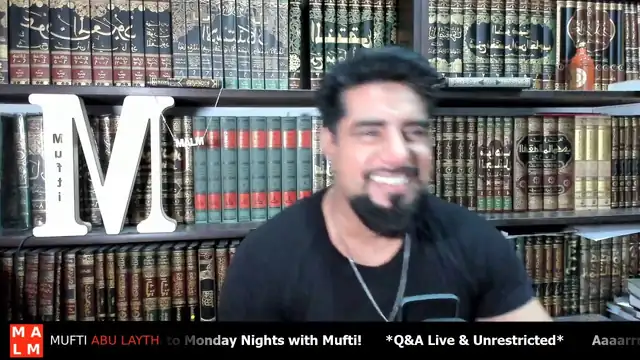 Play from 1:41:27
The video loads from YouTube only when you press play. Click a time in the transcript to seek.
Watch the answer
Open on YouTube at 1:41:27The player starts at 1:41:27, where the answer begins.
This segment1:41:27 to 1:46:32 · 5 min 05 sGeneral teaching
The answer in brief
machinesummary, machine-writtenMufti Abu Layth calls himself Maliki because he follows the lens of the school of Medina: the Quran at the centre, Medinan practice, reason and the aims of the shari'ah.
In more detail
Asked why he calls himself Maliki, Mufti Abu Layth says it is because he is Maliki: schools are inherited understandings of how to practise Islam, a lens through which the view changes with place and time while the lens stays the same. He says the lens of the school of Medina places the Quran centrally, gives precedence to the inherited practice of Medina and treats reason as vital, giving Imam Malik's questioning of the hadith on the dog and the vessel as an example. He traces the tradition from the Prophet through the companions and their children to Malik's teachers, and says the maqasid of the shari'ah are really a Maliki thing, citing al-Shatibi [?] and the nawazil literature, and al-Burzuli's fatwa some 700 years ago changing capital punishments into financial penalties. He says Imam Malik never gave such rulings, but that the way of thinking goes back to the city of the Prophet, which Malikis pride themselves on.
Question as read aloud · questioner not identifiedWhy do you call yourself Maliki?
- Some terms in this segment are uncertain
Position stated
Mufti Abu Layth says the school of Medina placed the Quran centrally, gave precedence to the inherited practice of Medina and held reason to be vital.
“in the school of medina it was about placing the quran centrally and then the inherited practice of medina took precedence and reason was always vital in determining that”
Category: method
Kind: general teachingTranscript
machine1:41:27 to 1:46:32 · click a time to seek · dotted terms open the glossary
one may work for such a company indeed indeed these things are not haram in my understanding mufti why you called yourself maliki that's a good question because i'm sorry just reading one of the other comments okay people behave in the comments behave and if any of them are uh trying to be rude to the mods mods
you can block them okay so right um why call myself maliki that's a a good question it's because i am maliki you see in islam there were understandings of islam that were inherited and they have then how you practice islam how you pray how you do things your way of looking at the your kind of lens not neces you see the lens doesn't mean that the view is always the same because you and your geographical location will
always change and it will change temporally as well so what we're talking about is the lens is the same so in the school of medina it was about placing the quran centrally and then the inherited practice of medina took precedence and reason was always vital in determining that hence when the hadith is there and imam malik in the madonna says about the the dog and and the bowl and this
impurity very famous hadith we don't know what it's all about you know how can something that this dog hunts be halal and yet it's sliver be impermissible that doesn't make any sense see reason was a very important point now this manhattan this way of looking was kind of set out by the scholars of medina vocalized by imam malik obviously he learned it from his teachers
who learned it from the their teachers who would have been the children of the companions who learned it from the companion who learned it from the prophet so this is why and that tradition then kind of dispersed throughout the globe there were many schools that belong to the school of medina all adding the interesting takes on it over time taking a look at things questioning narratives you had the you know right throughout the ages this was the same school that was the first school to expand on sharia that the sharia's objectives and if the objectives are not being met then that's a problem you need to make
sure that you meet the objectives the makasi the sharia really is a maliki thing you know it's uh you right from whether it's going to be right back then a shot to be from a landlord's coming right down to shaykh allah this is whether it's going to be the nawazil challenging the fatawa of the day and age where benefit where musliha where welfare is looked at so whether it was going to be um saying that we need to change the capital punishments of his day and age
700 years ago into uh penalty financial penalties or whether it was going to be his great grandson um ibn ardun um who said about women's inheritance needs to be 50 and the wife's inheritance is 50 giving that ruling i mean so this is nothing new there's a legacy of challenging now one could say when abu qasim al-burzulli gave that fatwa of changing the capital punishments and many maliki after one could say well imam malik never gave it of course he didn't we're not just
you see it's a way of thinking you have a kind of lens it's like we look through this this we're wearing a particular kind of a set of glasses it doesn't mean what we look at will always be the same we will look at things from different perspectives different altitudes from different time scales but that lens is similar so yes it does go back to the school of medina and the city of the prophet sallallahu alaihi wasallam and that's something we pride ourselves on allah
not like these other people whether it's going back to kufa or going back to a different city or like some going back to [Laughter] the worst of places just a barren desert right so it's not going back this going back to the city of the prophet so that's why i'm a maliki you know i had um um i mean i i feel this is is fine to say um it's it's not in any negative light but i had um
send me a message in which was um parts of it were reasonably polite and parts of it were quite challenging in saying look you know you uh um he was saying that look on certain things i could make sense like let's say but why is it i deny the evil eye and then if that's the case and i think this is an interesting question because many people may ask this why is it if i deny the evil eye then i still associate and allude to scholars like ibn ashur or imam malik
Paragraphs overlapping 1:41:27 to 1:46:32. Full text on the recording page.
Cite this segment
Stable id, transcript version and tier are part of the citation. Every change to a transcript is logged.Mufti Abu Layth Archive, segment 2021-01-12-S27, auto-transcribed, may contain errors. https://muftiabulayth.org/r/1zghntbmpis/s/27/ (accessed 1 November 2026)
- APA 7
Mufti Abu Layth. (2021, January 12). Why do you call yourself a Maliki? [Video, segment 2021-01-12-S27, auto-transcribed, may contain errors]. Mufti Abu Layth Archive. Retrieved November 1, 2026, from https://muftiabulayth.org/r/1zghntbmpis/s/27/
- Chicago author-date
Mufti Abu Layth. 2021. "Why do you call yourself a Maliki?" Video, segment 2021-01-12-S27, auto-transcribed, may contain errors. Mufti Abu Layth Archive. Recorded January 12, 2021. Accessed November 1, 2026. https://muftiabulayth.org/r/1zghntbmpis/s/27/
- BibTeX
@misc{abulayth-2021-01-12-S27,
  author = {Mufti Abu Layth},
  title = {{Why do you call yourself a Maliki?}},
  year = {2021},
  month = {1},
  date = {2021-01-12},
  howpublished = {\url{https://muftiabulayth.org/r/1zghntbmpis/s/27/}},
  url = {https://muftiabulayth.org/r/1zghntbmpis/s/27/},
  organization = {Mufti Abu Layth Archive},
  urldate = {2026-11-01},
  note = {Segment 2021-01-12-S27, auto-transcribed, may contain errors}
}
Something wrong here?
Tell us what is wrong and it will be checked against the recording. Nothing changes until a person has reviewed it.
Sending a note needs JavaScript, which is off or unavailable in this browser. Nothing has been sent.
No name, email address or account is asked for or stored, and the inbox does not store your IP address. For rate limiting it keeps an unreadable fingerprint of your connection for 48 hours, and our database provider's own logs record connections as every website's do. Only your note, its kind, the page and the moment in the recording are kept, for review.