
Recordings › Age of Aisha (ra)- Mufti Abu Layth · 11 Jan 2017 › Segment 7 of 18
The reports: Bukhari's six and nine against three other Bukhari reports
hadeeth ahadith ahaadeeth hadis hadees ahaadith saheeh sahih hadith saheeh hadith sound hadith authentic imam bukhari sahih bukhari saheeh al-bukhari saheeh bukhari imam al-bukhari imaam imams prayer leader muftis saheeh muslim imam muslim muslim ibn al-hajjaj aya ayat ayaat aayah aayat wahy wahi wahee sahabah sahaba sahabi sahabiyyah sahabiyat hijrat hijri madinah madina al-madinah madeenah yathrib nikah nikkah nikaah nikah nama nikahnama mehr meher haq mehr dower deen al-din ad-deen ad-din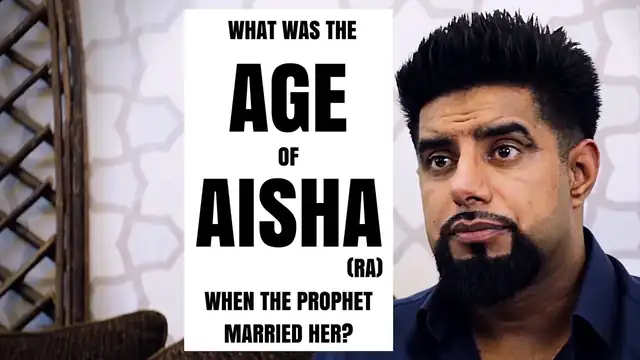 Play from 47:06
The video loads from YouTube only when you press play. Click a time in the transcript to seek.
Watch this part
Open on YouTube at 47:06The player starts at 47:06, the beginning of this part.
This segment47:06 to 57:37 · 10 min 31 sGeneral teaching
What this part covers
machinesummary, machine-writtenThe six-and-nine report conflicts with three other Bukhari reports: Aisha as a jariyah at an early revelation, her memory of her parents' Islam and Abu Bakr's migration, and her presence at Uhud when a fourteen-year-old boy was refused.
In more detail
After noting that Aisha had already been asked for before the proposal, Mufti Abu Layth turns to the reports. He says the famous six-and-nine report in Sahih al-Bukhari comes through Hisham ibn Urwa, that the Sahih Muslim version says seven, and that the surrounding details conflict: how long after the hijrah the marriage took place, whether the mahr was fifty or several hundred dirhams, and in whose house the marriage happened. He then says the report clashes with at least three others in Sahih al-Bukhari. First, Aisha says she was a jariyah, a girl approaching adolescence, when a verse [?] was revealed that Ibn Abbas places seven to eight years before Badr, which would make her three or four on the six-and-nine dating. Second, she says that as far back as she could reason her parents practised Islam and that Abu Bakr set out to migrate to Abyssinia when the persecution began, which Mufti dates to the fifth year of revelation, when she would have been at most one. Third, companions describe Aisha carrying water to the wounded at Uhud, while Ibn Umar was turned away from Uhud at fourteen and accepted at fifteen; Mufti asks why a fourteen-year-old boy would be refused any role when a nine- or ten-year-old girl was helping on the battlefield.
- Some terms in this segment are uncertain
Position stated
Mufti Abu Layth holds that the six-and-nine report conflicts with at least three other reports in Sahih al-Bukhari about Aisha's age.
“first of all that clashes with at least three other Hadith inkari so when you've got that already straight away you've it it clashes with three other Hadith inkari”
Category: method
Kind: general teachingTranscript
machine47:06 to 57:37 · click a time to seek · dotted terms open the glossary
reality could this make any sense that the prophet is contemplating to marry a a child could that even make any sense I mean we're not talking we're going we're going to look at the reports in a moment but could this make any sense from that perspective okay also worth mentioning before we move on to the reports is that a had already been asked for so it's it's something to contemplate that if she was six and the reports indicate she'd been asked for it been a few years I mean what was she asked for when she was three or I mean what was the purpose
of that and the response of ju's mother the wife of is and we fear that she will convert him I mean what kind of conversion could a six-year-old do so I mean just just think about these things for a moment suspending the reports because we're going to view that in a moment but just looking at the reality I want us to understand this Narrative of where what was affecting the prophet sallallahu alhi wasallam and why marriage was going to be so helpful in alleviating the stress of the year of Sorrow okay so Okay so we've got that
we've understood that let's move on to the second layer the report so we've understood the reality the reports okay now keeping I I want us to keep in mind the backdrop which I discussed the first premise of historicity that the Arabs generally documenting dates and age and events they it was never a conclusive matter never at times it may have been good at times it was conflicting but it was never conclusive and certain now right so with that in mind I
know there is this Hadith that we're we're going to discuss which is in bukari okay this famous Hadith of six and nine okay the prophet married her at six and at nine now I know uh that is transmitted by a uh by one of the the people known as Hisham and I'll come back to that and there is some some questions raised there and I know people will say that look uh this has other reportings as well it's not just in bukari it's in sah Muslim but in sah Muslim I want us to understand it uses a different number it says seven it does not say six uh some kind of conflict even when we look at this whole event
there's a difference of opinion in terms of uh when the prophet when the marriage actually took place after Hijra how how long after the migration did they get married it's a difference of opinion uh when Aisha speaks of how much money uh was exchanged in terms of the DAR or the Mahar there's a different reporting on whether you know whether it was 50 or whether it was in the hundreds of Dirhams and uh where the actual marriage took place the actual house in an event in one reporting she says oh I remember it I was taken to a strange house I did not know it belonged to you know it's this house of sah and we went there and and I was told well this is the house
now and in another report she says it's transmitted as oh no it was Abu Bakr her father's house and what I'm trying to highlight here is all the the the differences that the the kind of uh conflicting reports around the actual event okay but even if we do look at well somebody may say but this is a clear Hadith here you know in saying that I was married AA is saying I was married at the age of six and nine and moved in with the prophet at nine but then I would say well okay well first of all that clashes with at least three other Hadith
inkari so when you've got that already straight away you've it it clashes with three other Hadith inkari okay so you have a Hadith inar where is saying oh I remember when the verses when the verse of was revealed that that when this verse was revealed I was a jar and a jar in Arabic is used for uh it is used for a girl that is approaching adolescence I mean you could say
anything between I don't know the minimum 78 to about 13 around 12 13 in between that is called a jaria and the opposite for for a male is called a younger than that they refer they can refer to them as younger than AAR and then you can have a and so on and these are the different stages that they have of an absolute uh you know infant and so on and toddler and different ages so she says I was a and when was revealed so they
sayar right was revealed s years before the the Battle of bad which was into the second H so you can go back and we're looking at eighth hij okay eighth sorry eth the eth year of re uh after Revelation and it's the 10th year that the proposal of the Prophet takes place so if if Aisha was well only two I mean if she was six sorry at the time of the 10th year uh if she was when the prophets apparently proposing to her
then two years earlier she's what four years old three four and she says oh I remember this verse and when it was revealed and everything and I was a Jia I was she doesn't say I was a young uh a little infant but she's saying a Jia of an older age and some people may there could be a criticism here people say oh wellar was revealed gradually and some verses were revealed later but Imam says no he transmits from Abbas this verse he says this Ayah was revealed seven years at least seven to eight years before Battle of bad there's another Hadith in
bukari let's take a look at this Hadith that says as far back as I can remember that my parents uh thatl that they were upon practicing Islam she says as far back as that I could that I could reason when I was at an age of being able to reason my parents I remember my parents being upon Islam and she says that and if there would not be a day or a night except the messenger of Allah would visit our house and then she says and when the Muslims began to get
persecuted AB Bakr migrated to um he he migrated to abisinia now we know the migration took place in the fifth year of Revelation okay so this is five years before the proposal of the Prophet to Aisha so if she was six then she would have been at most one now if we go by this narration which is ridiculous she's saying she's not just saying she was a child she's saying I could understand use my intellect and understand religion now kids don't
understand what religion is now some people have tried to critique this by saying oh well the migration to ABIA continued all the way till the Muslims migrated to Medina which is true it did continue but the wording of this Hadith in bukari seems to contradict that because it says and when Muslims began to get persecuted and we know know that persecution began immensely and was the key part of it was in those years so when you look at the actual wording this is what it
supports you could take a look at another uh uh Hadith inkari and that is to do with the Battle of and I think this is also an interesting one because in this Hadith uh the companions are describing the events of and we know from the Battle of many Muslims were wounded and the companions say that oh uh we remember the chaos and they describe and we remember how and would were rushing in between the wounded and trying to Aid them and see to them and help
them and they describe Aisha's how she was going in between uh and helping the wounded and and those who had been struck now you think well why is that interesting well that's interesting because there is also a Hadith in bukari where Omar the son of Omar approaches the prophet for the Battle of and he says can I go to the Battle of and the prophet says how old are you and he says I'm 14 and the prophet forbids him says no you're too young to come on the
battlefield what's interesting is it mentions that over a year and a half later right when he's approached uh for another battle the prophet is approached byar and the prophet asks him then how old are you and he says I'm over 15 the prophet says okay now somebody could ask here well okay but Omar was actually asking to go to fight he was asking to go to fight and that's why he was too young well that doesn't actually make any sense because we know in the battle
of the Muslims were desperate for as much help as they could get right so the prophet forbade om did not even attend the battlefield so you tell me who would be more helpful in doing things like providing whether it was getting the artillery to the to the fighters removing the injured dragging whether it was having to move bodies would a N9 or a 10-year-old girl be more helpful in running around dragging bodies moving things or at least a 14-year-old
Paragraphs overlapping 47:06 to 57:37. Full text on the recording page.
Cite this segment
Stable id, transcript version and tier are part of the citation. Every change to a transcript is logged.Mufti Abu Layth Archive, segment 2017-01-11-S07, auto-transcribed, may contain errors. https://muftiabulayth.org/r/0ovisexs4ca/s/7/ (accessed 1 November 2026)
- APA 7
Mufti Abu Layth. (2017, January 11). The reports: Bukhari's six and nine against three other Bukhari reports [Video, segment 2017-01-11-S07, auto-transcribed, may contain errors]. Mufti Abu Layth Archive. Retrieved November 1, 2026, from https://muftiabulayth.org/r/0ovisexs4ca/s/7/
- Chicago author-date
Mufti Abu Layth. 2017. "The reports: Bukhari's six and nine against three other Bukhari reports." Video, segment 2017-01-11-S07, auto-transcribed, may contain errors. Mufti Abu Layth Archive. Recorded January 11, 2017. Accessed November 1, 2026. https://muftiabulayth.org/r/0ovisexs4ca/s/7/
- BibTeX
@misc{abulayth-2017-01-11-S07,
  author = {Mufti Abu Layth},
  title = {{The reports: Bukhari's six and nine against three other Bukhari reports}},
  year = {2017},
  month = {1},
  date = {2017-01-11},
  howpublished = {\url{https://muftiabulayth.org/r/0ovisexs4ca/s/7/}},
  url = {https://muftiabulayth.org/r/0ovisexs4ca/s/7/},
  organization = {Mufti Abu Layth Archive},
  urldate = {2026-11-01},
  note = {Segment 2017-01-11-S07, auto-transcribed, may contain errors}
}
Something wrong here?
Tell us what is wrong and it will be checked against the recording. Nothing changes until a person has reviewed it.
Sending a note needs JavaScript, which is off or unavailable in this browser. Nothing has been sent.
No name, email address or account is asked for or stored, and the inbox does not store your IP address. For rate limiting it keeps an unreadable fingerprint of your connection for 48 hours, and our database provider's own logs record connections as every website's do. Only your note, its kind, the page and the moment in the recording are kept, for review.