
Recordings › The Beard in Islam & Arab Culture | Mufti Abu Layth · 17 Dec 2019 › Segment 1 of 1
Is growing a beard compulsory in Islam?
salat salaah namaz prayer salaat namaaz as-salah al-salah salawat hadeeth ahadith ahaadeeth hadis ahaadith saheeh saheeh hadith sound hadith authentic al-bukhari imam bukhari sahih al-bukhari sahih bukhari saheeh al-bukhari saheeh bukhari imam al-bukhari imaam imams prayer leader 'urf muftis hukm ahkam hukum hukam ahkaam haraam forbidden mubah mubaah mandub mandoob mustahabb mustahab wajib waajib wajibat sunna sunnat sunan prophetic practice ulama ulema ulamaa sheikh shaikh sheik shuyukh shaykhs deobandis deoband as-salamu alaykum assalamu alaikum assalamualaikum salaam salaams salam alaykum wa alaykum as-salam peace greeting sabr patienceThe beard: an ancient Arab custom, and the wording of 'differ from the Jews and Christians'
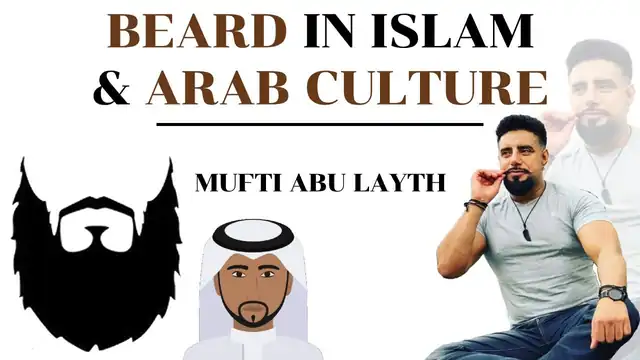 Play from 0:00
The video loads from YouTube only when you press play. Click a time in the transcript to seek.
Watch the answer
Open on YouTube at 0:00The player starts at 0:00, where the answer begins.
This segment0:00 to 7:50 · 7 min 50 sGeneral teaching
The answer in brief
machinesummary, machine-writtenGrowing a beard was an ancient Arab custom shared by Muslims and their opponents, not an Islamic requirement in itself. The command to grow it is worded like commands to dye the hair and pray in shoes that nobody treats as obligatory, and no sahih hadith says how to grow it.
In more detail
Asked to speak about the beard, Mufti Abu Layth refers viewers to his detailed videos and sums up: everyone agrees that ancient Arab men grew beards as part of their custom, like their dress, and the Prophet, raised among his people, lived as they did, while his opponents such as Abu Jahl also had long beards, so the beard was not distinctive of Muslims. He asks why, if riding a camel is not called a sunnah simply because the Prophet did it, growing a beard should be, and recommends a book by Shaykh Abdullah al-Judai [?] that gathers all the chains of the beard hadith. He cites the report in Bukhari that the Prophet trimmed his beard below his grip and asks whether the act was obligatory, religious, customary or merely permissible, like his own choice of a grey t-shirt. He then compares the command to grow the beard and differ from the Jews and Christians with commands in the same wording to dye the hair and to pray in shoes, which nobody treats as obligatory, and challenges anyone to bring a single sahih hadith that tells a person how to grow the beard, saying the rest is scholars' interpretation. He adds that the beard went out of fashion for centuries, and attributes the insistence on it in the subcontinent partly to the Deobandi movement, which he calls a modernist movement set up under the British Raj to be distinct from the British, declaring trousers, shirts and ties haram; he says such identity politics made sense then but is absurd in 2019, and mocks the idea that the shalwar kameez is Islamic dress.
Question as read aloud · questioner not identifiedCan you speak about the beard?
- The question was reconstructed from Mufti Abu Layth's restatement; the questioner's own words are not in the recording
- Some terms in this segment are uncertain
Position stated
Mufti Abu Layth says the beard was an ancient Arab custom shared by the Prophet's opponents, that the command to grow it and differ from the Jews and Christians is worded like commands to dye the hair and pray in shoes that nobody treats as obligatory, and that no sahih hadith says how to grow it.
“do we consider coloring or dyeing the hair to be obligatory or Sunnah or necessary or strongly recommended no let me give you another one”
Category: ruling
Kind: general teachingTranscript
machine0:00 to 7:50 · click a time to seek · dotted terms open the glossary
people's what's going on right so imam will he cuz he had asked can i speak about the beard sure look so the beard i've got detailed videos on the beard anyway and you can watch them you can refer to them they're on youtube they're not that long and I go through much detail but to sum it up for you everybody agrees that the ancient ancient Arabs ancient Arab civilization
had a custom part of which men grew facial here they had a beard so it was part of their kind of their custom and convention all men did it just as they had a custom of certain clothing they dressed in a particular way they lived in they lived in wiva part let's say Arabia Arabian Peninsula and that's what they did now the Prophet Muhammad sallallaahu I live Selim was I mean he was born and he was raised there amongst his people so it's very natural for the Prophet to be a part of his society so
he's not gonna be walking around in a different fashion kind of clothing he's going to be exactly like normal people so the same thing when it comes to the beard the prophet salallahu alaihe salam kept a beard but so did everybody all of the disbelievers of the prophet's time had beards abu jahil had a very long beard so the beard was not exclusive to muslims it was not something that muslims kind of oh here are the muslims they have a beard everybody had a beard so the question is well why is this Islamic then this is
the question why is this an Islamic requirement now people have said ok because you won't say riding a camel is a Sunnah of you know for us to do just because the Prophet did it so why is growing a beard so then what they say is oh but they certain hadith with the Prophet said let the beard grow okay fine there are these hadith but let's look at these heavy and if you want a very detailed book I've actually got it here
but it's right I won't be able to get it right now but it's by chef Abdullah judez who actually brings the entire chains and all the hadith to do with the beard so first of all we know that the Prophet had a beard we also know that he used to trim his beard so that's in Bukhari that if not more says the Prophet used to hold his beard like this and you would just trim it whatever was below that now him doing this action the process of Alison doing this action was this an obligatory action was this an Islamic action was this a customary action was this just a permissible
action like today I chose to wear a grey t-shirt as opposed to our and our blue or a black one that's just an arbitrary action it's not something Islamic Lee mandated so what we can do is look at all the other hadith when the Prophet is instructing to grow the beard and he says in some of them they transmitted Oh grow the beard and differ with the Jews and the Christians okay fine now this appears in the same in the same hadith you will see sorry this wording this
exact wording let's take this wording do this like a command an imperative whether it's a positive or negative as in do this or don't do this as in grow the beard or do something I'm differ from the Jews and the Christians what else is this ruling setting so let's take a look what else has mentioned this ruling so I'll tell you what has mentioned this ruling is the Prophet said he said dye your hair color your hair right you should color your hair as a command he said color your hair be different to
the Jews and Christian that's a thing that's a that's a heavy with the same wording do we consider coloring or dyeing the hair to be obligatory or Sunnah or necessary or strongly recommended no let me give you another one the Prophet said pray the Salah female aleikum salut female Allah come pray with your shoes on hardly fully or who don't want us all be different to the Jews and the Christians
oh it doesn't matter okay just what I thought so the question is thatthat society but they don't want to know that nobody does that it's the same wording so what I say is bring me one sake hadith just one where the Prophet is telling you how to grow up here there isn't a single one the rest is simply interpretation by scholars okay right what is going on somebody's who this Hassan sabar asking
for a shouter you nothing that a great expect honesty women all right so this is the so it's important to understand power structures and just because the clergy people look all people I've traditionally kept a beard and to be fair the beards come back into fashion now so many people will now keep a beard but for a few centuries it had gone out of fashion so people didn't keep a beard but but once again two forces the indian sub-continent kind of movement like the Deobandi movement which was really is a modernist movement which is claiming to
be traditional it's only set up under the British Raj and it's set up just to be distinct from the British so anything the British did they declared it her arm straight away and found Islamic stuff to declare it her wearing trousers was haram for example because wearing a shirt and a tie and things like this was Haram apparently because because the British worried now okay at that time when you're being attacked and under the British Raj fair enough identitarian politics but today in 2019 it's ridiculous to adhere to certain politics like that so and the dumb thing is they will say things like
don't dress like the Westerners where our shalwar kameez you know like a commercial water which the the pakistani dress and you think a chartered healthy Arabs walking around in 6th century Arabia were wearing shalwar kameez they're walking around eating biryani a
cha-cha-cha yeah logic is tomalak yeah this is the absurdity that we have people this is the ridiculousness so I hope that answers that question bring me a single ADIZ that explains how to grow the beard once ah hey sorry Hadees Oh ha to burhanakum right what
Paragraphs overlapping 0:00 to 7:50. Full text on the recording page.
Cite this segment
Stable id, transcript version and tier are part of the citation. Every change to a transcript is logged.Mufti Abu Layth Archive, segment 2019-12-17b-S01, auto-transcribed, may contain errors. https://muftiabulayth.org/r/0ln_vir6lni/s/1/ (accessed 1 November 2026)
- APA 7
Mufti Abu Layth. (2019, December 17). Is growing a beard compulsory in Islam? [Video, segment 2019-12-17b-S01, auto-transcribed, may contain errors]. Mufti Abu Layth Archive. Retrieved November 1, 2026, from https://muftiabulayth.org/r/0ln_vir6lni/s/1/
- Chicago author-date
Mufti Abu Layth. 2019. "Is growing a beard compulsory in Islam?" Video, segment 2019-12-17b-S01, auto-transcribed, may contain errors. Mufti Abu Layth Archive. Recorded December 17, 2019. Accessed November 1, 2026. https://muftiabulayth.org/r/0ln_vir6lni/s/1/
- BibTeX
@misc{abulayth-2019-12-17b-S01,
  author = {Mufti Abu Layth},
  title = {{Is growing a beard compulsory in Islam?}},
  year = {2019},
  month = {12},
  date = {2019-12-17},
  howpublished = {\url{https://muftiabulayth.org/r/0ln_vir6lni/s/1/}},
  url = {https://muftiabulayth.org/r/0ln_vir6lni/s/1/},
  organization = {Mufti Abu Layth Archive},
  urldate = {2026-11-01},
  note = {Segment 2019-12-17b-S01, auto-transcribed, may contain errors}
}
Something wrong here?
Tell us what is wrong and it will be checked against the recording. Nothing changes until a person has reviewed it.
Sending a note needs JavaScript, which is off or unavailable in this browser. Nothing has been sent.
No name, email address or account is asked for or stored, and the inbox does not store your IP address. For rate limiting it keeps an unreadable fingerprint of your connection for 48 hours, and our database provider's own logs record connections as every website's do. Only your note, its kind, the page and the moment in the recording are kept, for review.