
Recordings › Dr Javad T. Hashmi | Axis of Morality & Archetypal Myths in the Quran | MindTrap 46 |Mufti Abu Layth · 11 Dec 2020 › Segment 9 of 36
Where does morality come from if not from God?
salat salaah namaz prayer salaat namaaz as-salah al-salah salawat muftis hijaab hejab hijabi deen al-din ad-deen ad-dinGrounding morality: the Hijab and Apostate Prophet debate, and moral realism
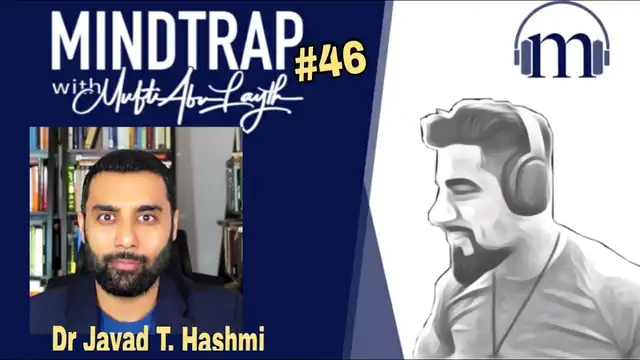 Play from 34:45
The video loads from YouTube only when you press play. Click a time in the transcript to seek.
Watch this part
Open on YouTube at 34:45The player starts at 34:45, the beginning of this part.
This segment33:58 to 39:47 · 5 min 49 sA view quoted in order to be discussed, not a position held
What this part covers
machinesummary, machine-writtenThe guest says a theist can ground moral realism in God while an atheist who relies on evolution alone cannot, and that traditionalist debaters exploit opponents who know little philosophy.
In more detail
Mufti Abu Layth recalls a debate in which Mohammed Hijab kept asking his atheist opponent, Apostate Prophet [?], where his morals come from, and asks how the guest sees the question of morality. The guest says Hijab has only a cursory knowledge of Western philosophy, like the one-eyed man in the land of the blind, and uses it against an opponent he considers to know nothing; after a long interruption for audio trouble, he says his own worldview is theistic and that he is a moral realist, and a critical or common-sense scientific realist, which is out of fashion in philosophy departments that no longer invoke God. He says that Islamic traditionalists who have studied the philosophy of science now debate people who know no philosophy, mentioning a debate on Joe Rogan's show with a Muslim MMA trainer, Firas [?], whom he finds brilliant though he disagrees with him. He argues that an atheist who believes only in evolution and biology has no ground for universal morality, whereas a theist can ground moral realism in God, and that traditionalists are not moral realists but ethical voluntarists; Mufti then begins to give his own perspective.
- Some terms in this segment are uncertain
Position stated
This segment presents a view in order to discuss or respond to it. It is recorded as quoted, never as held, and no position is attributed from it.
Kind: a view quoted in order to be discussed, not a position held Speakers: host and guest; guest speech is labelled and excluded from positionsTranscript
machine33:58 to 39:47 · click a time to seek · dotted terms open the glossary
A guest speaks in this segment. Guest speech is labelled and is excluded from the positions layer.
This segment states a view in order to discuss it. It is recorded as a quoted view, not as a position held.
Oh no also Muhammad hijab right? Yes. So there there was one also with the apostate prophet and I think it was uh facilitated by uh I've forgotten his name now the other Salah uh Adam Salah. So now on this he kept hijab kept saying uh do you believe in absolute morality or you know what what morality do you believe in and so uh he was arguing from a religious viewpoint that we have absolute morality himself.
Who who who was arguing that? Muhammad hijab. Uh yes. So he's saying that we have morals given to us and because you don't have morals. So is incest okay? Is this okay? Is that okay? And if you say we have morals then his point is where do you get these morals from? So um how how do you see because I see it entirely different. I don't see the morality debate like that and I've given my perspective before and I'll go into it but I'm just curious how you see uh this topic.
Thank you so much. So what I will say is this. I'm an academic and I study the academic philosophy. All right. Uh Muhammad hijab and these kind of folks they are honestly acting as oneeyed you know the oneeyed man is king in the land of the blind. M so he has this cursory knowledge of western liberalism and philosophy and then he uses that to bash in the head someone like apostate prophets who doesn't know anything.
So apostate prophets is completely he's a complete ignoramus. Okay. So here here's the issue. Sorry it just did that. [laughter] We've got a gin over there people but it's all uh sorry. Yeah. So no. tell you. Okay, so here's let me let me break down how I understand this. Now, keep in mind, I'm not a PhD in philosophy. I'm a PhD in the study of religion.
And I should clarify, I'm in the middle of my PhD right now. I Yeah, but here it goes again. This This is so annoying for people. I apologize. Do is is it the actual setting on the on on the Skype? Is it? Yeah. Do Do you want to uh shut it? You think by closing it and starting it again, it might make it easier or I I don't know.
I think if it keeps doing it. Okay. Sure. Okay. Yeah. But it's okay now. You can carry on. So So here's how I It is. Damn it. It is. Uh Okay. Hold on one sec. Sure. Okay. If you want to uh do that, you can. And I'll just uh explain my perspective whilst you if you want to reset it, you can do okay.
You want to do Okay, here we go. Okay, cool. If it keeps The problem is I think this is going to happen again and it might be something to do with my mic. I apologize. Um but sure, go for it. Yeah. Okay, so here's the issue. My worldview is very theistic. I root my morality in my theistic worldview.
So I am an Abrahamic believer. Um I believe in God. The source of my morality, it's called moral realism. Moral realism in western philosophy is now considered very p. It's not considered very respectable anymore. Why? Because in the western academy, in philosophy departments, they've kind of distanced God. You can no longer really invoke God. But in reality, you need God to rest your morality upon.
You need So I am a moral realist and I'm also a scientific realist. Either a critical realist or um or at least a common sense realist or at least a critical realist. The same thing realism I show when it comes to morality. Now what what has been going on recently on YouTube is that you have these people who have studied who are Islamic traditionalists who have studied the philosophy of science. That's what they've done.
They've studied philosophy of science and now they feel like the oneeyed man in a land of the blind. And what I would say is the people that they debate with are just people who don't know philosophy. So they actually Joe Rogan had the um he's brilliant himself. Uh the he's the MMA trainer who's Muslim. Um he he studied philosophy in undergrad. Um and he had a debate on philosophy of science.
And let me just say Ferras Feras Ferras. And I like that guy. I don't I have messaged him to to get him on Mine Trap. Let's see. So, so even though I completely disagreed with his overall viewpoints, I do find him brilliant and well read. Okay. But the fact is that it wasn't a fair debate. You're talking to a Joe Rogan and you're having a debate. Of course, it's going to be a one-sided affair. M anyways coming back to the point I do think apostate prophets has no standing when he as an atheist says that he believes in moral realism.
Where do you gr ground your morality in? If you just believe in evolution and biology, there's no reason to believe in universal morality. However, as a theist, I have every right to justify my moral realism in God. The traditionalist is not a moral realist in the sense that um well they believe in ethical volunteerism. They believe in uh the idea that God is the one who declares what's good and bad.
But they don't exist indeping and raping and killing babies is okay then that's okay. And they do believe this. We could uh this is a long long debate. Um, no, absolutely. I mean, my my perspective on this, by the way, on um on morality, I feel that what it is is that Allah has created a fra.
Paragraphs overlapping 33:58 to 39:47. Full text on the recording page.
Cite this segment
Stable id, transcript version and tier are part of the citation. Every change to a transcript is logged.Mufti Abu Layth Archive, segment 2020-12-11b-S09, auto-transcribed, may contain errors. https://muftiabulayth.org/r/zasz48lx_wi/s/9/ (accessed 1 November 2026)
- APA 7
Mufti Abu Layth. (2020, December 11). Where does morality come from if not from God? [Video, segment 2020-12-11b-S09, auto-transcribed, may contain errors]. Mufti Abu Layth Archive. Retrieved November 1, 2026, from https://muftiabulayth.org/r/zasz48lx_wi/s/9/
- Chicago author-date
Mufti Abu Layth. 2020. "Where does morality come from if not from God?" Video, segment 2020-12-11b-S09, auto-transcribed, may contain errors. Mufti Abu Layth Archive. Recorded December 11, 2020. Accessed November 1, 2026. https://muftiabulayth.org/r/zasz48lx_wi/s/9/
- BibTeX
@misc{abulayth-2020-12-11b-S09,
  author = {Mufti Abu Layth},
  title = {{Where does morality come from if not from God?}},
  year = {2020},
  month = {12},
  date = {2020-12-11},
  howpublished = {\url{https://muftiabulayth.org/r/zasz48lx_wi/s/9/}},
  url = {https://muftiabulayth.org/r/zasz48lx_wi/s/9/},
  organization = {Mufti Abu Layth Archive},
  urldate = {2026-11-01},
  note = {Segment 2020-12-11b-S09, auto-transcribed, may contain errors}
}
Something wrong here?
Tell us what is wrong and it will be checked against the recording. Nothing changes until a person has reviewed it.
Sending a note needs JavaScript, which is off or unavailable in this browser. Nothing has been sent.
No name, email address or account is asked for or stored, and the inbox does not store your IP address. For rate limiting it keeps an unreadable fingerprint of your connection for 48 hours, and our database provider's own logs record connections as every website's do. Only your note, its kind, the page and the moment in the recording are kept, for review.