
Recordings › Dr Javad T. Hashmi | Axis of Morality & Archetypal Myths in the Quran | MindTrap 46 |Mufti Abu Layth · 11 Dec 2020 › Segment 10 of 36
Is morality an instinct God put in us?
muftis fitrat natural dispositionMufti Abu Layth's view: the fitrah as a moral instinct built on harm and empathy
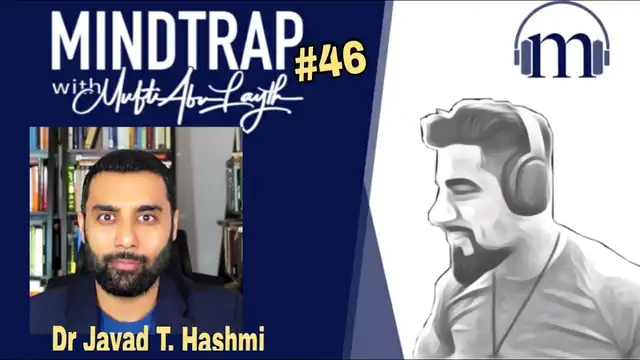 Play from 39:47
The video loads from YouTube only when you press play. Click a time in the transcript to seek.
Watch this part
Open on YouTube at 39:47The player starts at 39:47, the beginning of this part.
This segment39:47 to 43:17 · 3 min 30 sGeneral teaching
What this part covers
machinesummary, machine-writtenMufti Abu Layth holds that the fitrah is a hardwired moral instinct of recognising harm and feeling empathy, built on by environment and a collective consciousness; the guest adds that morality can be confidently grounded in God.
In more detail
Mufti Abu Layth sets out his view that Allah has created the fitrah as a kind of morality instinct, raw and hardwired like the language instinct and Chomsky's universal grammar, whose core components are recognising harm and hurt and feeling empathy, so that we do not want to inflict what we recognise as suffering. He says the rest is built on that base by our environment and age, as a language is learnt, and that he also believes in a collective consciousness of the age that tweaks our understanding. The guest finds this plausible but says one can confidently ground morality in God, who would not have given us intellect and moral consciousness in order to mislead us. He adds that problematising moral realism through cultural relativism is the zeitgeist of an age of atheism, now used by traditionalists against rationalist believers. Mufti then asks whether specific rules such as not stealing are taught by God or recognised by us.
- Guest speech overlaps this segment
Position stated
Waiting for the speaker checkA guest speaks in this segment and the captions do not say who said what. The view found here is held back until the speaker-separated transcript confirms the words are his, or the channel verifies it. The transcript and recording are published in full.
Kind: general teaching Speakers: host and guest; guest speech is labelled and excluded from positionsTranscript
machine39:47 to 43:17 · click a time to seek · dotted terms open the glossary
A guest speaks in this segment. Guest speech is labelled and is excluded from the positions layer.
But they don't exist indeping and raping and killing babies is okay then that's okay. And they do believe this. We could uh this is a long long debate. Um, no, absolutely. I mean, my my perspective on this, by the way, on um on morality, I feel that what it is is that Allah has created a fra.
The fra is a kind of morality instinct. It's a morality base. It's something very raw. Um, it's like the the language instinct we have. It's kind of hardwired but it's hardwired in a way that yes we are prone for language as you know Chsky would say L or uh but the but for us so there is this universal grammar there's this universal morality which is very simple as in [snorts] it the components are one we
recognize harm we can recognize hurt and then there's empathy So these two kind of core components what they do is they allow like when we recognize hurt and suffering there's an element of empathy that kind of makes us think oh like because we can empathize with it we don't want to afflict it now we then add the rest the way we build the way we learn a language we add the rest onto it so I feel that uh so That's the fra that there is this core kind of
uh compound but it's built upon in our environment and our age and we kind of and I suppose I will kind of also argue and I suppose people would disagree with this that there is this kind of collective consciousness of the age that does uh [laughter] I do feel in a I believe in a kind of collective consciousness which kind of also adds tweaks our understanding of things but uh that's how I see But yes, so it's I I mean I agree I agree with a lot of what you said.
Um what I well I think at least it's it's plausible. Um but I what I would just say is that I think you can very confidently say that we ground our morality in God because God is the source of our morality and God would not uh you know put in us these instruments for us to be misguided. uh why would we have this intellect and this uh conscious this feeling of moral consciousness if we weren't supposed to follow it?
So uh you can feel rest assured that this idea of moral realism is very much justified in our belief in God. And this idea of uh problematizing it based on this cultural relativism in my mind is the zeitgeist of the age of atheism that now these traditionalists are using which is quite sad actually. This is the most irreligious in order to counter rationalists believers.
They're using the most irreligious kind of arguments from postmodernists and using it to hit rationalist thinkers over the head with. So I think that's quite problematic. So that's that's what I would say on that. But would you feel that the morality uh is god-given as in the whole not I'm not just talking like how I said a base but the actual um so let's say uh do not steal do not um do these things like God has given us that like taught us that are you saying God has taught us or he's just told us or how do we recognize
these things to be wrong I'm saying that these ideals exist in that kind of in this kind of metaphys, you know, they Oh my god. [laughter] I don't even know how you're going. And now it's it's it's all the only other option I have is No, it's it's good right now. It's good.
Paragraphs overlapping 39:47 to 43:17. Full text on the recording page.
Cite this segment
Stable id, transcript version and tier are part of the citation. Every change to a transcript is logged.Mufti Abu Layth Archive, segment 2020-12-11b-S10, auto-transcribed, may contain errors. https://muftiabulayth.org/r/zasz48lx_wi/s/10/ (accessed 1 November 2026)
- APA 7
Mufti Abu Layth. (2020, December 11). Is morality an instinct God put in us? [Video, segment 2020-12-11b-S10, auto-transcribed, may contain errors]. Mufti Abu Layth Archive. Retrieved November 1, 2026, from https://muftiabulayth.org/r/zasz48lx_wi/s/10/
- Chicago author-date
Mufti Abu Layth. 2020. "Is morality an instinct God put in us?" Video, segment 2020-12-11b-S10, auto-transcribed, may contain errors. Mufti Abu Layth Archive. Recorded December 11, 2020. Accessed November 1, 2026. https://muftiabulayth.org/r/zasz48lx_wi/s/10/
- BibTeX
@misc{abulayth-2020-12-11b-S10,
  author = {Mufti Abu Layth},
  title = {{Is morality an instinct God put in us?}},
  year = {2020},
  month = {12},
  date = {2020-12-11},
  howpublished = {\url{https://muftiabulayth.org/r/zasz48lx_wi/s/10/}},
  url = {https://muftiabulayth.org/r/zasz48lx_wi/s/10/},
  organization = {Mufti Abu Layth Archive},
  urldate = {2026-11-01},
  note = {Segment 2020-12-11b-S10, auto-transcribed, may contain errors}
}
Something wrong here?
Tell us what is wrong and it will be checked against the recording. Nothing changes until a person has reviewed it.
Sending a note needs JavaScript, which is off or unavailable in this browser. Nothing has been sent.
No name, email address or account is asked for or stored, and the inbox does not store your IP address. For rate limiting it keeps an unreadable fingerprint of your connection for 48 hours, and our database provider's own logs record connections as every website's do. Only your note, its kind, the page and the moment in the recording are kept, for review.