
Recordings › Dr Javad T. Hashmi | Axis of Morality & Archetypal Myths in the Quran | MindTrap 46 |Mufti Abu Layth · 11 Dec 2020 › Segment 11 of 36
If morality is universal, why was slavery accepted for so long?
muftis koran quraan al-quran umma ummat zina zinaa zinah adultery salam as-salamu alaykum assalamu alaikum assalamualaikum salaam salaams salam alaykum wa alaykum as-salam greeting deen al-din ad-deen ad-dinMoral ideals in the mind of God: slavery, and ritual law versus moral law
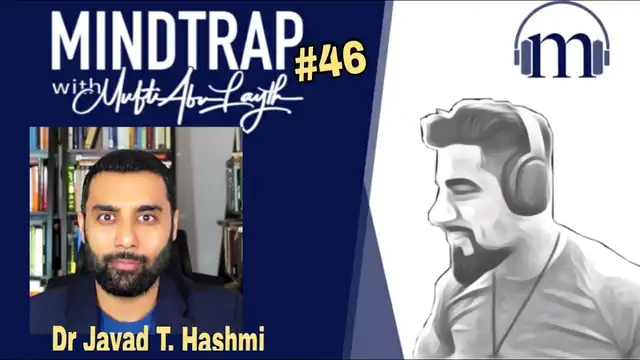 Play from 43:17
The video loads from YouTube only when you press play. Click a time in the transcript to seek.
Watch this part
Open on YouTube at 43:17The player starts at 43:17, the beginning of this part.
This segment43:17 to 47:41 · 4 min 24 sA view quoted in order to be discussed, not a position held
What this part covers
machinesummary, machine-writtenThe guest says moral ideals exist in God and humans approximate them; past acceptance of slavery came from not recognising others' full humanity, and ritual laws such as the pork prohibition differ from universal moral law.
In more detail
The guest says moral ideals exist in a metaphysical space, in the mind of God so to speak, and that human societies only approximate them, more in some ages than others. On slavery, often used as the trump card for cultural relativism, he says people always knew slavery was bad: Muslims did not want Muslims enslaved, and his dissertation on the ethics of war and peace shows they got intra-Muslim warfare right, but they did not recognise the full humanity of non-Muslims and so did not extend the ideal to them. Asked by Mufti Abu Layth whether fornication or drinking alcohol are such moral ideals, he distinguishes ritual law from moral or natural law: eating pork is a ritual practice of the Muslim community and he does not think God will hold a non-Muslim to account for it, whereas raping and killing babies is wrong in any religion or none. Mufti then asks whether God's morality changes with time, since raiding other tribes was once a survival tactic and God legislated different things for different prophets.
Position stated
This segment presents a view in order to discuss or respond to it. It is recorded as quoted, never as held, and no position is attributed from it.
Kind: a view quoted in order to be discussed, not a position held Speakers: host and guest; guest speech is labelled and excluded from positionsTranscript
machine43:17 to 47:41 · click a time to seek · dotted terms open the glossary
A guest speaks in this segment. Guest speech is labelled and is excluded from the positions layer.
This segment states a view in order to discuss it. It is recorded as a quoted view, not as a position held.
these things to be wrong I'm saying that these ideals exist in that kind of in this kind of metaphys, you know, they Oh my god. [laughter] I don't even know how you're going. And now it's it's it's all the only other option I have is No, it's it's good right now. It's good.
I think it just tries to uh pick it up. So um what I'm saying is that the ideals that u of morality they exist in this kind of metaphysical space out there somewhere idealize in God in the godhead in the mind of God so to speak. We only appro can ever approximate those ideals of morality and we try to approximate them as best as we can.
There's some ages in which we approximate it more than other ages based on certain factors. So the quintessential example for example is the idea of slavery, right? So somebody could say if you if morality is universal, why is it that only up until very recently society said slavery is wrong and bad? And that is kind of used as the Trump argument for moral relativists, cultural relativists.
I would argue that historically people have always known that slavery is bad and it's not a good thing. Muslims knew that. They knew that slavery was bad. Why? Why do we know that? Because they were against Muslims from being taken as slaves. It wasn't the issue that they didn't recognize that slavery is bad. It's that they didn't recognize the full humanity of the people they denied that ethical ideal to. So they didn't recognize non-Muslims as fully human.
So therefore they didn't extend this courtesy to non-Muslims. So for example, if you study the ethics of war and peace, which is what my dissertation is on, um you will find that Muslims actually got it very much right when they were talking about intramuslim uh war. They did say that you shouldn't take them as slaves and this kind of thing. So they just didn't recognize the other and that blinded them to the fact that we should extend this to other people.
But so they did recognize that slavery is bad and and they didn't want it for themselves. So I think that's enough indication to say that yes they did recognize it but they were blinded to it. Are you stating doc like let's say now let's take something as um let's say fornication or drinking alcohol. Mhm. Now, are we saying is this, if I understood this correct, this is a a moral ideal?
Each one of these is I don't think drinking I don't think drinking alcohol is a moral ideal necessarily. It may it may not be. Um, so where are these because when we're saying cuz when you're saying these morals are in the mind of God or they exist with God. So what what do you I take it do you mean by that like there's a whole long list of uh dos and don'ts.
So so what I would say is like eating pork for example Yeah. in my mind is not violating a moral universal moral norm. That is a specific ritual practice of the Muslim ummah. Yeah. that our prophet legislated that uh or the Quran legislated that is uh not a moral univer that's not a universal moral ideal. So if you are a non-Muslim in my mind I don't think that God will hold you to account for eating pork if it's not in your religious uh belief system I don't think you'll be held liable to that.
Meanwhile I think that's radically different than going out and raping and killing babies. we can all agree that that is uh morally wrong even if you have no religion or you have a different religion. So I think we need to differentiate between ritual ritual law and moral law but natural law but let's say natural law sure but let's say uh uh robbing people.
Yeah. Now like this tribe goes and robs that tribe and brings their goods. Um this is obviously something you know many pre-ivilization is something essential as a survival tactic now right is this when you're told okay don't do certain things do you think this is something uh human beings are learning picking up is this something god has because the issue comes here that god has legislated different things for different prophets so is god's morality then changing with time.
Paragraphs overlapping 43:17 to 47:41. Full text on the recording page.
Cite this segment
Stable id, transcript version and tier are part of the citation. Every change to a transcript is logged.Mufti Abu Layth Archive, segment 2020-12-11b-S11, auto-transcribed, may contain errors. https://muftiabulayth.org/r/zasz48lx_wi/s/11/ (accessed 1 November 2026)
- APA 7
Mufti Abu Layth. (2020, December 11). If morality is universal, why was slavery accepted for so long? [Video, segment 2020-12-11b-S11, auto-transcribed, may contain errors]. Mufti Abu Layth Archive. Retrieved November 1, 2026, from https://muftiabulayth.org/r/zasz48lx_wi/s/11/
- Chicago author-date
Mufti Abu Layth. 2020. "If morality is universal, why was slavery accepted for so long?" Video, segment 2020-12-11b-S11, auto-transcribed, may contain errors. Mufti Abu Layth Archive. Recorded December 11, 2020. Accessed November 1, 2026. https://muftiabulayth.org/r/zasz48lx_wi/s/11/
- BibTeX
@misc{abulayth-2020-12-11b-S11,
  author = {Mufti Abu Layth},
  title = {{If morality is universal, why was slavery accepted for so long?}},
  year = {2020},
  month = {12},
  date = {2020-12-11},
  howpublished = {\url{https://muftiabulayth.org/r/zasz48lx_wi/s/11/}},
  url = {https://muftiabulayth.org/r/zasz48lx_wi/s/11/},
  organization = {Mufti Abu Layth Archive},
  urldate = {2026-11-01},
  note = {Segment 2020-12-11b-S11, auto-transcribed, may contain errors}
}
Something wrong here?
Tell us what is wrong and it will be checked against the recording. Nothing changes until a person has reviewed it.
Sending a note needs JavaScript, which is off or unavailable in this browser. Nothing has been sent.
No name, email address or account is asked for or stored, and the inbox does not store your IP address. For rate limiting it keeps an unreadable fingerprint of your connection for 48 hours, and our database provider's own logs record connections as every website's do. Only your note, its kind, the page and the moment in the recording are kept, for review.