
Recordings › Dr Javad T. Hashmi | Axis of Morality & Archetypal Myths in the Quran | MindTrap 46 |Mufti Abu Layth · 11 Dec 2020 › Segment 8 of 36
Isn't reason subjective, and is something good only because God commands it?
salat salaah namaz prayer salaat namaaz as-salah al-salah salawat imam al-ghazali imaam imams prayer leader muftis ashaira asha'irah ashariyyah ash'arite mutazilite mu'tazilah koran quraan al-quran ayah aya ayat ayaat aayah aayat wahy wahi wahee hijaab hejab hijabiIs reason subjective? Moral relativism, al-Ghazali and the Euthyphro dilemma
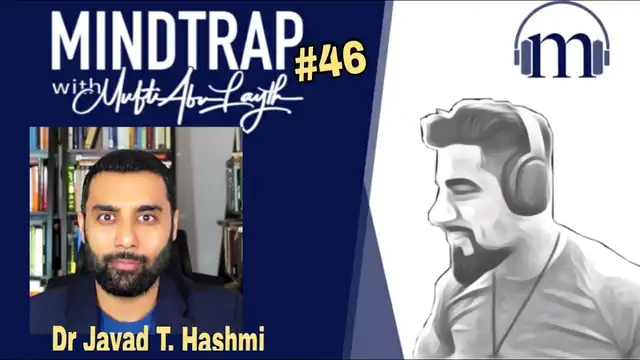 Play from 29:42
The video loads from YouTube only when you press play. Click a time in the transcript to seek.
Watch this part
Open on YouTube at 29:42The player starts at 29:42, the beginning of this part.
This segment29:42 to 33:58 · 4 min 16 sGeneral teaching
What this part covers
machinesummary, machine-writtenThe guest says the Ash'ari voluntarist view of ethics is the real relativism and argues for universal moral values grounded in God's nature; Mufti Abu Layth calls the Ash'ari denial of inherent good and bad nonsense.
In more detail
Mufti Abu Layth puts the common objection that reason is subjective, since what is reasonable changes over centuries. The guest replies that the Ash'aris and the so-called orthodoxy are the greater moral relativists: al-Ghazali, whom he respects as a great intellectual, argued for cultural relativism, while the Mu'tazila and the modernists argued for a universal morality not subject to human desire, and he sees a strange alliance today between academic postmodernists and traditionalists. Referring to the Euthyphro dilemma, he calls it a false dilemma and favours a modified divine command theory in which good flows from God's nature, and says the Ash'ari ethical voluntarism is more relativist than the view that universal moral values exist even if people disagree on them. Mufti says he finds absurd the Ash'ari view that there is no good and bad except what God commands or forbids, calling it complete nonsense, and notes that Abu Hanifa and other early theologians opposed it.
- Guest speech overlaps this segment
Position stated
Waiting for the speaker checkA guest speaks in this segment and the captions do not say who said what. The view found here is held back until the speaker-separated transcript confirms the words are his, or the channel verifies it. The transcript and recording are published in full.
Kind: general teaching Speakers: host and guest; guest speech is labelled and excluded from positionsTranscript
machine29:42 to 33:58 · click a time to seek · dotted terms open the glossary
A guest speaks in this segment. Guest speech is labelled and is excluded from the positions layer.
Once I let's say let's say I never had seen this verse before. Well, then even though I had at one point in time been convinced with my human rationality that this Quran is from Allah, now once I see this verse, my reason would say, "Wait a second, it might not be." I'm not trying to say that the Quran is something that we should not believe in. But what I'm saying is that we we we have to use reason continuously. Reason is not something that we just use to arrive at revelation and then stop.
And so that's that's my my way of thinking. And I'm inspired by the Islamic philosophers, the Mesazi and other uh freeth thinkers of the past as well as many Islamic modernists of the present. But people will say, doc um and they ask they say this to me all the time, but just putting it to you, they will say yes, but reason is very subjective. You know, using your reason, where do you draw the line?
because uh you know today you certain things are deemed reasonable which were not deemed reasonable 500 years ago and so on and so forth you know like whose reason this is often uh a question which of is is hurled at many people who as you know who advocate the voice of reason so what is your response to that absolutely so what I would say is actually the usheries are and the quote unquote orthodoxy they are more moral relativists than anyone else.
In fact, if you read and I respect Imam Ghazali a lot. I think he was a great intellectual but he was actually he would argue for cultural relativism. He argued very voseiferously for cultural relativism. On the other hand, it was the Islamic rationalists, the Mazalis and now the modernists who argued for universal morality which says that there is a belief that it's not subject to human desire whether or not something for example killing baby raping and killing babies is not okay in some cultures and not okay in others.
So in fact what we see today is this strange alliance between postmodernists in the academy and the uh traditionalists who follow this kind of moral relativist argument. So they actually and this goes back to the euthiferral problem right where they say are things good because God says they're good or does God say they're good because they are good? They are good. Yeah. Right. So I think this is a false dilemma.
I think uh there's the modified uh divine command theory which states things are good because of God's very nature. So it flows from God's nature what is good. So it's not subjective and neither is there these categories that exist before God. Rather good flows naturally from God. But the point I'm trying to say is once you have this ethical relativism it's called volunt uh ethical volunteerism.
That's what the usheries believe. That's actually more relativist than what [clears throat] than what I'm saying and what many Islamic modernist rationalists are saying, which is precisely that we have universal moral values which we should come to. Now, we might disagree what those are. Yeah. But we believe that they exist and we can say that there are at least some that we can agree on and some maybe there's disagreement on.
But it's so so I would I would throw this argue this accusation back against the traditionalists. Sure. So just just to just to unpack that a bit. So I mean the Asharis they their thing on this by the way I completely I I find it uh that element absurd that they say there is no no such thing as good and bad. It's just whatever God said do becomes good translates as good.
Whatever God said don't do translates as bad. Uh complete nonsense. As opposed to people like Imam Abuhanifh opposed that and as did uh some of the other earlier theologians. Coming to you, do you believe that uh there is uh I mean what how do you believe morality to be? I know recently there was a discussion between u Muhammad hijab and um apostate prophet which they kept it it was Daniel Hakikachu right?
Oh no also Muhammad hijab right? Yes. So there there was one also with the apostate prophet and I think it was uh facilitated by uh I've forgotten his name now the other Salah uh Adam Salah. So now on this he kept hijab kept saying uh do you believe in absolute morality or you know what what morality do you believe in and so uh he was arguing from a religious viewpoint that we have absolute morality himself.
Paragraphs overlapping 29:42 to 33:58. Full text on the recording page.
Cite this segment
Stable id, transcript version and tier are part of the citation. Every change to a transcript is logged.Mufti Abu Layth Archive, segment 2020-12-11b-S08, auto-transcribed, may contain errors. https://muftiabulayth.org/r/zasz48lx_wi/s/8/ (accessed 1 November 2026)
- APA 7
Mufti Abu Layth. (2020, December 11). Isn't reason subjective, and is something good only because God commands it? [Video, segment 2020-12-11b-S08, auto-transcribed, may contain errors]. Mufti Abu Layth Archive. Retrieved November 1, 2026, from https://muftiabulayth.org/r/zasz48lx_wi/s/8/
- Chicago author-date
Mufti Abu Layth. 2020. "Isn't reason subjective, and is something good only because God commands it?" Video, segment 2020-12-11b-S08, auto-transcribed, may contain errors. Mufti Abu Layth Archive. Recorded December 11, 2020. Accessed November 1, 2026. https://muftiabulayth.org/r/zasz48lx_wi/s/8/
- BibTeX
@misc{abulayth-2020-12-11b-S08,
  author = {Mufti Abu Layth},
  title = {{Isn't reason subjective, and is something good only because God commands it?}},
  year = {2020},
  month = {12},
  date = {2020-12-11},
  howpublished = {\url{https://muftiabulayth.org/r/zasz48lx_wi/s/8/}},
  url = {https://muftiabulayth.org/r/zasz48lx_wi/s/8/},
  organization = {Mufti Abu Layth Archive},
  urldate = {2026-11-01},
  note = {Segment 2020-12-11b-S08, auto-transcribed, may contain errors}
}
Something wrong here?
Tell us what is wrong and it will be checked against the recording. Nothing changes until a person has reviewed it.
Sending a note needs JavaScript, which is off or unavailable in this browser. Nothing has been sent.
No name, email address or account is asked for or stored, and the inbox does not store your IP address. For rate limiting it keeps an unreadable fingerprint of your connection for 48 hours, and our database provider's own logs record connections as every website's do. Only your note, its kind, the page and the moment in the recording are kept, for review.