
Recordings › Dr Javad T. Hashmi | Axis of Morality & Archetypal Myths in the Quran | MindTrap 46 |Mufti Abu Layth · 11 Dec 2020 › Segment 35 of 36
Are the jinn real, or a symbol?
muftis dalil daleel adillah adilla evidence shirq mushrik mushrikin polytheism djinn jinnat jinni shaytaan iblis iblees shayateen shayatin devil akhirah akhira aakhirah akhirat hereafter koran quraan al-quran wahy wahi wahee shaykh shaikh sheik shuyukh shaykhs jihaad mujahid in sha allah insha'allah in shaa allah insha allah inshaa allahAre the jinn real? A late antique belief rearticulated, and Shaytan as personified evil
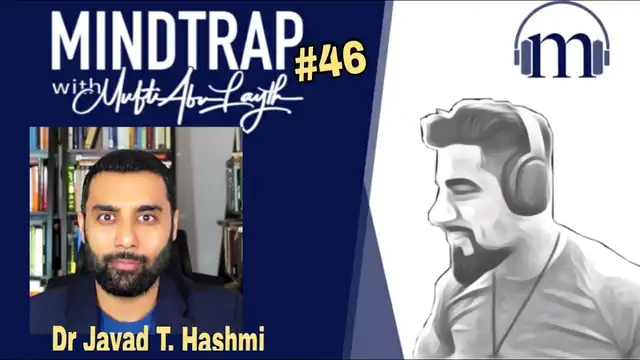 Play from 2:41:04
The video loads from YouTube only when you press play. Click a time in the transcript to seek.
Watch this part
Open on YouTube at 2:41:04The player starts at 2:41:04, the beginning of this part.
This segment2:41:04 to 2:47:50 · 6 min 46 sGeneral teaching
What this part covers
machinesummary, machine-writtenThe guest says the Quran rearticulated a late antique belief in jinn to subordinate them to God, that he does not literally believe in them, and that Shaytan personifies human evil; Mufti Abu Layth agrees that inner impulses are personified as good and bad forces.
In more detail
The guest says that although the Quran mentions jinn he is not a materialist, believing in God, the afterlife, consciousness as what ruh refers to, and possibly unseen things such as dark matter, but that the descriptions of jinn and angels are too crude to take literally. Mufti Abu Layth remarks that jinn in Arabic simply refers to something hidden from sight, and the guest says his own view is different: the Quran must be contextualised in late antiquity, where pagans propitiated the jinn and believed they gave knowledge of the unseen to oracles and poets, and the Quran rearticulated this belief step by step, making the jinn subservient to God and blocking routes to shirk. He says he cannot be certain on a matter of the unseen but does not literally believe in jinn, calls Yasir Qadhi's claim that jinn stories prove the Quran theologically horrible, and says Shaytan is a symbol personifying humanity's innate evil so that we understand the struggle within. Mufti says this resonates with him: insinuations and pre-cognitive impulses whose source we do not understand are personified as good or bad forces, an interpretation he is in line with regarding the Shaytan and the angel said to accompany each person.
- Guest speech overlaps this segment
Position stated
Waiting for the speaker checkA guest speaks in this segment and the captions do not say who said what. The view found here is held back until the speaker-separated transcript confirms the words are his, or the channel verifies it. The transcript and recording are published in full.
Kind: general teaching Speakers: host and guest; guest speech is labelled and excluded from positionsTranscript
machine2:41:04 to 2:47:50 · click a time to seek · dotted terms open the glossary
A guest speaks in this segment. Guest speech is labelled and is excluded from the positions layer.
Like if you just knock her out, it'll take one man. If you want to uh consrain her without hurting her, we call the police and we the the point I'm trying to make is that we have this rational explanation that makes so much more sense. But he jumps to jin. Now the question is okay the Quran does mention jin. What to do about that? Right? Um now I'm not going towards a I I could be accused of you're just a materialist.
You're denying anything outside of the material existence. I am not a materialist like you. I have acknowledged that there's thing called consciousness and that that is probably what Ru is talking about. I believe in the afterlife, right? I believe in God. Um, and I do think that there could be things that are unseen like dark matter, etc. Things that, but why do I not believe in literal gins and angels like they do because their descriptions are too crude?
It's not that I'm a materialist. No, I I think that's absolute sense. There's no I think that's an absolutely rational response because if I'm understanding you that look the jin are the jin just simply means in Arabic the unseen. It's something of the unseen. It doesn't mean as in the unseen but something that is hidden from you being able to see it. It's called jin in Arabic.
Now I my view my view is a little different but if you want me to elaborate on I thought that's what you meant but yeah so so my view is that we need to see what the Quran is doing and focus on that and then we can know what it is saying. So if we look and in order to do that we need to contextualize the Quran. So um in order to contextualize the Quran you need to understand the Quran as a text that arrived in the late antique period and it was in a certain millu in which people believed in certain things and we need to know what those things
are to realize what the Quran is doing. So at that time the pagans used to believe that they could uh propitiate the jin and have their needs fulfilled. That's a new word, propitiate. I'm have to check that one out. Yes. [laughter] Ultra ultraarians. Yeah.
So, so uh they would not only propitiate the jin, but they would also um believe that the jin had knowledge of the unseen and that they would give this knowledge to the uh prophetess, the um uh the oracle. Sorry. They believe that they give the knowledge to the oracle and to the poets. So actually I get some help from my author Muhammad but he says what the Quran is doing and this is now me putting it in my own wow to sorry to win or regain the favor of a god or a spirit by doing something that pleases them propitiate
sounds like a you've got a lisp [laughter] propish pish I'm going to take a pish sorry sorry I got distracted [laughter] that's the gin enemy. Sorry. Yeah, you are a jin by the way. Look at you. Look at your belt. You're a jin. So, um, yeah, what the Quran is doing is moving the is theologically rearticulating the belief system of that environment.
And what it slowly did over time is make all of them subservient to God and block any means of committing shik in these means of propitiating them or believing in their knowledge of the unseen. So therefore what the Quran what the Quran did is it first or it it moved in a stepwise fashion to rearticulate this belief because you can't just get rid of this belief of jin they believe in it.
So what it is doing is it's just revelation is revealed for the environment in those in that world view but what's we need to dethize it in order to re understand it for our time but without saying belittling what it's doing what it's actually doing is quite profound so that's we need to do so I don't believe that that is a very interesting interesting point I don't believe I can say this with certainty because this is a matter of the unseen but I no I don't literally believe in jin So I believe it's also a mythological belief that they had at that time and that the Quran is theologically rearticulating it so that
everything is under God and minimizing the belief in jin. Meanwhile, what Dr. Uh my criticism of uh Sheikh uh Yaser is is that he actually in a recent uh video said that we can actually prove God and the Quran is truth by the fact that jin exists and that we know jin exists from all these stories of poltergeists and all these kind of thing.
This is proof that our belief is true. So now are you arguing that jin are the proof miracle of the prophets? This is crazy. This is this is I mean theologically this is horrible to believe. The Quran is actually moving us away from a reliance and belief on in their pre-Islamic belief in jin. It's moving us in a different direction and rearticulating it. So um that is that is how I take that and I think it's a symbol like Shayan and these are symbols.
It's personifying and objectifying human evil, our innate evil so that we can understand the struggle within us. Why? Satan whispers to us. It objectifies and personifies it so that we can understand it as a battle and that has useful for our practical purposes. So that is what the Quran is doing in my opinion. Yeah. No, that that's very I that part I totally uh you know that resonates with me that there are uh there are aspects to us um insinuations precognitive cognition uh which we don't
understand where it comes from. these things being personified as good forces or bad forces uh is absolutely is what I've said is one of the interpretations which I actually am in line with when it comes to things like the uh you know people say we we have with us the shaitan and we have an angel and so on and so forth these things are just personifying I know we've been going on so much doc and I know you've uh you've really this is and prior to this we were trying to set up and I've had doc sitting there for so long uh going on with all this, but it's been so amazing.
So much uh information. We never got round to discussing the jihad aspect and there's a few other things as well. So inshallah maybe I'd love to uh get you on again and get uh inshallah your whole take on that because that's very interesting as well and that's what your thesis uh was. Uh are there certain things you're doing currently if people want to connect with you or they should tune in to certain things that you're doing any any projects to be very so the project that I'm working on right now is the side project which is what I've been talking about this entire time which is translating this uh and going through this book and
Paragraphs overlapping 2:41:04 to 2:47:50. Full text on the recording page.
Cite this segment
Stable id, transcript version and tier are part of the citation. Every change to a transcript is logged.Mufti Abu Layth Archive, segment 2020-12-11b-S35, auto-transcribed, may contain errors. https://muftiabulayth.org/r/zasz48lx_wi/s/35/ (accessed 1 November 2026)
- APA 7
Mufti Abu Layth. (2020, December 11). Are the jinn real, or a symbol? [Video, segment 2020-12-11b-S35, auto-transcribed, may contain errors]. Mufti Abu Layth Archive. Retrieved November 1, 2026, from https://muftiabulayth.org/r/zasz48lx_wi/s/35/
- Chicago author-date
Mufti Abu Layth. 2020. "Are the jinn real, or a symbol?" Video, segment 2020-12-11b-S35, auto-transcribed, may contain errors. Mufti Abu Layth Archive. Recorded December 11, 2020. Accessed November 1, 2026. https://muftiabulayth.org/r/zasz48lx_wi/s/35/
- BibTeX
@misc{abulayth-2020-12-11b-S35,
  author = {Mufti Abu Layth},
  title = {{Are the jinn real, or a symbol?}},
  year = {2020},
  month = {12},
  date = {2020-12-11},
  howpublished = {\url{https://muftiabulayth.org/r/zasz48lx_wi/s/35/}},
  url = {https://muftiabulayth.org/r/zasz48lx_wi/s/35/},
  organization = {Mufti Abu Layth Archive},
  urldate = {2026-11-01},
  note = {Segment 2020-12-11b-S35, auto-transcribed, may contain errors}
}
Something wrong here?
Tell us what is wrong and it will be checked against the recording. Nothing changes until a person has reviewed it.
Sending a note needs JavaScript, which is off or unavailable in this browser. Nothing has been sent.
No name, email address or account is asked for or stored, and the inbox does not store your IP address. For rate limiting it keeps an unreadable fingerprint of your connection for 48 hours, and our database provider's own logs record connections as every website's do. Only your note, its kind, the page and the moment in the recording are kept, for review.