
Recordings › Dr Javad T. Hashmi | Axis of Morality & Archetypal Myths in the Quran | MindTrap 46 |Mufti Abu Layth · 11 Dec 2020 › Segment 29 of 36
Who was Dhul Qarnayn, and who are Gog and Magog?
muftis koran quraan al-quran mecca makka mekka 'alim aalim ulama ulema ulamaa da'wah dawat da'ee invitationDhul Qarnayn as Cyrus, and Gog and Magog as the colonial powers: Mufti Abu Layth's reading
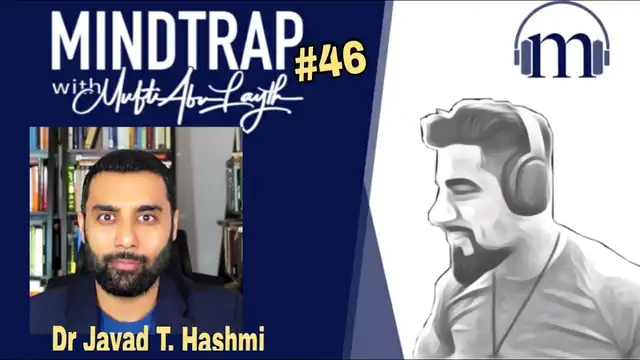 Play from 2:01:55
The video loads from YouTube only when you press play. Click a time in the transcript to seek.
Watch this part
Open on YouTube at 2:01:55The player starts at 2:01:55, the beginning of this part.
This segment2:01:55 to 2:06:50 · 4 min 55 sGeneral teaching
What this part covers
machinesummary, machine-writtenMufti Abu Layth identifies Dhul Qarnayn most likely with Cyrus the Great and reads Gog and Magog as havoc-wreaking forces, later the colonial powers; the guest says this already relies on ad hoc literary reinterpretation.
In more detail
Mufti Abu Layth asks the guest about Dhul Qarnayn, which the guest notes became a hot topic after Yasir Qadhi's remarks about zombies, and gives his own view that Dhul Qarnayn was most likely Cyrus the Great. He says the Quran relates biblical stories because the learned of Arabia, outside the still largely pagan Hijaz, were Christians and Jews, and rabbis and others learned in scripture were brought to challenge the Prophet. On Gog and Magog he says he understands them as a fluid term for peoples or forces that wreak havoc, set straight in that time, with a later unleashing before the end of time that he relates to the colonial period. The guest notes that Javed Ahmad Ghamidi holds a similar view, and says that, following Khalafallah, Mufti has already been forced to use literary methods ad hoc; Mufti replies that the ambiguity adds a mystery reflecting the dynamism of human cognition.
- Guest speech overlaps this segment
Position stated
Waiting for the speaker checkA guest speaks in this segment and the captions do not say who said what. The view found here is held back until the speaker-separated transcript confirms the words are his, or the channel verifies it. The transcript and recording are published in full.
Kind: general teaching Speakers: host and guest; guest speech is labelled and excluded from positionsTranscript
machine2:01:55 to 2:06:50 · click a time to seek · dotted terms open the glossary
A guest speaks in this segment. Guest speech is labelled and is excluded from the positions layer.
So let me just ask you one question. Sure. And I think it's a hot topic so we can discuss it of course. What do you take of uh Vulcarnain? Okay. How do you understand the story of Vulcarnain and we know and you can give the background of why that's a hot topic nowadays. Okay. Uh okay. Um I mean uh if you'd like you don't have to. Right. No, I'm not sure why it's a hot uh Well, you know, she Yaser Kadi got in trouble for his statements about zombies.
Oh, right. Yes, of course. [laughter] I believe that Dul Carnain was most likely Cyrus the Great. Um, that's who the Quran was referring to. I've mentioned that I think recently as well on my Monday nights with MUI. Um, and the reason being, you see, to me, the stories of the Quran, I agree with you on this part absolutely that look, the stories of the Quran, yes, obviously there's the moral aspect.
I'm taking a moral from the story, but they then other stories could have been mentioned. Why just biblical ones? They're being mentioned because when the prophet is giving his dawa in Arabia the so you've got obviously the the middle Arabia with the prophet is and you've got the southern kingdoms and the northern kingdoms of Arabia. The learned and advanced people were really the Christians and the Jews.
They were seen as kind of like the academics of the day and age. So when the people of Makkah, it's surprisingly only the hij that was still quite pagan. the rest of Arabia, whether it was down south, the southern the Axomite kingdoms or the northern uh Petrian kind of Arabia, it was still heavily Christian and with Jews. So when people were bringing uh debaters, you know, these people to challenge the prophet, they would often be rabbis or uh people learned in in biblical stuff.
So the Quran especially Jews they were being brought hence the Quran is addressing them quite a bit and their stories they ask you about yeah like this is a prime example like yes but how my question and that's a key point because we'll get to that but my question to you is it's not just the historical event that happened in the past the Quran seems to say that there are these people Gog and Magog how do you understand Gog and Magog And well that story how do you understand that?
Yeah. So that that's a a good one. I've understood and major and major name of a that's being expressed. So but there's there's analog. There's a story of God. Yeah. There's a story. Exactly. So but I'm just saying the term.
So I've understood this to be a fluid term referring to a specific people but it's in that time but in essence it's talking about people that or forces that run havoc that that kind of like wreak havoc and and in that particular time yach sorry is kind of setting them straight but there will be later on before the end of time it mentions later on which I actually feel was the colonial period that there will be certain forces that once again once once they unleash on the world it will change the face of the world as it's known.
Yes. So, so and that is a view that has been expressed by a couple other scholars as well. Uh Jave Ahmed Rami who I respect deeply has a similar sort of view. Does he say that as well? Okay. He he he he says that it [snorts] refers to the different I I don't want to misrepresent his yeah I don't want to misrepresent his view but he does take the view that it's talking about a certain nation that will come from a certain so and and I think he thinks it means the west so it's a very similar view so um my response to this and I'm relying on this author again to
yes is notice that You always [laughter] so notice which means disagreeing with Allah. I'm joking. That's funny. Uh you you've already been forced to use this is what he would say. You've already been forced to use the literary methods to reinterpret the story. So, and he says just understand it in the beginning like that because in the end you'll be forced to it anyways and then when you do it you're going to be haphazard and ad hoc.
Have you noticed that how many different things that you have to on an ad hoc basis respond to and it's always oh this word is not clear this could mean this. Well, it doesn't explicitly say this. Look how many stories you have to do that. But does that not just just saying but does that not add because I would argue that adds the element of mystery which reflects the dynamism in human uh cognition.
But what I would say is it wasn't a mystery for the people at the time at which this was revealed because we know as western scholars have found we not only know uh what they were talking about we know when that legend was created. So that legend was I believe it was um a scholar professor Sydney Griffith I believe he has written on this uh I might be mistaken on the name of the I might might have been another scholar but um he basically says and he's proved actually that uh we can say with pretty good certainty that the or first of all that number and number two
Paragraphs overlapping 2:01:55 to 2:06:50. Full text on the recording page.
Cite this segment
Stable id, transcript version and tier are part of the citation. Every change to a transcript is logged.Mufti Abu Layth Archive, segment 2020-12-11b-S29, auto-transcribed, may contain errors. https://muftiabulayth.org/r/zasz48lx_wi/s/29/ (accessed 1 November 2026)
- APA 7
Mufti Abu Layth. (2020, December 11). Who was Dhul Qarnayn, and who are Gog and Magog? [Video, segment 2020-12-11b-S29, auto-transcribed, may contain errors]. Mufti Abu Layth Archive. Retrieved November 1, 2026, from https://muftiabulayth.org/r/zasz48lx_wi/s/29/
- Chicago author-date
Mufti Abu Layth. 2020. "Who was Dhul Qarnayn, and who are Gog and Magog?" Video, segment 2020-12-11b-S29, auto-transcribed, may contain errors. Mufti Abu Layth Archive. Recorded December 11, 2020. Accessed November 1, 2026. https://muftiabulayth.org/r/zasz48lx_wi/s/29/
- BibTeX
@misc{abulayth-2020-12-11b-S29,
  author = {Mufti Abu Layth},
  title = {{Who was Dhul Qarnayn, and who are Gog and Magog?}},
  year = {2020},
  month = {12},
  date = {2020-12-11},
  howpublished = {\url{https://muftiabulayth.org/r/zasz48lx_wi/s/29/}},
  url = {https://muftiabulayth.org/r/zasz48lx_wi/s/29/},
  organization = {Mufti Abu Layth Archive},
  urldate = {2026-11-01},
  note = {Segment 2020-12-11b-S29, auto-transcribed, may contain errors}
}
Something wrong here?
Tell us what is wrong and it will be checked against the recording. Nothing changes until a person has reviewed it.
Sending a note needs JavaScript, which is off or unavailable in this browser. Nothing has been sent.
No name, email address or account is asked for or stored, and the inbox does not store your IP address. For rate limiting it keeps an unreadable fingerprint of your connection for 48 hours, and our database provider's own logs record connections as every website's do. Only your note, its kind, the page and the moment in the recording are kept, for review.