
Recordings › Dr Javad T. Hashmi | Axis of Morality & Archetypal Myths in the Quran | MindTrap 46 |Mufti Abu Layth · 11 Dec 2020 › Segment 18 of 36
Does the Quran speak in symbols and metaphors?
averroes ibn rushd al-hafid muftis koran quraan al-quranMufti Abu Layth on symbols and stories: Ibn Rushd, Harari and Karen Armstrong
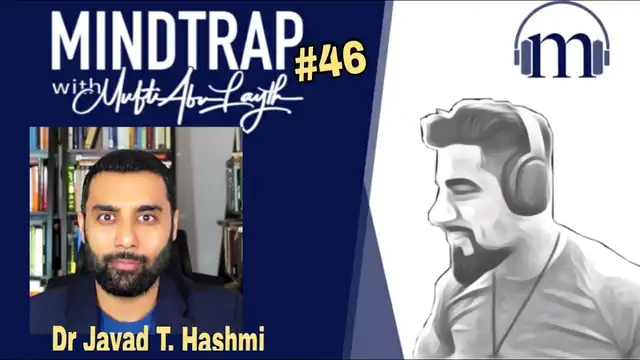 Play from 1:13:07
The video loads from YouTube only when you press play. Click a time in the transcript to seek.
Watch this part
Open on YouTube at 1:13:07The player starts at 1:13:07, the beginning of this part.
This segment1:13:07 to 1:15:55 · 2 min 48 sGeneral teaching
What this part covers
machinesummary, machine-writtenMufti Abu Layth agrees with Ibn Rushd that the Quran speaks in symbols and that scripture is a kind of art, but asks whether the guest thinks the prophets and their stories are fictitious.
In more detail
Mufti Abu Layth says he is in line with Ibn Rushd's way of thinking, agrees that the Quran speaks in symbols and metaphors, and that anthropomorphic language was used deliberately because people, especially of that age, could relate to it. He cites Yuval Noah Harari's Sapiens, which he loved, that what distinguishes humans is stories, myths and psychosocial narratives, retelling Harari's example that a thousand humans would outdo a thousand monkeys because of the power of shared stories. He notes he has said on his Monday night sessions that scripture is in many ways a kind of art, and mentions Karen Armstrong on the art of scripture. He then asks the guest whether he holds that the flood of Noah, Abraham, Moses, Jesus or Adam are entirely fictitious.
- Guest speech overlaps this segment
Position stated
Waiting for the speaker checkA guest speaks in this segment and the captions do not say who said what. The view found here is held back until the speaker-separated transcript confirms the words are his, or the channel verifies it. The transcript and recording are published in full.
Kind: general teaching Speakers: host and guest; guest speech is labelled and excluded from positionsTranscript
machine1:13:07 to 1:15:55 · click a time to seek · dotted terms open the glossary
A guest speaks in this segment. Guest speech is labelled and is excluded from the positions layer.
And then we and then that and that gives us the basis for human rights and these things that we value today that unfortunately atheistic secularism secular atheism is getting rid of underneath our feet and then we'll be left with nothing but nihilism and this bleak moral worldview. So that's how I understand uh these stories. I me see just to kind of uh just um kind of my my because I'm just hearing that and and where I stand from.
So I so several things you've said like uh the Quran obviously Rush somebody I'm definitely in line with his way of thinking and that the Quran speaks in symbols it speaks in metaphors it speaks in uh all these things I totally agree and everything you've said about God uh this kind of anything anthropomorphic or things like that it's not that these things were accidentally said but it's because humans could relate to it especially I would feel especially the people of the day and age and by extension others as well from different uh times.
Um right now and the stories thing is as Uvel Harrari has kind of like made very clear in his book as well and I totally loved his book Sapiens that look human beings what distinguishes us is stories and I totally agree that that is true because the stories they they carry much more than what people think when when we say stories sounds like like a bedtime story but it means myths and psychosocial narratives and everything entities like that and and I love the example he gives where he says um he says you know if you put a uh in one of his interviews he says if you put a monkey on an island
and you put a human on an island and you had to bet on who would survive uh he says I would bet on the monkey the monkey would outs survive the the human but if you put a thousand men on an island and a thousand monkeys the thousand men would outs survive the you know they would accomplish all sorts and he says and why is that it's not just because of the number because it's the power of stories the power of myth now [snorts] uh okay so with that in mind coming to this you see so the stories in the Quran and and I have said by the way in my Monday nights with mui and repetitively
that scripture is more kind of art in many ways I I've said that that I do agree with that understanding and Karen Armstrong speaks of the art of scripture. So, but when we're saying like the flood of Noah or let's say Abraham or Moses or Jesus or Adam or Adam or Adam or Adam, are we saying these are entirely fictitious events uh and and people?
Is this what we're is this what you're uh purporting? Is this or just to be clear on where you stand on it? Okay. So in my class I actually someone asked me a very good question. They said I was now I was using the Islamic philosophers. I didn't say this was my view but sure. Okay. But no this is my this is my now we're behind the scenes and cuz it's [laughter] just it's just me and you here. There's no audience or anything.
Paragraphs overlapping 1:13:07 to 1:15:55. Full text on the recording page.
Cite this segment
Stable id, transcript version and tier are part of the citation. Every change to a transcript is logged.Mufti Abu Layth Archive, segment 2020-12-11b-S18, auto-transcribed, may contain errors. https://muftiabulayth.org/r/zasz48lx_wi/s/18/ (accessed 1 November 2026)
- APA 7
Mufti Abu Layth. (2020, December 11). Does the Quran speak in symbols and metaphors? [Video, segment 2020-12-11b-S18, auto-transcribed, may contain errors]. Mufti Abu Layth Archive. Retrieved November 1, 2026, from https://muftiabulayth.org/r/zasz48lx_wi/s/18/
- Chicago author-date
Mufti Abu Layth. 2020. "Does the Quran speak in symbols and metaphors?" Video, segment 2020-12-11b-S18, auto-transcribed, may contain errors. Mufti Abu Layth Archive. Recorded December 11, 2020. Accessed November 1, 2026. https://muftiabulayth.org/r/zasz48lx_wi/s/18/
- BibTeX
@misc{abulayth-2020-12-11b-S18,
  author = {Mufti Abu Layth},
  title = {{Does the Quran speak in symbols and metaphors?}},
  year = {2020},
  month = {12},
  date = {2020-12-11},
  howpublished = {\url{https://muftiabulayth.org/r/zasz48lx_wi/s/18/}},
  url = {https://muftiabulayth.org/r/zasz48lx_wi/s/18/},
  organization = {Mufti Abu Layth Archive},
  urldate = {2026-11-01},
  note = {Segment 2020-12-11b-S18, auto-transcribed, may contain errors}
}
Something wrong here?
Tell us what is wrong and it will be checked against the recording. Nothing changes until a person has reviewed it.
Sending a note needs JavaScript, which is off or unavailable in this browser. Nothing has been sent.
No name, email address or account is asked for or stored, and the inbox does not store your IP address. For rate limiting it keeps an unreadable fingerprint of your connection for 48 hours, and our database provider's own logs record connections as every website's do. Only your note, its kind, the page and the moment in the recording are kept, for review.