
Recordings › Dr Javad T. Hashmi | Axis of Morality & Archetypal Myths in the Quran | MindTrap 46 |Mufti Abu Layth · 11 Dec 2020 › Segment 17 of 36
Can I accept evolution and still take the Quran's stories as true?
koran quraan al-quran ayah aya ayat ayaat aayah aayat wahy wahi wahee deen al-din ad-deen ad-dinA 'Bultmannian leap': evolution, scientific facts and the higher truths of religion
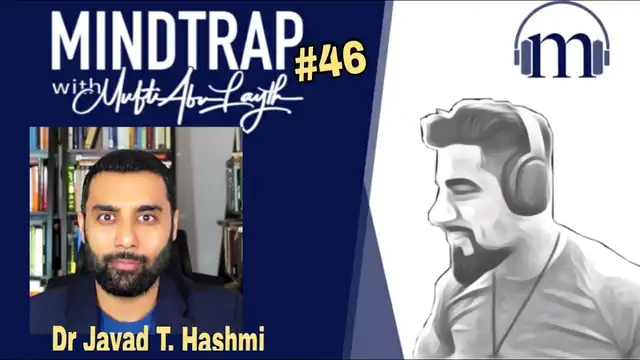 Play from 1:09:21
The video loads from YouTube only when you press play. Click a time in the transcript to seek.
Watch this part
Open on YouTube at 1:09:21The player starts at 1:09:21, the beginning of this part.
This segment1:09:21 to 1:13:07 · 3 min 46 sA view quoted in order to be discussed, not a position held
What this part covers
machinesummary, machine-writtenThe guest calls for reading the Quran wholesale as sacred literature, accepting evolution as scientific fact while holding that religion's symbolic truths, not science, ground human rights and meaning.
In more detail
The guest proposes what he calls a Bultmannian leap, after the Christian theologian Rudolf Bultmann who argued for demythologising the Bible: biting the bullet and reading the whole Quran as sacred literary art, rather than dealing ad hoc with each miracle. He says symbol, parable and legend are the language of religion and convey a higher truth than scientific truth, and that Muslims have an inferiority complex that makes them reconcile the Quran with Darwin. He says he wholeheartedly believes in evolution as a scientific fact, but that evolution alone leaves an anaemic moral worldview, which is where social Darwinism came from, whereas religion voices higher truths in symbolic language that ground human rights, which he says secular atheism is removing, leaving nihilism.
Position stated
This segment presents a view in order to discuss or respond to it. It is recorded as quoted, never as held, and no position is attributed from it.
Kind: a view quoted in order to be discussed, not a position held Speakers: host and guest; guest speech is labelled and excluded from positionsTranscript
machine1:09:21 to 1:13:07 · click a time to seek · dotted terms open the glossary
A guest speaks in this segment. Guest speech is labelled and is excluded from the positions layer.
This segment states a view in order to discuss it. It is recorded as a quoted view, not as a position held.
truth. So for example the Quranic verse that says there is nothing like unto him. So I think this is a more sophisticated way and it's a more systematic way of understanding Quranic stories, the ideas of miracles and all of these things that we now know in our scientific day and age we can no longer believe in. This will allow us to make what I call a Boltmanian leap. Rudolph Baltman was a Christian theologian who had to argue that we have to dethize the Bible in order to understand it for our today day and age.
I think we need to make a similar leap today. And it's a systematic leap. You just have to bite a bullet. Yeah. Once you bite the bullet, then you no longer need to have this what I consider ad hoc constant need to say, well, what is this? So, what is what do we do with this miracle? What do we do with this issue? what do we do with this? We're constantly having to face these issues. Put the whole thing as a literary piece like put it as understand it as a literary uh art and a sacred literary art and understand that uh religion and revelation use the language of uh
symbolism, parables, metaphors, legends. This is precisely the language of religion and this is a beautiful thing. We should not minimize this. Yeah. And last would say truth. This is a higher truth than scientific truths. Have so actually have this inferiority complex where we think oh my god evolution and Darwin and science these are true and re and and now we have to make the Quran reconcile it with that.
Now I of course wholeheartedly believe in evolution as a scientific fact is scientific facts are actually inferior to religious truths metaphorical truths deeper truths. So uh if we and that's what religion does. So if if and I would just close on this for example human evolution is based on the idea that we came from a common ancestor and that it was just random chance and mutations and natural selection and then human humanity was created and it was even created it could be multiple uh forerunners like it it may not have been from the same human being
that we came to. Well if you believe in that idea which there's your private jet again is it? Oh, yep. It is that's that's what's catching the mic. I got to tell that pilot to stop taking [laughter] joy ride. I know. So So So what I would say is and I and I'll close on this. I'm sorry for going off, but um even though I believe that historically and scientifically evolution is the way humans were put on this earth, if we just leave it at that, then we're left with a very uh anemic moral worldview.
What the Quran is and and that's where social Darwinism comes from. So after Darwinis, after evolution, you had social Darwinism. If you just believe in evolution and no religion, then you would say, uh, why would you believe in human rights? You would just believe that the the strong should kill the weak because it's natural selection and I need to increase my progeny and that's it. Now, what religion does, it gives us those higher moral and religious truths and it voices them in the in the language of uh symbolism and parables and etc.
And then we and then that and that gives us the basis for human rights and these things that we value today that unfortunately atheistic secularism secular atheism is getting rid of underneath our feet and then we'll be left with nothing but nihilism and this bleak moral worldview. So that's how I understand uh these stories. I me see just to kind of uh just um kind of my my because I'm just hearing that and and where I stand from.
Paragraphs overlapping 1:09:21 to 1:13:07. Full text on the recording page.
Cite this segment
Stable id, transcript version and tier are part of the citation. Every change to a transcript is logged.Mufti Abu Layth Archive, segment 2020-12-11b-S17, auto-transcribed, may contain errors. https://muftiabulayth.org/r/zasz48lx_wi/s/17/ (accessed 1 November 2026)
- APA 7
Mufti Abu Layth. (2020, December 11). Can I accept evolution and still take the Quran's stories as true? [Video, segment 2020-12-11b-S17, auto-transcribed, may contain errors]. Mufti Abu Layth Archive. Retrieved November 1, 2026, from https://muftiabulayth.org/r/zasz48lx_wi/s/17/
- Chicago author-date
Mufti Abu Layth. 2020. "Can I accept evolution and still take the Quran's stories as true?" Video, segment 2020-12-11b-S17, auto-transcribed, may contain errors. Mufti Abu Layth Archive. Recorded December 11, 2020. Accessed November 1, 2026. https://muftiabulayth.org/r/zasz48lx_wi/s/17/
- BibTeX
@misc{abulayth-2020-12-11b-S17,
  author = {Mufti Abu Layth},
  title = {{Can I accept evolution and still take the Quran's stories as true?}},
  year = {2020},
  month = {12},
  date = {2020-12-11},
  howpublished = {\url{https://muftiabulayth.org/r/zasz48lx_wi/s/17/}},
  url = {https://muftiabulayth.org/r/zasz48lx_wi/s/17/},
  organization = {Mufti Abu Layth Archive},
  urldate = {2026-11-01},
  note = {Segment 2020-12-11b-S17, auto-transcribed, may contain errors}
}
Something wrong here?
Tell us what is wrong and it will be checked against the recording. Nothing changes until a person has reviewed it.
Sending a note needs JavaScript, which is off or unavailable in this browser. Nothing has been sent.
No name, email address or account is asked for or stored, and the inbox does not store your IP address. For rate limiting it keeps an unreadable fingerprint of your connection for 48 hours, and our database provider's own logs record connections as every website's do. Only your note, its kind, the page and the moment in the recording are kept, for review.