
Recordings › Reply to Yasir Qadhi's False Claims on 2nd Coming of Jesus | Mufti Abu Layth · 14 Mar 2021 › Segment 20 of 30
Does 'he will speak to people in maturity' or 'before his death' prove that Jesus will return?
hadeeth ahadith ahaadeeth hadis hadees ahaadith tafseer exegesis tafaseer commentary muftis koran quraan al-quran ayah aya ayat ayaat aayah aayat qira'at qira'ah qiraa'aat qira'aat tilawah tilawat tilaawah wahy wahi wahee sahabah sahaba sahabi sahabiyyah sahabiyat tabi'un tabieen tabi'i hijrah hijra hijrat migration ulama ulema ulamaaSpeaking in the cradle and in maturity, and 'before his death': who first read them as a return
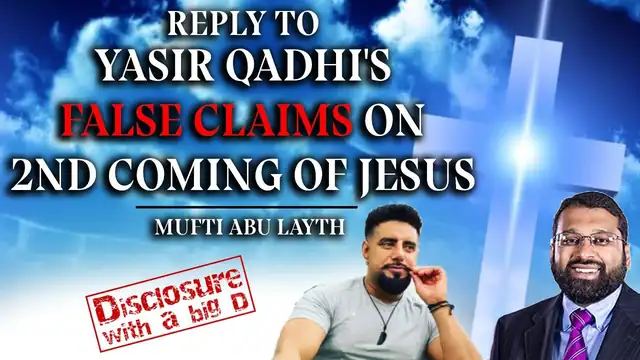 Play from 1:20:13
The video loads from YouTube only when you press play. Click a time in the transcript to seek.
Watch this part
Open on YouTube at 1:20:13The player starts at 1:20:13, the beginning of this part.
This segment1:20:13 to 1:25:27 · 5 min 14 sGeneral teaching
What this part covers
machinesummary, machine-writtenThe verse about Jesus speaking in the cradle and in maturity concerns those he addresses, children and grown men, and the first to read it as a return was al-Husayn ibn al-Fadl, who died in 282 AH and transmitted strange reports. 'Before his death' was recited by Ubayy and Ibn Abbas as 'before their death' and read by commentators as referring to Jesus, the Prophet, the truth or Allah.
In more detail
On the verse in Al Imran and al-Ma'idah that Jesus will speak to people in the cradle and in maturity, which Qadhi calls a clear indication of the return since Jesus must speak as a mature man, Mufti Abu Layth says many past scholars held that Jesus already reached maturity in this world, and that in his own reading the phrase concerns those addressed rather than Jesus: he addresses both the child in the crib and the grown man, which is mentioned because the Jewish high priests of the time disparaged children and found it blasphemous that Jesus addressed them as a boy, as in the Gospel of Luke. He says the books of tafsir show that the return reading came from none of the Prophet, the companions, the tabi'in or their successors, but first from al-Husayn ibn al-Fadl al-Bajali al-Naysaburi (d. 282 AH), who when asked whether the return is in the Quran pointed to this verse, and whom al-Hakim [?] says transmitted strange and sometimes fabricated reports; he cites al-Baghawi [?] and al-Tabarani [?] for the quotation. On the second verse, that the People of the Book will believe before his death, he notes that since Qadhi cites other recitations he should note that Ubayy and Ibn Abbas recited it as before their death, meaning the People of the Book, and that commentators including al-Tabari, al-Nasafi [?] and others said the pronoun could refer to Jesus, to the Prophet Muhammad, to the truth or to Allah, a plurality Qadhi does not highlight. He then introduces the verse Qadhi calls the strongest, that Jesus is a sign of the Hour.
- Some terms in this segment are uncertain
Position stated
Mufti Abu Layth holds that 'he will speak to people in the cradle and in maturity' refers to those Jesus addresses, children and grown men, not to a return, that the first to read it as a return was al-Husayn ibn al-Fadl al-Bajali (d. 282 AH), a transmitter of strange reports, and that 'before his death' was recited as 'before their death' and read by commentators as referring to Jesus, the Prophet, the truth or Allah.
“it's not jesus who's going to be speaking like that it's the people he will address he will address the child in the crib and he will address the old man or the mature man”
Category: teaching
Kind: general teachingTranscript
machine1:20:13 to 1:25:27 · click a time to seek · dotted terms open the glossary
these are biddah now here he brings the first verse of the quran which is in two places ali imran in 46 and suramar 110 that uh about jesus yo nasa film now note um he says this is clear indication that jesus is coming back yeah because how else is he going to speak to people
as a as a kahal as a as a mature man even though first of all many scholars in the past said that he already reached kahula in this dunya that said this verse of the quran it's not what i've highlighted is it's not jesus who's going to be speaking like that it's the people he will address he will address the child in the crib and he will address the old man or the mature man and why is this being mentioned because the jews at the time especially the high priests had this kind of disparaging
outlook towards children which they would never address children hence they found jesus addressing them when he was at the age of 10 i think in the gospel of luke to be almost blasphemous that how dare he addresses as not just addresses as in excuse me can i have that but as in anything religious but here it's mentioning so here and nasa film film is to do with nas and it's not to do with jesus that said now his interpretation that this is coming from jesus who was the first person to
ever say this we have it documented in the books of the seed was it the prophet no was it the companions no was it the tabe no the ataba no people after them know what about after them along comes a man called hussain ibn nafadal al-bajali and nisapuri who dies in 282 hijri he dies at over 170 270 years plus after the prophet this man was the first person to come up with this interpretation for this verse he was asked brings it
brings it other people bring it brings it that he was asked that have you er but they he was asked do you find the coming of jesus in the quran and he says yes this verse is also somebody that people said transmitted strange hadith al-haqim says not only did he transmit at times bizarre hadith at least some were fabricated
that is this person hussein ibrafada that is whose interpretation he is following here you can see there at the bottom i've got from bagawi antabrani that his quote so he brings a second verse now first of all since he's including other recitations he says this is clearly about jesus in the recitation of obeying since he's quoting of the recitations he
quotes ibn abbas says and so since he's quoting other recitations it says pablo multi him before their death as in the people of the book before their death okay they also go on to say most highlight that this could have yes they say it could have been talking about jesus they say he could have been talking about the prophet muhammad sallallahu alaihi they say it could have been talking about the truth and allah as you can see here that you know and many tafasir i just cited here that tabari nissafi al-asid mentions that it was the truth
and allah mashari and tafsir al-madhari and transmissions now he does say there's some difference on this but he doesn't highlight the plurality that several people were saying that now he mentions the strongest verse there is
that it is a sign for the hour do not be doubtful about it he says this verse is the strongest verse in the quran leaves no doubt right now okay well first of all why doesn't he highlight the he he does say one person disagreed he says hassan well for his information not just hassan sayed all of these people mentioned it was the quran that it's speaking about that the quran is a sign since revelation will end with it and that actually makes much more sense
if you think about it that the entire revelation will now end makes a lot more sense than rather saying jesus is a sign for the hour first of all doesn't even mean sign right so elm means knowledge of the hour the quran contains information it's revelatory detail about the hour now what he doesn't do is cite verses that go against the second coming of jesus he doesn't highlight that so as you can see here there are three
Paragraphs overlapping 1:20:13 to 1:25:27. Full text on the recording page.
Cite this segment
Stable id, transcript version and tier are part of the citation. Every change to a transcript is logged.Mufti Abu Layth Archive, segment 2021-03-14-S20, auto-transcribed, may contain errors. https://muftiabulayth.org/r/tr3nsx3ufy8/s/20/ (accessed 1 November 2026)
- APA 7
Mufti Abu Layth. (2021, March 14). Does 'he will speak to people in maturity' or 'before his death' prove that Jesus will return? [Video, segment 2021-03-14-S20, auto-transcribed, may contain errors]. Mufti Abu Layth Archive. Retrieved November 1, 2026, from https://muftiabulayth.org/r/tr3nsx3ufy8/s/20/
- Chicago author-date
Mufti Abu Layth. 2021. "Does 'he will speak to people in maturity' or 'before his death' prove that Jesus will return?" Video, segment 2021-03-14-S20, auto-transcribed, may contain errors. Mufti Abu Layth Archive. Recorded March 14, 2021. Accessed November 1, 2026. https://muftiabulayth.org/r/tr3nsx3ufy8/s/20/
- BibTeX
@misc{abulayth-2021-03-14-S20,
  author = {Mufti Abu Layth},
  title = {{Does 'he will speak to people in maturity' or 'before his death' prove that Jesus will return?}},
  year = {2021},
  month = {3},
  date = {2021-03-14},
  howpublished = {\url{https://muftiabulayth.org/r/tr3nsx3ufy8/s/20/}},
  url = {https://muftiabulayth.org/r/tr3nsx3ufy8/s/20/},
  organization = {Mufti Abu Layth Archive},
  urldate = {2026-11-01},
  note = {Segment 2021-03-14-S20, auto-transcribed, may contain errors}
}
Something wrong here?
Tell us what is wrong and it will be checked against the recording. Nothing changes until a person has reviewed it.
Sending a note needs JavaScript, which is off or unavailable in this browser. Nothing has been sent.
No name, email address or account is asked for or stored, and the inbox does not store your IP address. For rate limiting it keeps an unreadable fingerprint of your connection for 48 hours, and our database provider's own logs record connections as every website's do. Only your note, its kind, the page and the moment in the recording are kept, for review.