
Recordings › Reply to Abu Ibraheem (Salafi)- By Mufti Abu Layth al-Maliki · 2 Jan 2018 › Segment 3 of 7
Shaving the beard: Qadi Iyad's view and the demand for one hadith
hadeeth ahadith ahaadeeth hadis hadees ahaadith saheeh sahih hadith saheeh hadith sound hadith authentic tafsir tafseer exegesis tafasir tafaseer 'urf haraam forbidden fard farz faraid fard ayn fard kifayah fardh saheeh muslim imam muslim muslim ibn al-hajjaj quran quraan al-quran 'alim aalim ulama ulema ulamaa shaikh sheik shuyukh shaykhs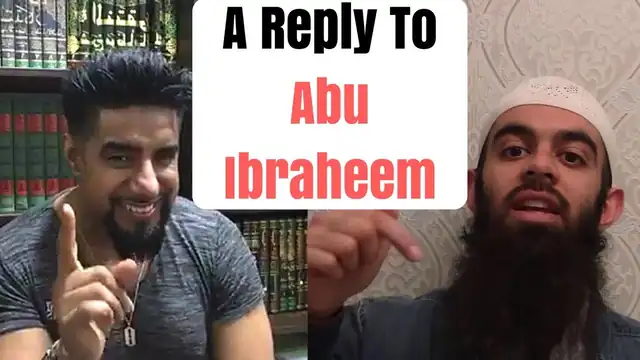 Play from 10:31
The video loads from YouTube only when you press play. Click a time in the transcript to seek.
Watch this part
Open on YouTube at 10:31The player starts at 10:31, the beginning of this part.
This segment10:31 to 14:24 · 3 min 53 sA view quoted in order to be discussed, not a position held
What this part covers
machinesummary, machine-writtenThe view that shaving the beard is not haram is presented as Qadi Iyad's, and Mufti Abu Layth challenges the critic to produce a hadith teaching how to keep a beard. He adds that truth is not decided by the number of scholars holding a view.
In more detail
After closing the previous point, Mufti Abu Layth turns to the critic's complaint that he justifies anything by quoting some scholar, illustrated by a clip in which, asked whether shaving the beard is haram, Mufti cited Qadi Iyad's commentary on Sahih Muslim that it is not, and said many of the Shafi'is said the same. He quotes the critic's reply that the Prophet said to grow the beard, and asks in return for one hadith in which the Prophet, in over twenty years of teaching, taught how to have a beard, saying a report of a Companion seeing the Prophet trim his beard could reflect Arab custom or the Prophet's personal preference. He points out that the critic himself answers by quoting how a shaykh [?] and Ibn Baz explained the matter, so that the critic is doing what he condemns, and that the critic's scholars are accepted while Mufti's are rejected. He then asks whether truth is a democracy, saying truth does not need numbers and one person can be right.
- May contain a view quoted in order to be discussed; no position is attributed until reviewed
- Some terms in this segment are uncertain
Position stated
This segment presents a view in order to discuss or respond to it. It is recorded as quoted, never as held, and no position is attributed from it.
Kind: a view quoted in order to be discussed, not a position heldTranscript
machine10:31 to 14:24 · click a time to seek · dotted terms open the glossary
This segment states a view in order to discuss it. It is recorded as a quoted view, not as a position held.
God is uncreated and you're a human and you are created so technically you are not the utmost so the caliphs kind of angle was that wait a minute no the Word of God which we have is also created and subject to interpretation by men and I am created and I am the authority of God the hand of God on earth so I reign supreme this is what the debate was about it was political he had nothing to do really with theological aspects and it doesn't mean anything because the must have which is a book the Koran which is a book everybody
knows that this book the must have is created you can't even understand what this debate is about that's why it is absurd ok moving on moving on right then he lowered what else does he say all right the beard the beard so this was one point point he brought up he says that look Multi appellate anything he wants to say he just brings up a quote of some scholar and he says that this color has said this so he brings my quote sorry my clip where I'm asked about the beard and I said look ah
the ER said where I'm asked about shaving the beard is it Haram and other yard said that that is not Haram in his commentary on side Muslim and I quote how many of the chef's area have said things like that as well he then says ho look huh the Prophet said huh the Prophet said grow your beard well here comes the second surprise you bring me just one hadith where the Prophet said how to have a beard just
one just one oh no oh no solamente just one my mom's asking you for one hadith the Prophet lived as a prophet for we're talking 22 to 23 years of his life teaching and preaching surely the beard is something that must have been so important allegedly bring me one hadith where the Prophet said how to have a beard not abnormal saying that trimming his beard saying I saw the
Prophet cut his beard here because many of the Arabs used to cut their beard here not just the Prophet that could have been done as a cultural aspect it could have been done as a as a personal preference the prophet's personal preference may have been to trim the beard here we did the Prophet once in one hadith teach people how to grow a beard you mean he never did that oh but I thought it was an obligate oh yeah it is an obligation but how do I do I mean do it how Schieffelin has explained
in the book how Sheikh bin baz has explained oh but but all you just quote ting scholars to me who you said I should be quoting scholars to you he not enmity you just are you doing the same thing back to me [Laughter] hamari believe hum come yellow that one so right so you're just quoting scholars back to me oh so your scholars are okay
but my skull is are wrong i cha cha cha [Laughter] this now can you see the absurdity in this Puritan East way of thinking now they say why do you why do you just quote one scholar from here or there tell me is truth a democracy do I need a numbers game for it to be true no truth can be even if one person said so why why why can that one person be
Paragraphs overlapping 10:31 to 14:24. Full text on the recording page.
Cite this segment
Stable id, transcript version and tier are part of the citation. Every change to a transcript is logged.Mufti Abu Layth Archive, segment 2018-01-02-S03, auto-transcribed, may contain errors. https://muftiabulayth.org/r/r7s1dcclcwu/s/3/ (accessed 1 November 2026)
- APA 7
Mufti Abu Layth. (2018, January 2). Shaving the beard: Qadi Iyad's view and the demand for one hadith [Video, segment 2018-01-02-S03, auto-transcribed, may contain errors]. Mufti Abu Layth Archive. Retrieved November 1, 2026, from https://muftiabulayth.org/r/r7s1dcclcwu/s/3/
- Chicago author-date
Mufti Abu Layth. 2018. "Shaving the beard: Qadi Iyad's view and the demand for one hadith." Video, segment 2018-01-02-S03, auto-transcribed, may contain errors. Mufti Abu Layth Archive. Recorded January 2, 2018. Accessed November 1, 2026. https://muftiabulayth.org/r/r7s1dcclcwu/s/3/
- BibTeX
@misc{abulayth-2018-01-02-S03,
  author = {Mufti Abu Layth},
  title = {{Shaving the beard: Qadi Iyad's view and the demand for one hadith}},
  year = {2018},
  month = {1},
  date = {2018-01-02},
  howpublished = {\url{https://muftiabulayth.org/r/r7s1dcclcwu/s/3/}},
  url = {https://muftiabulayth.org/r/r7s1dcclcwu/s/3/},
  organization = {Mufti Abu Layth Archive},
  urldate = {2026-11-01},
  note = {Segment 2018-01-02-S03, auto-transcribed, may contain errors}
}
Something wrong here?
Tell us what is wrong and it will be checked against the recording. Nothing changes until a person has reviewed it.
Sending a note needs JavaScript, which is off or unavailable in this browser. Nothing has been sent.
No name, email address or account is asked for or stored, and the inbox does not store your IP address. For rate limiting it keeps an unreadable fingerprint of your connection for 48 hours, and our database provider's own logs record connections as every website's do. Only your note, its kind, the page and the moment in the recording are kept, for review.