
Recordings › My Thoughts on Mohammed Hijab & His Approach | Mufti Abu Layth · 12 Dec 2019 › Segment 2 of 4
Does the Quran forbid Muslims from being friends with non-Muslims who challenge Islam?
muftis koran quraan al-quran ayah aya ayat ayaat aayah aayat salafis salafism wahhabi wahabi wahhabism hijaab hejab hijabiThe verse on not loving those who oppose Allah: context, not a ban on friendship
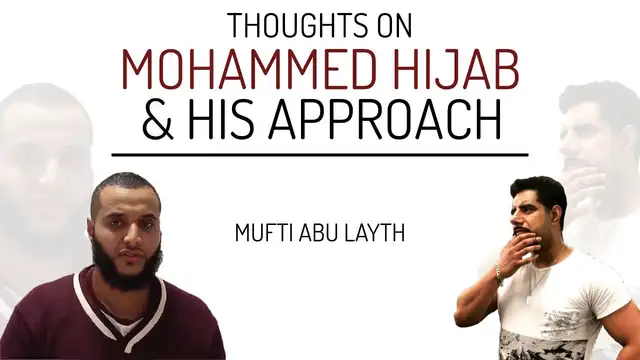 Play from 2:40
The video loads from YouTube only when you press play. Click a time in the transcript to seek.
Watch this part
Open on YouTube at 2:40The player starts at 2:40, the beginning of this part.
This segment2:40 to 6:33 · 3 min 53 sGeneral teaching
What this part covers
machinesummary, machine-writtenThe verse about not loving those who oppose Allah was revealed when tribes were confederating to attack the Muslims and concerns loyalty to them, not friendship with non-Muslims. Permission to marry Christians and Jews shows love and friendship with non-Muslims are allowed.
In more detail
Mufti Abu Layth takes up the verse Hijab relied on, that those who believe in Allah and His Messenger will not be found loving those who oppose Him. He explains that the verb is the third, reciprocal form of the root of love, expressing an overwhelming mutual love, and reports Hijab's reading that one cannot be friends with anyone who challenges Islam in any way, such as an atheist questioning its validity. He says the verse is definitely not saying that: everyone who is not a Muslim challenges Islam at some level, just as his own lifestyle denies Hinduism or Sikhism without open hostility, and non-Muslims in the Prophet's lifetime who were not at war were not necessarily happy with Islam either. He says the verse was revealed when the non-Muslims were forming a confederation of tribes to attack the Muslims while some Muslims still had ties to those tribes, so Allah was saying that no true believer would hold that tribe's interests above the Muslims'. He adds that since Muslims may marry Christians and Jews there must be love or at least friendship with them, so saying one must only be harsh against non-Muslims is utterly unacceptable.
- Some terms in this segment are uncertain
Position stated
Mufti Abu Layth says the verse that believers will not be found loving those who oppose Allah and His Messenger was revealed about Muslims who kept ties with tribes confederating to attack the Muslims, and that it does not forbid friendship with non-Muslims, as the permission to marry Christians and Jews shows.
“this verse was revealed at a time when Muslims were being attacked and they and the non-muslims were forming allies and a confederation of different tribes to attack the Muslims”
Category: teaching
Kind: general teachingTranscript
machine2:40 to 6:33 · click a time to seek · dotted terms open the glossary
and unacceptable that's not true that Allah teaches us that for example we can met because he said he uses the verse of the Quran that you will never find those who believe in a line is messenger you were the Lavina Cafaro that they now he said that they are friends now you word is from the verb the third form of Allah which is a reciprocal a kind of way you have another person involved and it's to do from the word would about love that you are kind of expressing this overwhelming
love for them and but he said in his interview that Allah saying you can't be friends with them unless they don't those who challenge Islam in any way so if an atheist is challenging the validity of Islam then you cannot be friends with him that verse definitely is not saying anything like that okay that is not at all because in all honesty all people to some extent who don't believe in Islam are challenging Islam to some extent they may not be so vocal but at their own level obviously if they believed in Islam they would be
Muslim I mean this is given the pretext that they've heard about Islam they would say yeah that's you know some it's like I might not be openly challenging let's say you know I may not be preoccupied with challenging Hinduism or Sikhism or but ultimately my very lifestyle choice denies it's like I don't agree with it and I would challenge it at some level so what I'm trying to say is if you're not part of something you're ultimately always challenging it but
it's maybe you're on a spectrum so it's not true that Muslims sorry non-muslims in the past in the prophet's lifetime who weren't declaring war against muslims were somehow happy with islam as well but that is not a necessary follow so it doesn't you know that doesn't follow necessarily so we've got they would have been very many people that would have just been like okay you know we're not we don't have animosity against Islam but we think they may have thought it's wrong they may have thought it's dumb they may have thought it's stupid but they may not but
they may not have had open animosity against it so so coming back to this point this verse of the Quran where it says that expressing a love for those people first of all this verse was revealed at a time when Muslims were being attacked and they and the non-muslims were forming allies and a confederation of different tribes to attack the Muslims and you had some people who still had ties with some of those different tribes so Allah was saying that you know you won't find
somebody who's in his heart a believer and yet he's got that tribe over the Muslims their interests best at heart so this is what the rest of the Quran was speaking about it's not speaking about oh you can't be friends with that's stupid because if you can marry Christians and Jews then of course there's gonna be love you know there's got to be some kind of love all right so the thing is or at the very least there's gonna be a friendship a kind of friendship so to say that well you know
no you must only be harsh against non-muslims and that is utterly unacceptable so I hope that this was maybe a kind of like a blunder that you know maybe Mohammed hijab didn't think it through and he just said he'd already used say something else and he said that but otherwise I do see in him some maturity of thought and I'm I'm hopeful that maybe in years to come maybe not right now because right now he's still like his kind of the field he's arguing from is a very kind of Salafi esque standpoint and seller fees in all
Paragraphs overlapping 2:40 to 6:33. Full text on the recording page.
Cite this segment
Stable id, transcript version and tier are part of the citation. Every change to a transcript is logged.Mufti Abu Layth Archive, segment 2019-12-12-S02, auto-transcribed, may contain errors. https://muftiabulayth.org/r/oxtsv9fn3ze/s/2/ (accessed 1 November 2026)
- APA 7
Mufti Abu Layth. (2019, December 12). Does the Quran forbid Muslims from being friends with non-Muslims who challenge Islam? [Video, segment 2019-12-12-S02, auto-transcribed, may contain errors]. Mufti Abu Layth Archive. Retrieved November 1, 2026, from https://muftiabulayth.org/r/oxtsv9fn3ze/s/2/
- Chicago author-date
Mufti Abu Layth. 2019. "Does the Quran forbid Muslims from being friends with non-Muslims who challenge Islam?" Video, segment 2019-12-12-S02, auto-transcribed, may contain errors. Mufti Abu Layth Archive. Recorded December 12, 2019. Accessed November 1, 2026. https://muftiabulayth.org/r/oxtsv9fn3ze/s/2/
- BibTeX
@misc{abulayth-2019-12-12-S02,
  author = {Mufti Abu Layth},
  title = {{Does the Quran forbid Muslims from being friends with non-Muslims who challenge Islam?}},
  year = {2019},
  month = {12},
  date = {2019-12-12},
  howpublished = {\url{https://muftiabulayth.org/r/oxtsv9fn3ze/s/2/}},
  url = {https://muftiabulayth.org/r/oxtsv9fn3ze/s/2/},
  organization = {Mufti Abu Layth Archive},
  urldate = {2026-11-01},
  note = {Segment 2019-12-12-S02, auto-transcribed, may contain errors}
}
Something wrong here?
Tell us what is wrong and it will be checked against the recording. Nothing changes until a person has reviewed it.
Sending a note needs JavaScript, which is off or unavailable in this browser. Nothing has been sent.
No name, email address or account is asked for or stored, and the inbox does not store your IP address. For rate limiting it keeps an unreadable fingerprint of your connection for 48 hours, and our database provider's own logs record connections as every website's do. Only your note, its kind, the page and the moment in the recording are kept, for review.