
Recordings › Can Hudood Punishments change? Mufti Abu Layth & Shaykh Akram Nadwi · 14 Sep 2017 › Segment 1 of 1
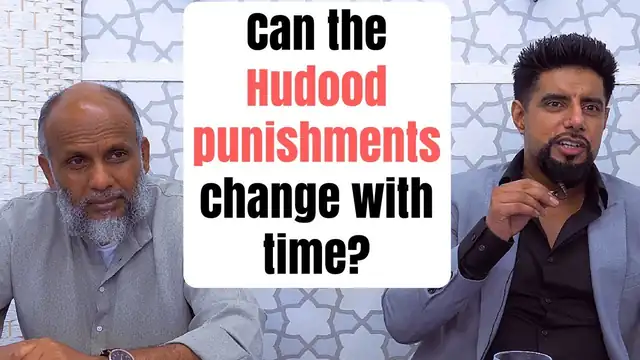
Can Islamic punishments like stoning and cutting off hands change with time?
haj pilgrimage hadj hadeeth ahadith ahaadeeth hadis hadees ahaadith tafsir tafseer exegesis tafasir tafaseer imam bukhari sahih al-bukhari sahih bukhari saheeh al-bukhari saheeh bukhari imam al-bukhari magrib salat al-maghrib maghrib prayer sunset prayer imaam imams prayer leader shari'ah shariat sharee'ah maaliki malikite malikiyyah shafi shafei shafiite shafi'i school hambali hanbalite muftis haraam forbidden ulema ulamaa scholars tauba taubah repentance rahmah rahma rahmatCan the hudud change with time? Substituting fixed punishments today
 Play from 0:00
The video loads from YouTube only when you press play. Click a time in the transcript to seek.
Watch the answer
Open on YouTube at 0:00The player starts at 0:00, where the answer begins.
This segment0:00 to 5:03 · 5 min 03 sGeneral teaching
The answer in brief
machinesummary, machine-writtenYes, in his understanding: the Sharia itself asks for punishments fitting the age, so today they would be replaced by penalties such as prison, following Maliki and other precedents.
In more detail
Mufti Abu Layth says Islam has come to be characterised by a view of the Sharia as cutting off hands and stoning, which makes many people hate it. He says Islam is for all times and places and that the Sharia itself demands to reflect its era, linking this to trajectory hermeneutics and to hadith in which the Prophet refrains from a change because people were new to Islam. He cites al-Burzuli [?] of the Maliki school, whose view that the hudud reflect the age was adopted in parts of the Maghrib with financial penalties, a debate on it before a Tunisian ruler, and Sultan Suleiman al-Qanuni substituting financial penalties as well. He says that in his understanding the hudud today would, by demand of the Sharia, be substituted with penalties relevant to the age such as custodial sentences, certainly not stoning or cutting off the hand, and that this is not an attempt to appease the West. He adds Ibn Hajar's comment in his commentary on al-Bukhari on the man forgiven after praying, the view that the hudud drop with tawbah attributed to the Hanbali school and the old view of al-Shafi'i, and Abdullah bin Bayyah saying the same, ending that the Prophet, a mercy to the worlds, is today wrongly seen as a barbarian.
Question as read aloud · questioner not identifiedCan the hudud punishments, such as stoning to death and cutting off the hands, change with time?
- The question was reconstructed from Mufti Abu Layth's restatement; the questioner's own words are not in the recording
- Some terms in this segment are uncertain
Position stated
Mufti Abu Layth says that in his understanding the hudud would today be substituted, by demand of the Sharia, with penalties relevant to the age such as custodial sentences.
“in my understanding in this day and age the ha dude would be substituted by demand of the sharia so they would not be things like in my understanding definitely not things like stoning”
Category: ruling
Kind: general teachingTranscript
machine0:00 to 5:03 · click a time to seek · dotted terms open the glossary
this is one of the things that Islam unfortunately today has become characterized by and many people non-muslims especially whenever they speak of Islam they speak of Sherea Sherea Sherea right and so Sharia for them is cutting people's hands off and stoning people to death right so this has now become characteristic of Islam and because of this people hate Islam many people do they hate Islam and see as an affront to freedoms so okay now just backtracking to this question in my the way Islam has taught us the way I
understand Islam has come for each day for all ears for all times and places and it is the Sharia itself that demands to reflect the time of its era so this is not something I'm saying this is my understand that the Sharia wants this so today that Islam would have and I've spoken of this before trajectory ethics that the ethics or trajectory hermeneutics would change as the ethics of the people change and you see the Prophet sometimes saying things like this in the hadith that oh Lola and now Maki hadith or Adam bill Islam
if your people weren't new Muslims yet then I would have done this but I won't or I won't change the caliber because people will do this or people will say this so you see this in the hadith as well now several of the ulama namely people like a blossom albertalli especially from the Maliki method in the 7th century 700s and so on around that era and and people who come after him as well had written that according to the mikaze of the Sharia the Haddad would reflect the day and age so a blossom albertalli wrote on this and he actually taught it and this became the view in several parts of the Maghreb during his
time that they substituted the hood for financial penalties in their time for what they called a la Rama Mallya and they said this is what the Sharia wants and there was this famous debate in front of a Tunisian King as well and the Tunisian King first of all adopted Brazil view and there's another male Kiba Shema who debates him doesn't accept his view and and then that the king says okay I'm gonna go to ignoramus view now and the public go mad hey no we're not going back to her dude so then he says okay I'll just go back to Buddha leaves via the famous story but my mom literally was not speaking about if there was no Sultan other some other Maliki said if
there was no salt on he was speaking about the day and age has changed and then you see people like the ottoman famous if you want to call him calif or king of the time as well solomon alpar noona who around the similar kind of time or just shortly after does the same kind of thing he substitutes the ha dude with haram ismailia with financial penalties in my understanding in this day and age the ha dude would be substituted by demand of the sharia so they would not be things like in my understanding definitely not things like stoning but they wouldn't be things like cutting off the hand and stuff like this they would be whatever is relative and relevant of
for the age so for example custodial sentences or whatever is suitable or commensurate for the crime that's my understanding there's a huge precedents for this with in fact this is not an attempt to appease the West these Oh Lamar came centuries before the West had ever risen to significance and what's interesting is even a Hajer in Baja in his commentary on soil Bukhari speaks and shows about the the hadith where somebody comes the Prophet and says I've done something wrong and the prophecies have you prayed and that's okay it's forgiving in that hadith it doesn't mention what it was but even Hajj or
says in another rewai mentions it was Xena and he says this is a la da da here every wire in Delhi nebula the according to the head of the rewired or the other or rewired in the Hanna Beulah and the humbly method the October the the Jamil who dude tosco to be tawba so all of the who dude dropped with Toba and that was the whole Kadima Imam Shafi'i as well and this is why this kind of reasoning you see right through to people like share here here we'll Leticia entreaty and many of the later recent people and this my line of thinking is in line with that people
today like chef Abdullah bin Bayer also say exactly the same thing and so that's my understanding that HA dude would not be there and it's unfortunate that Islam has become characterized by that and that the who the prophet sallallahu alayhi wa sallam who was a rahmatan lil al-amin a paragon of mercies today seen as a barbarian and this is unfortunately upheld by certain people in the name of Islam that's my understanding along I'm sure if you could contribute
Paragraphs overlapping 0:00 to 5:03. Full text on the recording page.
Cite this segment
Stable id, transcript version and tier are part of the citation. Every change to a transcript is logged.Mufti Abu Layth Archive, segment 2017-09-14-S01, auto-transcribed, may contain errors. https://muftiabulayth.org/r/lyzck5dygjk/s/1/ (accessed 1 November 2026)
- APA 7
Mufti Abu Layth. (2017, September 14). Can Islamic punishments like stoning and cutting off hands change with time? [Video, segment 2017-09-14-S01, auto-transcribed, may contain errors]. Mufti Abu Layth Archive. Retrieved November 1, 2026, from https://muftiabulayth.org/r/lyzck5dygjk/s/1/
- Chicago author-date
Mufti Abu Layth. 2017. "Can Islamic punishments like stoning and cutting off hands change with time?" Video, segment 2017-09-14-S01, auto-transcribed, may contain errors. Mufti Abu Layth Archive. Recorded September 14, 2017. Accessed November 1, 2026. https://muftiabulayth.org/r/lyzck5dygjk/s/1/
- BibTeX
@misc{abulayth-2017-09-14-S01,
  author = {Mufti Abu Layth},
  title = {{Can Islamic punishments like stoning and cutting off hands change with time?}},
  year = {2017},
  month = {9},
  date = {2017-09-14},
  howpublished = {\url{https://muftiabulayth.org/r/lyzck5dygjk/s/1/}},
  url = {https://muftiabulayth.org/r/lyzck5dygjk/s/1/},
  organization = {Mufti Abu Layth Archive},
  urldate = {2026-11-01},
  note = {Segment 2017-09-14-S01, auto-transcribed, may contain errors}
}
Something wrong here?
Tell us what is wrong and it will be checked against the recording. Nothing changes until a person has reviewed it.
Sending a note needs JavaScript, which is off or unavailable in this browser. Nothing has been sent.
No name, email address or account is asked for or stored, and the inbox does not store your IP address. For rate limiting it keeps an unreadable fingerprint of your connection for 48 hours, and our database provider's own logs record connections as every website's do. Only your note, its kind, the page and the moment in the recording are kept, for review.