
Recordings › Monday Nights with Mufti #200| Q&A Unscripted & Unrestricted! 😉 | Mufti Abu Layth · 2 Feb 2021 › Segment 12 of 27
Damascus, 1998: the two people who inspired Mufti Abu Layth to memorise the Quran
hadeeth ahadith ahaadeeth hadis hadees ahaadith muftis haraam forbidden riba ribaa sood usury jahannam jahanam jahannum koran quraan al-quran wahy wahee revelation aalim scholar ummah umma ummat alhamdulilah al-hamdu lillah alhumdulillah alhamdulillaah hamdulillah ma sha allah masha'allah masha allah mashaa allah Most recent answer on Memorisation and recitation7 earlier answers on this topic, oldest 2014 ↓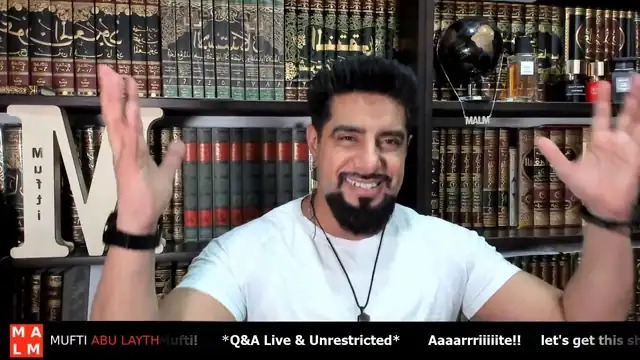 Play from 1:07:17
The video loads from YouTube only when you press play. Click a time in the transcript to seek.
Watch this part
Open on YouTube at 1:07:17The player starts at 1:07:17, the beginning of this part.
This segment1:07:17 to 1:17:17 · 10 min
What this part covers
machinesummary, machine-writtenMufti Abu Layth credits a scholar's Quran ijazah and a convert classmate who memorised on the bus with starting his own memorisation in Damascus.
In more detail
Mufti Abu Layth recalls arriving in Damascus at 18 from a sheltered community in Birmingham and enrolling at Damascus University within months. There Abdur Rahman Mangera spoke proudly of the subcontinent's scholarly heritage and showed him his ijazah in the Quran, planting the wish to memorise it. Mufti then tells of an American convert in his Arabic class, laid-back and stylish, who memorised half a page a day on the bus to university; Mufti says he felt inspired and embarrassed, and from that day began memorising until he completed the Quran. He says Mangera remembered the certificate but not him when they met in the Netherlands, and asks anyone who was in Damascus in the late 1990s to help him reconnect with the convert.
Position stated
No position summary has been recorded for this segment.
Transcript
machine1:07:17 to 1:17:17 · click a time to seek · dotted terms open the glossary
So you know and I'm grateful for that. I'm grateful he he obviously can't remember it. I spoke to him about it and he was like, uh, I don't remember at all. You know, that's fascinating when you think about it. Yeah, [snorts] I was very early in my journey. So, very early. I had um just turned 18. I you know, flown off to Damascus, new country.
And I wasn't, you know, growing up, I think [snorts] we were, relatively speaking, we like that little community or whatever within I mean, we were within Birmingham, but we were in an area called Hansworth and just maybe it's just people or generally, but also people I was around were very sheltered. I don't think we had a um kind of um you know that I mean that's a different discussion in and of itself but so flying off to a new country doing all of these things were almost unbelievable but they they
happened alhamdulillah and it was a big step but when I was there within maybe four or five months of me being there I had signed up to actually within about four months I signed up to Damascus University and that's where I met him uh Dr. or I think he's a doctor Mui Ab Manger he's uh let me just see Abdul Rahman Manger I thought for a moment I thought you say Abdah Abdah Abdul Rahman so I met him and it's interesting that he had turned up to Damascus University and the
whole you know the whole ga and and he was I don't know what whether he used to study there or not but he wasn't in in my class but I used to see him sometimes so I started speaking to him and and uh I remember he he told me that he had graduated from this alim course. So I said okay what you know tell me about that. So he started telling me oh and he was really proud of the Indian uh ilmi heritage you know the what the ilmi what the subcontinent this have produced and they obviously some things that it's unquestionable there is you know credit
where credit is due so he goes off really you know saying you don't understand we study bkari we study abu cover to cover we study all these things and he was one of the first people to actually kind of inspire me a bit like that like I want to do that as well. I was already on this path to learn but I wasn't um but one thing he definitely inspired me to do and that I'm grateful.
So this he kind of did this this Dra hadith thing but not fully. That was somebody else I met after him who kind of really he had just come back from Pakistan and he he told me about all these things and that really did it for me. But at this stage there he raised interest but he had this one day he was carrying this is Muy Manger he was carrying this large certificate he's kind of walking around in he had it rolled up and he was carrying it in Damascus University so so I go up to him just shake hands and chat and uh and I said what's that and he and he he opens it it's like this
you know this massive um um eaz he has in the Quran. So he says, "This is my jazza in the Quran." So I said, "What's that?" And he and he says, "Well, you know, this goes back to the prophet and I've read it to this person. I've read the whole Quran and then he's granted me this." And I said, "Well, how how do you how does somebody get that?" And he said, "Well, you know, you should memorize the Quran." And you know a person like I suppose he wasn't saying it to me you should memorize but he was just saying you know a person should memorize and then if they've memorized they could get
an e jazza. So that really made me think wow like I would really like that. I thought that that's just I you know it just I suppose Allah kind of puts it in your heart and but he was that person that kind of first showed me that and mentioned that and even though at that stage I didn't think I could do it I just thought wow I would love to be able to receive that and so it kind of created this mam this this presence of it in my in my mind this value with it.
Now then there was this in my class in my Damascus Arabic class there was this American black guy really kind of cool you know I wish I could really connect with some of these people now I the I suppose the shame part is I don't even remember that guy's name now but because he wasn't we weren't always together in the same class and stuff but he was the he was from America I remember that and he was Um, and he very had this kind of swag about him.
He was a convert and so this is the year 98. Um, and he was and he was doing hif now. I totally didn't expect it. You know, me sheltered stereotypical, you know, back then. And and here's a convert and I last thing you expect is convert is memorizing the Quran. And so so I'm chatting to him.
We used to really get on and chat and but he seemed really for me at that time he seemed really liberal, laidback and I and I used to think wow that like how come he doesn't get disturbed by all these like music and all these things because I had been taught haram haram haram haram haram going to go to hell hell hell hell. So this guy one day he's uh that I'm with who's in my class.
He had this small little Quran just a Jew or something and he was reading it. So I I said to him, "Ah, mashallah, you reading the Quran." And he said, "No, I'm just going over what my lesson is today." So I said, "What's your lesson?" So he said, "Like what it is is every day I memorize a certain portion of the Quran." So this smacked me in the face. this this metaphorically like I'm telling this was such a wakeup call for me.
It was like a [laughter] I was I I was like what? And he said like I'd memorize um a certain portion of the Quran every day. So I here's this guy you know and I'm being judgmental here. This is back then, 1998. Um, cuz I was in the full th and all of that kind of stuff and wearing jeans, wearing a t-shirt, cool guy, you know, got that swag American, you know, like that kind of almost like that Will Smith kind of effect, that kind of person.
And and and he's telling me, "Oh, by the way, I I memorize a portion of the Quran every day." I said, "Well, how how where do you memorize it?" And he and he said anyway he said like I'll he said he said like for example on the way to uni he said I will just when I catch the bus he says I've got half an hour I just go over it then I go over it again during the day and I said how much do you memorize?
So he said like uh so he kind of opens the the musaf and he says look I uh you know like I'll do half a page and I just do about half a page a day. So I have to say wahi I felt on one hand so inspired and on the other hand I felt so embarrassed [laughter and gasps] cuz I thought you know why am I why was you know this is so embarrassing for me.
I thought like in my mind cuz I kind of felt that look here is a person who's embraced Islam. Yeah, he has enough motivation to learn the Quran and what about me? I've come here to study Islam and I'm not memorizing the Quran and I thought and this guy can do it on the way to uni in a bus.
So from that day I began memorizing and alhamdulillah I then memorized the Quran. But I uh the reason I mention this story is because uh those two people for memorizing the Quran I am you know indebted to them I guess for that. So I actually did tell Mimi Manger this when we met in Netherlands. I told him but he he he couldn't remember it.
He was like he said I I remember going to uni. I remember having that certificate. You're right. I remember I used to carry it with me rolled. He could remember all the details, just couldn't remember me. I'm like, "Ah, don't worry about it, man. Don't worry about it." So, and this other brother, I don't I wonder, honestly, I don't even know his name, which is embarrassing now. But, uh, yeah, I would love to reconnect.
I mean, I wonder if people know people who were in Damascus in the late 90s. If so, put us in touch. Cool, guys. Let's uh move on to some of your questions. There's another super chat coming through. All right, Dervish, you're doing it, man. You're doing it. Much love. Much love.
Right. So, have you heard of Paul Williams? Who's Paul Williams? Paul Williams sounds a bit familiar. What's is that? Uh, [gasps and snorts] is that a mus? Right. I'm probably mixing him up. What's your opinion on Imm Shibi?
Paragraphs overlapping 1:07:17 to 1:17:17. Full text on the recording page.
Cite this segment
Stable id, transcript version and tier are part of the citation. Every change to a transcript is logged.Mufti Abu Layth Archive, segment 2021-02-02b-S12, auto-transcribed, may contain errors. https://muftiabulayth.org/r/ijwbevcc6o8/s/12/ (accessed 1 November 2026)
- APA 7
Mufti Abu Layth. (2021, February 2). Damascus, 1998: the two people who inspired Mufti Abu Layth to memorise the Quran [Video, segment 2021-02-02b-S12, auto-transcribed, may contain errors]. Mufti Abu Layth Archive. Retrieved November 1, 2026, from https://muftiabulayth.org/r/ijwbevcc6o8/s/12/
- Chicago author-date
Mufti Abu Layth. 2021. "Damascus, 1998: the two people who inspired Mufti Abu Layth to memorise the Quran." Video, segment 2021-02-02b-S12, auto-transcribed, may contain errors. Mufti Abu Layth Archive. Recorded February 2, 2021. Accessed November 1, 2026. https://muftiabulayth.org/r/ijwbevcc6o8/s/12/
- BibTeX
@misc{abulayth-2021-02-02b-S12,
  author = {Mufti Abu Layth},
  title = {{Damascus, 1998: the two people who inspired Mufti Abu Layth to memorise the Quran}},
  year = {2021},
  month = {2},
  date = {2021-02-02},
  howpublished = {\url{https://muftiabulayth.org/r/ijwbevcc6o8/s/12/}},
  url = {https://muftiabulayth.org/r/ijwbevcc6o8/s/12/},
  organization = {Mufti Abu Layth Archive},
  urldate = {2026-11-01},
  note = {Segment 2021-02-02b-S12, auto-transcribed, may contain errors}
}
Something wrong here?
Tell us what is wrong and it will be checked against the recording. Nothing changes until a person has reviewed it.
Sending a note needs JavaScript, which is off or unavailable in this browser. Nothing has been sent.
No name, email address or account is asked for or stored, and the inbox does not store your IP address. For rate limiting it keeps an unreadable fingerprint of your connection for 48 hours, and our database provider's own logs record connections as every website's do. Only your note, its kind, the page and the moment in the recording are kept, for review.