
Recordings › Karbala & it's precursors | Mufti Abu Layth · 16 Oct 2020 › Segment 3 of 18
Where did the rivalry between Banu Umayya and Banu Hashim come from?
ka'bah ka'ba kaabah muftis iman imaan eemaan eeman makka mekka ulama ulema ulamaaThe roots of the rivalry: Banu Umayya and Banu Hashim, and a minor Makkah
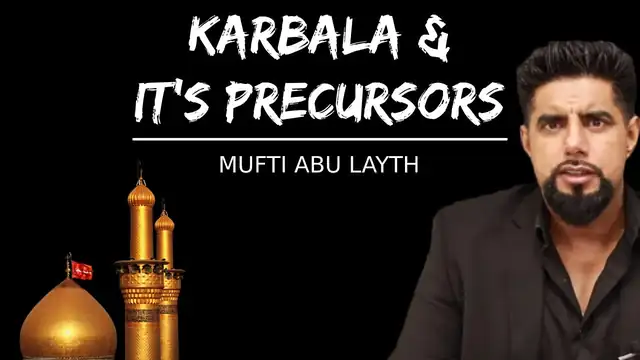 Play from 6:25
The video loads from YouTube only when you press play. Click a time in the transcript to seek.
Watch this part
Open on YouTube at 6:25The player starts at 6:25, the beginning of this part.
This segment6:25 to 10:40 · 4 min 15 sGeneral teaching
What this part covers
machinesummary, machine-writtenThe rivalry behind Karbala began before Islam between Banu Umayya and Banu Hashim; Mufti Abu Layth holds that Makkah and Quraysh mattered far less in pre-Islamic Arabia than later Muslims assumed.
In more detail
Mufti Abu Layth says the roots of Karbala lie before Islam, in a rivalry between two related clans of Quraysh, Banu Umayya and Banu Hashim, which at that stage was benign, a contest over prestige such as feeding and watering the pilgrims. He says he does not buy the popular narrative that Quraysh were highly regarded in Arabia, and that in his understanding Makkah was an almost irrelevant town, on no trade route or map, whose importance later Muslims projected back because the majesty of Islam eclipsed pre-Islamic history. He says that at the conquest of Makkah Banu Umayya were the town's powerhouse, and that Abu Sufyan, Muawiya and others embraced Islam. Because the Prophet was of Quraysh, he says, Quraysh gained an unmatched standing, so the clans set aside their quarrels and stood together as Quraysh.
Position stated
Mufti Abu Layth says that in his understanding Makkah was an almost irrelevant town in pre-Islamic Arabia, not as later Muslims thought it was.
“and neither Mecca, in my understanding, was a very uh almost irrelevant town in Arabia. It wasn't how later Muslims thought it was.”
Category: historical claim
Kind: general teachingTranscript
machine6:25 to 10:40 · click a time to seek · dotted terms open the glossary
Uh you've got another governor uh who he has set called uh Ubayd in Kufa, who's dispatched this army. What is What is all of this about? So, we have to pause this and go back. People, there has been some nastiness in in Muslim politics, okay? But that's that's the norm in old politics.
This thing about Rajniti, about Siyasa, is it it's problematic massively. And the truth is that really, the roots of Karbala are way before Islam. They start with a kind of rivalry that begins with two clans of Quraysh.
You've got the the kind of Bani Umayya and the Bani Hashim, who are ultimately, as they go up, they're actually brothers at some point. And they kind of break off, and you've got, you know, and they become these kind of like clans. They're all related, they're all part of Quraysh. But the rivalry at that stage is kind of um benign. As in, it's not like they're not trying to kill each other.
But they are prepared to you know, put each other down, and who is more superior, and who is more um who gets to who is more prestigious when it comes to the Kaaba, who does this. So, Bani Hashim were in charge of feeding the pilgrims, giving them water, doing things like this. There is, by the way, I don't fully buy the um you know, the popular narrative that Quraysh were really popular in Arabia.
I don't believe they were. I don't believe they were that popular at all. Um and neither Mecca, in my understanding, was a very uh almost irrelevant town in Arabia. It wasn't how later Muslims thought it was. Because what happened is the the magnificence of Islam, the majesty of Islam, kind of eclipses pre-Islamic history.
So, people assume because Mecca is now significant, they assume Mecca was significant, and then they kind of amplify all these stories. It wasn't in it was it's not on any of the trade routes, it's not even on any of the maps. It's not uh there was no caravan that used to come to Mecca. There but the people of Mecca would meet the caravan at a certain point, at a certain kind of junction in its route.
So, it it I I'm not saying it was unknown, but it wasn't significant and important. Just to make that point there, because I disagree later on I mean, there there'll be a significant point to do with Quraysh, and I disagree with some of the Muslim interpretation. Okay, so you've got that. Now, fast forward. You've got Islam. When Islam comes, and the Prophet sallallahu alayhi wasallam returns to Fath of Mecca to liberate Mecca, Bani Umayya are really the the kind of like powerhouses of are the powerhouse
of Mecca. Now, Abu Sufyan does kind of he sees, and he does give in to Islam, as do other people, as does Muawiyah and all these other people, they become Muslim, radiyallahu anhum. Now, in many ways, it is true that look, they did see Why did they all of a sudden support uh the whole thing of One is embracing the faith, but one is really going out and supporting the Prophet, and supporting and they they shift the focus from Bani Umayya to Quraysh.
And that was because the Prophet was such an incredibly powerful figure as you can as which is understandable. And he brought Islam. Now because he is Qurayshi, he is of Quraysh and all of them are Quraysh, this gave Quraysh an unquash like an unfathomable kind of ranking.
All of a sudden like automatically they got a boost. So it was better for them to kind of just these little kind of quibbles that they've got just to quash them and to just go with being Qurayshi. We are just Quraysh is enough as opposed to these little infightings. So that's what happens.
Now after the prophet passes, this is where the the the kind of the turbulence begins. So initially with in the time of Abu Bakr who is to be the leader? Now this is something I don't want to go into in too much detail. I've spoken of it previously, but I you know some Muslim scholars I've heard for example I've heard many people speak.
Paragraphs overlapping 6:25 to 10:40. Full text on the recording page.
Cite this segment
Stable id, transcript version and tier are part of the citation. Every change to a transcript is logged.Mufti Abu Layth Archive, segment 2020-10-16-S03, auto-transcribed, may contain errors. https://muftiabulayth.org/r/iabl5vis3rg/s/3/ (accessed 1 November 2026)
- APA 7
Mufti Abu Layth. (2020, October 16). Where did the rivalry between Banu Umayya and Banu Hashim come from? [Video, segment 2020-10-16-S03, auto-transcribed, may contain errors]. Mufti Abu Layth Archive. Retrieved November 1, 2026, from https://muftiabulayth.org/r/iabl5vis3rg/s/3/
- Chicago author-date
Mufti Abu Layth. 2020. "Where did the rivalry between Banu Umayya and Banu Hashim come from?" Video, segment 2020-10-16-S03, auto-transcribed, may contain errors. Mufti Abu Layth Archive. Recorded October 16, 2020. Accessed November 1, 2026. https://muftiabulayth.org/r/iabl5vis3rg/s/3/
- BibTeX
@misc{abulayth-2020-10-16-S03,
  author = {Mufti Abu Layth},
  title = {{Where did the rivalry between Banu Umayya and Banu Hashim come from?}},
  year = {2020},
  month = {10},
  date = {2020-10-16},
  howpublished = {\url{https://muftiabulayth.org/r/iabl5vis3rg/s/3/}},
  url = {https://muftiabulayth.org/r/iabl5vis3rg/s/3/},
  organization = {Mufti Abu Layth Archive},
  urldate = {2026-11-01},
  note = {Segment 2020-10-16-S03, auto-transcribed, may contain errors}
}
Something wrong here?
Tell us what is wrong and it will be checked against the recording. Nothing changes until a person has reviewed it.
Sending a note needs JavaScript, which is off or unavailable in this browser. Nothing has been sent.
No name, email address or account is asked for or stored, and the inbox does not store your IP address. For rate limiting it keeps an unreadable fingerprint of your connection for 48 hours, and our database provider's own logs record connections as every website's do. Only your note, its kind, the page and the moment in the recording are kept, for review.