
Recordings › Monday Nights with Mufti #188 | Q&A Unscripted & Unrestricted! 😉 | Mufti Abu Layth · 27 Oct 2020 › Segment 21 of 33
Who were the Bedouin Arabs criticised in Surah al-Tawbah?
salah salat salaah namaz prayer salaat namaaz as-salah al-salah muftis sunna sunnat sunan prophetic practice kufr kuffar kafir kaafir kufar kaafirun koran quraan al-quran sura soorah surat suwar soora chapter ayah aya ayat ayaat aayah aayat madinah madina al-madinah madeenah yathrib salam as-salamu alaykum assalamu alaikum assalamualaikum salaam salaams salam alaykum wa alaykum as-salam greeting tawba tauba taubah repentance ibadah ibada ibaadah ibadat rahmah rahma rahmatMufti Abu Layth on who the Bedouin Arabs of Surah al-Tawbah were
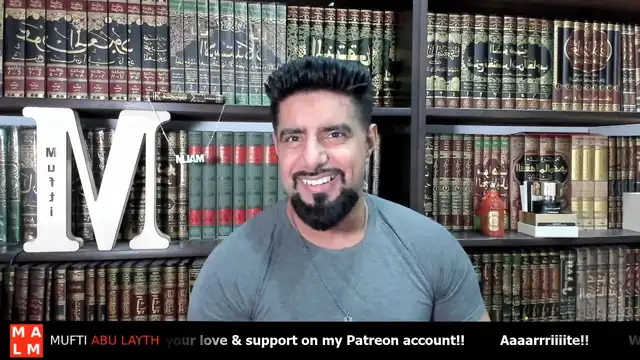 Play from 2:22:11
The video loads from YouTube only when you press play. Click a time in the transcript to seek.
Watch the answer
Open on YouTube at 2:22:11The player starts at 2:22:11, where the answer begins.
This segment2:21:31 to 2:27:42 · 6 min 11 sGeneral teaching
The answer in brief
machinesummary, machine-writtenMufti Abu Layth says the a'rab of Surah al-Tawbah were semi-nomadic raiding tribes not under settled rule, some of whom joined only as a power play.
In more detail
A viewer asks who the a'rab were in the Prophet's time, in light of Surah al-Tawbah verse 97. Mufti Abu Layth reads and translates verses 97 to 99: the Bedouins are the hardest in disbelief and hypocrisy, some treat what they spend as a debt and wait for misfortune to strike the believers, and others spend sincerely as a means of nearness to God. He says the verses refer to tribes of the Hijaz and beyond that were not under established rule, unlike the settled southern and northern kingdoms. Mufti says these semi-nomadic raiding tribes had military strength and wealth that could help the Prophet, but some joined as a power play, and that people not exposed to the voice of reason were harshest against him.
Question as read aloud · questioner not identifiedWho are the a'rab as understood in the time of the Prophet? Can you provide some context in light of Surah al-Tawbah verse 97?
Position stated
Mufti Abu Layth says the verses speak of the tribes of the Hijaz and beyond that were not under established rule.
“he's speaking of the kind of tribes that were in the hij and I suppose expanded out as well, but that weren't under established rule.”
Category: teaching
Kind: general teachingTranscript
machine2:21:31 to 2:27:42 · click a time to seek · dotted terms open the glossary
You won't be able to do it. I guarantee it. I can to that extent that I can swear by Allah they will not be able to. Not I mean not conclusive not I don't mean they'll just say oh look this means this and no no no clear clearnah or sunnah clearly not a single they won't be able to prove it you know the way they have the right they'll go to the school of medina jalain is one of and ali yep that's correct I'm not sure if that was the question Daniel Ramirez as you're doing
it. Who are the are the Arabs as it's understood in the time of the prophet? Can you provide some context in light of the verb uh in light of the verse that is found in surah Toba verse 97? right now. Let's [clears throat] see. We've got verse 97.
[snorts] Oh, right. And then it goes on to say, then it goes on to say,
right here. Now this here, right? So just translating that the are the worst of disbelief and hypocrisy and more dis and more likely that they do not know the the transgressions against God. um or his messenger and Allah is indeed most knowledgeable, most wise and they are from the who who take what they spend as a as a kind of form of indebtment
like they kind of indebt you with it. uh and they try to await your moments of weakness to exploit that because you're kind of indebted to them and then Allah says that you know rather these things are against them and Allah is all knowledgeable all hearing because hearing because of what they Allah is saying that because of what they plot and when they whisper their secrets and from those people who believe in Allah and the last day and they take what they spend as a form of getting
close to God, right? and it and and the and salawatin as a form of see here it's interesting because salawat is used with as a sense of purification for them but a closeness with the prophet wasawatul and this kind of peace of mind that they give the prophet that they want to basically they're doing it sincerely for God and to help the prophet that indeed it is an act of worship uh and Allah will envelop them with his mercy.
Indeed, he's all forgiving, most compassionate. Now, these verses, who are the that Allah is speaking of, he's speaking of the kind of tribes that were in the hij and I suppose expanded out as well, but that weren't under established rule. So in the southern kingdoms you had um Arabs that were like a kind of civilization.
They weren't very tribal. I mean they had tribes but they were more a settled people and they had like centuries of civilization the that way predates Islam. So you had that and then you've got oh right the northern kingdoms are a bit like that as well. Then in the middle you've got this whole thing.
You've got the hij to the east. Uh you've got um places um no I was thinking maybe up to Bah but maybe parts of Bahrain may have been settled but you've got this whole region where they there were the kinder kind of tribes as well and but a lot of Arab tribes are still quite nomadic as in they may be semi-ettled but they're not really settled.
These people had a lot of a lot to offer cuz they had a lot of milit military strength but they also had wealth cuz they would raid they often raiding kingdom. So they would raid this kingdom got a lot of wealth wealth in money, wealth in stock in these kind of things. So they could help the prophet but some of them were doing it really just as a power play and Allah is exposing that.
And here that some of these that you see they are the most in disbelief. Why? Because you see a people like that are not open to reason that why because the Quran is trying to reason belief and people who are not really so exposed to the voice of reason.
They will be the most harshest in their ways against you. And this is what the verse generally means or it is relating you know it's referring to in my understanding. Uh and why because these people these bedwin eyes these are the are the bedwin these kind of nomadic people that still move around they raid people. they do things um they're very difficult to to kind of show reason to.
Uh Muisab, have you read Juan Coo's book on the prophet? What do you think? I've heard great things about it. I haven't read it yet. No. Right. So, uh, Kiwi Rockstar says, "Please answer." I'm not sure what the question is to answer. Let me just go back, take a look. Nope, I can't see a question.
Paragraphs overlapping 2:21:31 to 2:27:42. Full text on the recording page.
Cite this segment
Stable id, transcript version and tier are part of the citation. Every change to a transcript is logged.Mufti Abu Layth Archive, segment 2020-10-27-S21, auto-transcribed, may contain errors. https://muftiabulayth.org/r/w6tqwuuumcg/s/21/ (accessed 1 November 2026)
- APA 7
Mufti Abu Layth. (2020, October 27). Who were the Bedouin Arabs criticised in Surah al-Tawbah? [Video, segment 2020-10-27-S21, auto-transcribed, may contain errors]. Mufti Abu Layth Archive. Retrieved November 1, 2026, from https://muftiabulayth.org/r/w6tqwuuumcg/s/21/
- Chicago author-date
Mufti Abu Layth. 2020. "Who were the Bedouin Arabs criticised in Surah al-Tawbah?" Video, segment 2020-10-27-S21, auto-transcribed, may contain errors. Mufti Abu Layth Archive. Recorded October 27, 2020. Accessed November 1, 2026. https://muftiabulayth.org/r/w6tqwuuumcg/s/21/
- BibTeX
@misc{abulayth-2020-10-27-S21,
  author = {Mufti Abu Layth},
  title = {{Who were the Bedouin Arabs criticised in Surah al-Tawbah?}},
  year = {2020},
  month = {10},
  date = {2020-10-27},
  howpublished = {\url{https://muftiabulayth.org/r/w6tqwuuumcg/s/21/}},
  url = {https://muftiabulayth.org/r/w6tqwuuumcg/s/21/},
  organization = {Mufti Abu Layth Archive},
  urldate = {2026-11-01},
  note = {Segment 2020-10-27-S21, auto-transcribed, may contain errors}
}
Something wrong here?
Tell us what is wrong and it will be checked against the recording. Nothing changes until a person has reviewed it.
Sending a note needs JavaScript, which is off or unavailable in this browser. Nothing has been sent.
No name, email address or account is asked for or stored, and the inbox does not store your IP address. For rate limiting it keeps an unreadable fingerprint of your connection for 48 hours, and our database provider's own logs record connections as every website's do. Only your note, its kind, the page and the moment in the recording are kept, for review.