
Recordings › Karbala & it's precursors | Mufti Abu Layth · 16 Oct 2020 › Segment 13 of 18
Why did the army at Karbala not let Husayn go back?
sahih saheeh sahih hadith saheeh hadith sound hadith muftis jahannam jahanam jahannum ahl al-sunnah ahl as-sunnah ahlus sunnah ahl al-sunna sunnis shiah shiite shi'i twelver ithna ashariThe tragedy unfolds: Muslim ibn Aqil's death, the interception and the burned camp
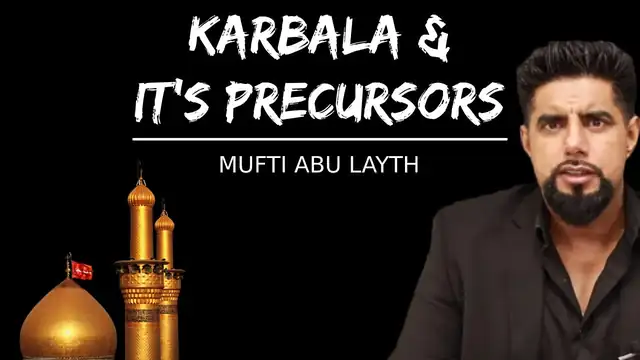 Play from 45:10
The video loads from YouTube only when you press play. Click a time in the transcript to seek.
Watch this part
Open on YouTube at 45:10The player starts at 45:10, the beginning of this part.
This segment45:10 to 50:20 · 5 min 10 sGeneral teaching
What this part covers
machinesummary, machine-writtenAfter Muslim ibn Aqil was killed, Husayn's party was intercepted and the men martyred; Mufti Abu Layth thinks the army may have refused to let him go because some of its own clans had invited him.
In more detail
Mufti Abu Layth says Muslim ibn Aqil could not send word back in time and was caught and killed on Ubaydullah ibn Ziyad's orders, betrayed by the Shia of Kufa, after being tortured and thrown from a building, as was Hani, who sheltered him, and other sympathisers. He tells of the poet al-Farazdaq meeting Husayn on the road and telling him that the people of Iraq had their hearts with him but their swords against him. Ibn Ziyad sent Umar ibn Sa'd to intercept Husayn, and at Karbala nearly all the men were martyred. He says Sunni sources report negotiations, Husayn asking to withdraw or to be taken to Yazid, and that Husayn recognised in the force men of clans that had petitioned him; he feels there may be truth in that, since they would then fear execution for treason if he reached Yazid. He says this fits reports that they burned the camps, though they did not attack the women, perhaps because Husayn carried the signed petitions with him.
Position stated
Mufti Abu Layth says he feels there may be some truth to the Sunni reports that Husayn recognised in the army men of clans that had petitioned him to come.
“are you guys not part of the petitioners who petitioned me to come?" And he calls out and he announces this. Now, I feel that there may be some truth to that.”
Category: historical claim
Kind: general teachingTranscript
machine45:10 to 50:20 · click a time to seek · dotted terms open the glossary
If you are to resist, go to Yemen. The people of Iraq were never loyal to your father. That Shia were kind of like a wavering bunch. So, but he did but he didn't listen, radiyallahu anhu, and he felt that look, I'm going to go. Now, he did send his cousin Muslim ibn Aqil to go check it out.
And Muslim ibn Aqil goes there, but he can't unfortunately send the message back in time and he himself is killed uh by under the instructions of Obaid, who catches him, he kills him, and um you know, and the people And this is it, the Shia betray him. You know, they And in fact, this There's a uh a famous saying that uh there's a poet, Farazdaq, who meets Hussein when he's on route because he hasn't received the message that what's happening over there.
And he thinks it's all good because he told Muslim that Muslim ibn Aqil that you go and if there's any trouble, you send a message. Because no message has come, he set off. And he meets this poet on the way and he asks him that what what's the situation? And he tells him that look, you know, the people of Iraq of that where you're going, you know, qulubuhum ma'ak wa suyufuhum alayk.
That these people, their hearts may be with you, but they their swords are against you. Like these people are not to be trusted. But yeah, I mean, Muslim ibn Aqil unfortunately suffered a tragic death. He was uh tortured. He was killed. He was thrown off a building, uh decapitated.
Uh anybody that gave him shelter, there was a person called Hani that gave him shelter. He was um you know, he was tortured, tormented, murdered. Uh anybody who was seen as a sympathizer. And this was by the instructions of Obaid, now who was the governor of Kufa. Now, Obaid dispatches the army. We've come back to the beginning point. He dispatches an army with Umar ibn Sa'd ibn Abi Waqqas a kind of battalion.
He says, "Look, Hussein is coming. Intercept them." Now, he goes there, they intercept them, and this is where Karbala uh takes place. It's at the point of Karbala. Unfortunately, uh all the men, for the most part, are martyred. Now, Umar ibn um that those like Umar ibn Sa'd ibn Abi Waqqas, he definitely obviously knew what he was doing.
Uh they There are some points about they You see, that some people say that how did this fighting happen? Did they just go there and attack them? Because the general Sunni sources show that they when they go there, they don't just straight away start attacking. That there is some kind of a some negotiations, but it seems unclear what seems to have happened. There are narrations that Hussein radiyallahu anhu does ask them to let him go and he will uh just like he won't go to Kufa, he'll he'll retreat.
And but they say no. Um He There's narrations that he asks them that I want to see Yazid. Take me to Yazid. And they say no. Now, some of the reasons why were they saying no? Some Sunni sources suggest that Hussein radiyallahu anhu when he was there, the army that had come, these couple of hundred men, whatever, he recognizes some of them.
Or he recognizes the clan that they're from. And he says that look, "Such and such clan and such and such, are you guys not part of the petitioners who petitioned me to come?" And he calls out and he announces this. Now, I feel that there may be some truth to that. And this may have been part of the reason that they felt that there's really we can't let him go back.
Because if he gets to Yazid and says that for example, we are the people we are part of like let's say this clan, this particular tribe is also part of the tribe that petitioned him, then we're all going to get executed for treason. So, it's better to just you know, bury this matter here. And this also lends credence to the fact that when they do uh unfortunately martyr Hussein radiyallahu anhu and all the um the men, pretty much all the men that are were there that were fighting they also burned the camps
but they don't actually attack any of the women or anything like this but they do burn the camps now why did they burn the camps is is something that historians weren't too sure about uh now it this seems to lend support to that that they say that some Sunni narrations also mention that and some historical some historical narrations mention that Hussein had the petitions with him so you know these things he had carried them in a sack that all these kind of letters that were signed by such and such tribes that please come we will
give you our allegiance and this is why they weren't sure with so they they point was just burn everything um so that kind of makes a lot of sense to me they do uh there are a lot of stories about how the martyrdom occurs now I I do feel that that definitely a lot of the detail is probably not authentic okay so there's like very precise detail of you know particular arrow did a particular thing and this did this and you know all this kind of stuff and I don't think that was true
Paragraphs overlapping 45:10 to 50:20. Full text on the recording page.
Cite this segment
Stable id, transcript version and tier are part of the citation. Every change to a transcript is logged.Mufti Abu Layth Archive, segment 2020-10-16-S13, auto-transcribed, may contain errors. https://muftiabulayth.org/r/iabl5vis3rg/s/13/ (accessed 1 November 2026)
- APA 7
Mufti Abu Layth. (2020, October 16). Why did the army at Karbala not let Husayn go back? [Video, segment 2020-10-16-S13, auto-transcribed, may contain errors]. Mufti Abu Layth Archive. Retrieved November 1, 2026, from https://muftiabulayth.org/r/iabl5vis3rg/s/13/
- Chicago author-date
Mufti Abu Layth. 2020. "Why did the army at Karbala not let Husayn go back?" Video, segment 2020-10-16-S13, auto-transcribed, may contain errors. Mufti Abu Layth Archive. Recorded October 16, 2020. Accessed November 1, 2026. https://muftiabulayth.org/r/iabl5vis3rg/s/13/
- BibTeX
@misc{abulayth-2020-10-16-S13,
  author = {Mufti Abu Layth},
  title = {{Why did the army at Karbala not let Husayn go back?}},
  year = {2020},
  month = {10},
  date = {2020-10-16},
  howpublished = {\url{https://muftiabulayth.org/r/iabl5vis3rg/s/13/}},
  url = {https://muftiabulayth.org/r/iabl5vis3rg/s/13/},
  organization = {Mufti Abu Layth Archive},
  urldate = {2026-11-01},
  note = {Segment 2020-10-16-S13, auto-transcribed, may contain errors}
}
Something wrong here?
Tell us what is wrong and it will be checked against the recording. Nothing changes until a person has reviewed it.
Sending a note needs JavaScript, which is off or unavailable in this browser. Nothing has been sent.
No name, email address or account is asked for or stored, and the inbox does not store your IP address. For rate limiting it keeps an unreadable fingerprint of your connection for 48 hours, and our database provider's own logs record connections as every website's do. Only your note, its kind, the page and the moment in the recording are kept, for review.