
Recordings › Discussion on Miracles: A fallacy against God | Mufti Abu Layth · 13 Oct 2020 › Segment 1 of 14
Why does Mufti Abu Layth hold views that most scholars disagree with?
maaliki malikite malikiyyah maliki school muftis iman imaan eemaan eeman shaytan shaitan shaytaan iblees shayateen shayatin satan devil qiyamah qiyama qiyamat yawm al-qiyamah yawm al-qiyama day of judgement koran quraan al-quran khalifah khalifa khulafa khilafah khilafat caliphate khilafa ulama ulema ulamaa salam as-salamu alaykum assalamu alaikum assalamualaikum salaam salaams salam alaykum wa alaykum as-salam greetingWhere does he get his beliefs from, against the majority of scholars?
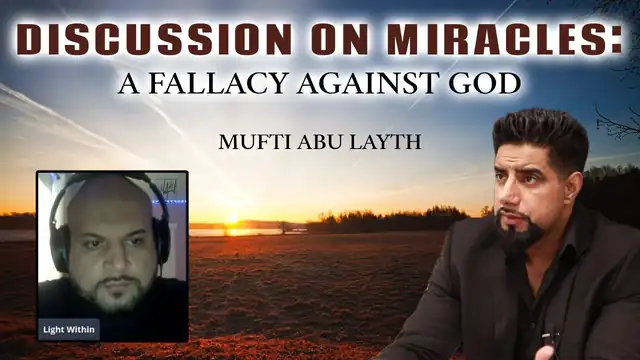 Play from 0:45
The video loads from YouTube only when you press play. Click a time in the transcript to seek.
Watch the answer
Open on YouTube at 0:45The player starts at 0:45, where the answer begins.
This segment0:07 to 3:56 · 3 min 49 sGeneral teaching
The answer in brief
machinesummary, machine-writtenMufti Abu Layth takes his beliefs from the Quran in the light of reason, since God calls people to faith through reason, and tests whether a belief is coherent as a whole.
In more detail
A caller says he has listened to Mufti Abu Layth's talks on the return of Jesus and to his critics, and asks on what source he bases interpretations that the majority of scholars, Malikis included, disagree with. Mufti says someone recently asked him something similar about Jesus having a biological father, and whether he was just trying to be different. He says he takes his beliefs from the Quran in the light of reason, since God calls people to faith on the basis of reason and would not then ask them to believe what goes against it. He adds that he asks whether a belief makes sense holistically and coherently, giving the example of a man living alone in the cosmos for millennia, which reason would not generally accept.
Question as read aloud · questioner not identifiedWhen you make these interpretations or beliefs yourself, how are you basing them differently from all the other madhhabs, even the Malikis? What are you using as a source?
Position stated
Mufti Abu Layth says he takes his beliefs from the Quran in the light of reason, since God calls people to faith based on reason.
“i'm getting my beliefs from the quran but in light of the voice of reason so i do i believe that look allah calls us to faith based on reason”
Category: method
Kind: general teachingTranscript
machine0:07 to 3:56 · click a time to seek · dotted terms open the glossary
um my question was regarding i have listened to some of your talks in regards to the resurrection of jesus peace be upon him and your stand as a maliki and um i have also listened to you know your critics and um it seems like a majority of scholars you know from different methods they disagree with you and your interpretation of things so when you make these interpretations yourself or these uh beliefs yourself what are you how are you basing it differently than all the other mud hubs even the molecules you know what are you using as
a source you see that that's a very uh good question i mean people have asked me sometimes in fact somebody i don't know whether it was today you sorry whether it was yesterday or the day before i sometimes i lose the sense of time but uh somebody very recently was asking me as well that look uh about uh an issue to do with jesus and my belief on jesus actually that wasn't to do with the resurrection that was more to do with whether he had a biological father and the issue that the question that they asked me as well was that mufti you know where are you getting
this from is this i understand you know you're doing this but what what what are your motivations behind saying this and doing this are you just trying to be different from the christians or are you trying to is that is that the purpose and i think that's what the person assumed because he was saying you know and uh but isn't this causing greater harm you know you're trying to and but i mean in a similar way to your question uh by the way sorry like within what what do we call you abdul malik malik number one
the famous caliph but still right so right so i've done malik but this question that look where am i getting first first of all where am i getting my kind of beliefs from secondly why why am i going out with these kind of beliefs that it's a kind of like a slight follow-up so i'm getting my beliefs from the quran but in light of the voice of reason so i do i believe that look allah calls
us to faith based on reason so it doesn't make sense that he would call us to believe based on reason and then tell us to believe in something which goes against reason this is one part of the of the belief uh of what um what powers certain perspectives that i then take it is the voice of reason um secondly i do you know analyzing certain things i look at it and i do think like holistically
does this make sense i mean one is from a reason perspective but one is does it make sense comprehensively like within itself so the jesus thing is a is a good example because one is the from the reason perspective you know can a human being just be living up there in the cosmos just on his own he's just floating in mid cosmos somewhere this obviously is from a reason perspective that's not a belief that reason would generally accept okay but i'm sorry to cut you but if you start
using our reason then we could reason and question everything we could reason even uh the encounter of jibrael with prophet muhammad right so they say that one of the first persons who used reason was iblis because he was asked to prostrate in front of adam and he used reason by saying that no i'm made of fire he's made of dirt why should i so isn't part of is it wasn't part of belief also that it's fate that's something we don't have to understand everything that we expected that's a very good question uh abdul malik first and firstly the police iblis was
Paragraphs overlapping 0:07 to 3:56. Full text on the recording page.
Cite this segment
Stable id, transcript version and tier are part of the citation. Every change to a transcript is logged.Mufti Abu Layth Archive, segment 2020-10-13-S01, auto-transcribed, may contain errors. https://muftiabulayth.org/r/hiu1gjszg1e/s/1/ (accessed 1 November 2026)
- APA 7
Mufti Abu Layth. (2020, October 13). Why does Mufti Abu Layth hold views that most scholars disagree with? [Video, segment 2020-10-13-S01, auto-transcribed, may contain errors]. Mufti Abu Layth Archive. Retrieved November 1, 2026, from https://muftiabulayth.org/r/hiu1gjszg1e/s/1/
- Chicago author-date
Mufti Abu Layth. 2020. "Why does Mufti Abu Layth hold views that most scholars disagree with?" Video, segment 2020-10-13-S01, auto-transcribed, may contain errors. Mufti Abu Layth Archive. Recorded October 13, 2020. Accessed November 1, 2026. https://muftiabulayth.org/r/hiu1gjszg1e/s/1/
- BibTeX
@misc{abulayth-2020-10-13-S01,
  author = {Mufti Abu Layth},
  title = {{Why does Mufti Abu Layth hold views that most scholars disagree with?}},
  year = {2020},
  month = {10},
  date = {2020-10-13},
  howpublished = {\url{https://muftiabulayth.org/r/hiu1gjszg1e/s/1/}},
  url = {https://muftiabulayth.org/r/hiu1gjszg1e/s/1/},
  organization = {Mufti Abu Layth Archive},
  urldate = {2026-11-01},
  note = {Segment 2020-10-13-S01, auto-transcribed, may contain errors}
}
Something wrong here?
Tell us what is wrong and it will be checked against the recording. Nothing changes until a person has reviewed it.
Sending a note needs JavaScript, which is off or unavailable in this browser. Nothing has been sent.
No name, email address or account is asked for or stored, and the inbox does not store your IP address. For rate limiting it keeps an unreadable fingerprint of your connection for 48 hours, and our database provider's own logs record connections as every website's do. Only your note, its kind, the page and the moment in the recording are kept, for review.