
Recordings › Mufti Abu Layth & Ustadh AbdusShakur Brooks: A discussion on Maliki Fiqh · 9 May 2014 › Segment 4 of 7
Is Imam Malik's own fatwa the Maliki madhhab?
salat salaah namaz salaat namaaz as-salah al-salah salawat hadeeth ahadith ahaadeeth hadis hadees ahaadith madhab mazhab school of law madhahib mazahib madhaahib malik ibn anas malik bin anas imam maalik imam malik ibn anas imaam imams prayer leader maaliki malikite malikiyyah maliki school fatwah fatwaa fataawa legal opinion sunna sunnat sunan prophetic practice koran quraan al-quran hijaab hejab hijabiImam Malik's own fatwa versus the later madhhab
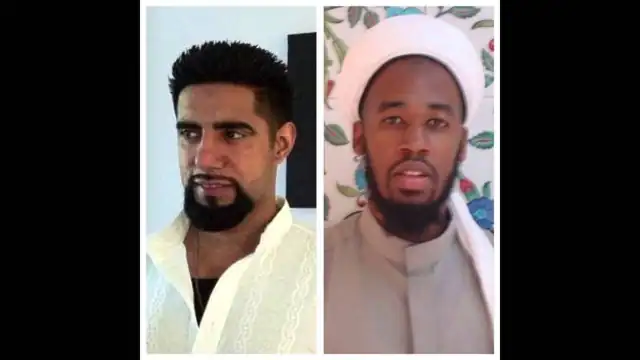 Play from 19:50
The video loads from YouTube only when you press play. Click a time in the transcript to seek.
Watch this part
Open on YouTube at 19:50The player starts at 19:50, the beginning of this part.
This segment19:50 to 22:26 · 2 min 36 sA view quoted in order to be discussed, not a position held
What this part covers
machinesummary, machine-writtenThe speakers disagree on whether Imam Malik's own words or the later transmitted madhhab decide a ruling; one says Malik's hijab fatwas were relaxed and left the face uncovered.
In more detail
The speakers dispute whether Imam Malik's own statements or the madhhab as transmitted is decisive, using the example of praying while holding back the call of nature: one says Imam Malik in the Mudawwana [?] holds the prayer invalid only if it takes away concentration, the other that the madhhab as it came down treats it differently. One speaker then says that Imam Malik's fatwas on hijab, such as a woman not having to cover her hair before her slave, are much more relaxed than those of other madhhabs, and that his fatwa clearly has the woman not covering the face, in line with the Quran and Sunnah.
- Guest speech overlaps this segment
- Low audio confidence in the transcript
- Some terms in this segment are uncertain
Position stated
This segment presents a view in order to discuss or respond to it. It is recorded as quoted, never as held, and no position is attributed from it.
Kind: a view quoted in order to be discussed, not a position held Speakers: host and guest; guest speech is labelled and excluded from positionsTranscript
machine19:50 to 22:26 · click a time to seek · dotted terms open the glossary
A guest speaks in this segment. Guest speech is labelled and is excluded from the positions layer.
This segment states a view in order to discuss it. It is recorded as a quoted view, not as a position held.
after aftering and him ageing to what said about the of the not being yeah Bing because the this m talking you see but then this is now going to be the opinion of some versus the opinion of but the they all agree upon is by Quran and Sunnah it isn't ordained okay now the rest is going to be some interpretations saying that look guys I think you know what you should just do this anyway because there's going to be not not necessarily because the interpretation is obviously based on
other and for example in in the of IM Malik the in our of IM Malik is that if you pray yeah with something in your stomach and you're holding it back then your prayer is invalid that's the statement of IM Malik no but that's not necessarily like because IM Malik in the M says that if no but IM Malik in the himself says when he says he says that if it does not he says then it's okay that's in the and he says only if it takes his attention away from Salah that he no longer can
concentrate on the Salah then his Salah would be invalid but that's not the the M that's why they made that would actually still be the maab if you understand it like that no but that's not how no because that's not how it came down to us how it came how it came down through the through the nus we understood it to be that in the case if it prohibits him from doing a waj then his prayer becomes inval yeah because the thing is that look Imam Malik himself is saying that like I I mean to me it's reasonably clear in the M he's saying they're making I okay but the earlier said they're making they're making like the I don't know you see if you're saying in the sense of just
clarification I don't think it's a in because imik himself is saying that look it doesn't invalidate the Salah he says but if if the thing is if it takes away like if it takes away the fact that you can't if that no I'm saying if a person becomes occupied in his mind and occupies him but this is now not a there's a clarification isn't it there's a difference between a whe I mean okay but but that's okay fair enough that's besides the point here but the thing is that you see also you're
going okay for example within the Maliki we also have things like uh the rulings when it comes to stuff like between the woman and her slave and stuff like this she doesn't have to cover her hair she doesn't have to do stuff like I mean very you see when you see IM Malik's fatawa regarding the concept of hij they are relatively speaking much more relaxed than the other MBS his understanding of what this and neither has he ever himself in fact his fwa seemed very clear in the sense that the woman doesn't cover the face that's what it uh you know the fwa we
have from the IM himself which then fall in line with the Quran and Sunnah rulings as well okay then you see that's another thing you have to keep in mind because you see if we put things in the perspective why he wouldn't talk about it then if we talk about the position of the malakis in regards to women coming out of their houses they weren't going out except for you understand so who who says that I mean you can find that way in no I mean we like you you find clearly in the books of Hadith that the women were coming out they were in the marketplaces even the fact that I mean you see several of these here's the difference now that would be under the
Paragraphs overlapping 19:50 to 22:26. Full text on the recording page.
Cite this segment
Stable id, transcript version and tier are part of the citation. Every change to a transcript is logged.Mufti Abu Layth Archive, segment 2014-05-09-S04, auto-transcribed, may contain errors. https://muftiabulayth.org/r/hcscudhd8bu/s/4/ (accessed 1 November 2026)
- APA 7
Mufti Abu Layth. (2014, May 9). Is Imam Malik's own fatwa the Maliki madhhab? [Video, segment 2014-05-09-S04, auto-transcribed, may contain errors]. Mufti Abu Layth Archive. Retrieved November 1, 2026, from https://muftiabulayth.org/r/hcscudhd8bu/s/4/
- Chicago author-date
Mufti Abu Layth. 2014. "Is Imam Malik's own fatwa the Maliki madhhab?" Video, segment 2014-05-09-S04, auto-transcribed, may contain errors. Mufti Abu Layth Archive. Recorded May 9, 2014. Accessed November 1, 2026. https://muftiabulayth.org/r/hcscudhd8bu/s/4/
- BibTeX
@misc{abulayth-2014-05-09-S04,
  author = {Mufti Abu Layth},
  title = {{Is Imam Malik's own fatwa the Maliki madhhab?}},
  year = {2014},
  month = {5},
  date = {2014-05-09},
  howpublished = {\url{https://muftiabulayth.org/r/hcscudhd8bu/s/4/}},
  url = {https://muftiabulayth.org/r/hcscudhd8bu/s/4/},
  organization = {Mufti Abu Layth Archive},
  urldate = {2026-11-01},
  note = {Segment 2014-05-09-S04, auto-transcribed, may contain errors}
}
Something wrong here?
Tell us what is wrong and it will be checked against the recording. Nothing changes until a person has reviewed it.
Sending a note needs JavaScript, which is off or unavailable in this browser. Nothing has been sent.
No name, email address or account is asked for or stored, and the inbox does not store your IP address. For rate limiting it keeps an unreadable fingerprint of your connection for 48 hours, and our database provider's own logs record connections as every website's do. Only your note, its kind, the page and the moment in the recording are kept, for review.