
Recordings › Sex Slaves: Concubines and Collective Consciousness -Mufti Abu Layth · 28 Apr 2020 › Segment 1 of 3
Is slavery haram in Islam, and did Muslim scholars ban it before the UN?
maaliki malikite malikiyyah maliki school muftis hukm ahkam hukum hukam ahkaam haraam forbidden koran quraan al-quran ulama ulema ulamaa sheikh shaikh sheik shuyukh shaykhs subhan allah subhaanallah subhanallaahConcubines were female slaves; slavery is categorically haram and Maliki fatwas preceded the UN
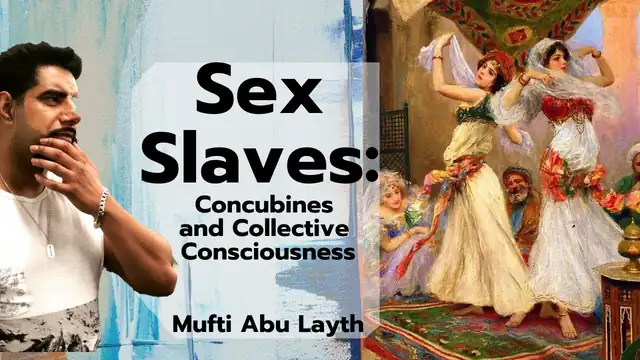 Play from 0:00
The video loads from YouTube only when you press play. Click a time in the transcript to seek.
Watch this part
Open on YouTube at 0:00The player starts at 0:00, the beginning of this part.
This segment0:00 to 2:37 · 2 min 37 sGeneral teaching
What this part covers
machinesummary, machine-writtenSlavery is categorically haram today, and Maliki scholars issued fatwas forbidding it long before the UN; Mufti Abu Layth explains this through trajectory hermeneutics. Concubines were female slaves, not wives.
In more detail
Mufti Abu Layth says that what everyone calls concubines were female slaves, which modern media call sex slaves, and that the Quran refers to them as what the right hand possesses. He stresses that these things no longer exist, so the discussion is theoretical, and that slavery today would be categorically haram, as he has explained before. He notes that many Muslim scholars, among them many Malikis including a shaykh he has mentioned before [?] and others in Mali, issued fatwas forbidding slavery and the slave trade in Africa a century, a century and a half or even two or three centuries before the UN resolution banning it. He recalls his explanation of trajectory hermeneutics: because slavery was so embedded, Islam set its rulings on an arc so that when human ethics developed to that level the ruling would become active and slavery would be made haram. He then turns to the question of how female slaves differed from wives, saying they were not wives but slaves.
- Some terms in this segment are uncertain
Position stated
Mufti Abu Layth holds that slavery is categorically haram today, that Maliki and other scholars forbade it by fatwa long before the UN resolution, and that the Quran's rulings on slavery set a trajectory towards its prohibition once human ethics developed.
“obviously these things don't really exist today so it's this is just a theoretical kind of discussion on it these things would all slavery would be categorically Haram I have explained that”
Category: ruling
Kind: general teachingTranscript
machine0:00 to 2:37 · click a time to seek · dotted terms open the glossary
concubines as that the word that everybody knows right so which are female slaves and to some modern terms sex slaves right so the thing is they wouldn't actually call sex slaves to be fair that's the modern media calling them that but traditionally they were slaves okay so female slaves or you could call them concubines or whatever now and in the quran when they referred to as what the right hand possesses obviously these things don't really exist today so it's
this is just a theoretical kind of discussion on it these things would all slavery would be categorically Haram I have explained that and it's it's interesting to know that even several amount before the UN kind of resolution to ban slavery worldwide was embraced many Muslims over a century and maybe century and a half earlier and in some places maybe two centuries earlier many Muslim and amongst the many Maliki subhanAllah if not sure who I mentioned his chef Araya he and other people had
issued Fatah WA saying forbidding slavery and the trade of slavery that was taking place at that time let's say in Africa and they said this was Haram and there were other molecule amount as well from places like Mali and other places who had issued the Fatah WA way before - three centuries even before it was you know passed as a resolution by the UN that slavery was Haram in Islam okay so and I've explained this previously about trajectory hermeneutics that Islam set it up and it wanted to
it's not that it because slavery was so embedded so it set the rulings with a trajectory that when human ethics would develop to that level it would reach the trajectory it was like an arc and sorry an arch kind of like that and so as it would reach that it would actually and the ruling would be active and slavery would be made Haram so that's trajectory hermeneutics okay that's what we call that kind of that trajectory ethics so now so with that female slaves as well the question is well traditionally how were they first
of all how are they different two wives they weren't wives they were slaves I suppose the reason the question is being asked and it's asked in many of the places how were men allowed to have sex with them and this is at this point that all the guys call god damned if only we still have only we still had this still going on all of us
Paragraphs overlapping 0:00 to 2:37. Full text on the recording page.
Cite this segment
Stable id, transcript version and tier are part of the citation. Every change to a transcript is logged.Mufti Abu Layth Archive, segment 2020-04-28-S01, auto-transcribed, may contain errors. https://muftiabulayth.org/r/5is8qpu5llu/s/1/ (accessed 1 November 2026)
- APA 7
Mufti Abu Layth. (2020, April 28). Is slavery haram in Islam, and did Muslim scholars ban it before the UN? [Video, segment 2020-04-28-S01, auto-transcribed, may contain errors]. Mufti Abu Layth Archive. Retrieved November 1, 2026, from https://muftiabulayth.org/r/5is8qpu5llu/s/1/
- Chicago author-date
Mufti Abu Layth. 2020. "Is slavery haram in Islam, and did Muslim scholars ban it before the UN?" Video, segment 2020-04-28-S01, auto-transcribed, may contain errors. Mufti Abu Layth Archive. Recorded April 28, 2020. Accessed November 1, 2026. https://muftiabulayth.org/r/5is8qpu5llu/s/1/
- BibTeX
@misc{abulayth-2020-04-28-S01,
  author = {Mufti Abu Layth},
  title = {{Is slavery haram in Islam, and did Muslim scholars ban it before the UN?}},
  year = {2020},
  month = {4},
  date = {2020-04-28},
  howpublished = {\url{https://muftiabulayth.org/r/5is8qpu5llu/s/1/}},
  url = {https://muftiabulayth.org/r/5is8qpu5llu/s/1/},
  organization = {Mufti Abu Layth Archive},
  urldate = {2026-11-01},
  note = {Segment 2020-04-28-S01, auto-transcribed, may contain errors}
}
Something wrong here?
Tell us what is wrong and it will be checked against the recording. Nothing changes until a person has reviewed it.
Sending a note needs JavaScript, which is off or unavailable in this browser. Nothing has been sent.
No name, email address or account is asked for or stored, and the inbox does not store your IP address. For rate limiting it keeps an unreadable fingerprint of your connection for 48 hours, and our database provider's own logs record connections as every website's do. Only your note, its kind, the page and the moment in the recording are kept, for review.