
Recordings › Age of Aisha (ra)- Mufti Abu Layth · 11 Jan 2017 › Segment 12 of 18
Why is the report that Aisha was six and nine so much better known than the others?
salat salaah namaz prayer salaat namaaz as-salah salawat aqidah aqeedah aqida aqeeda aqaid hadeeth ahadith ahaadeeth hadis hadees ahaadith saheeh sahih hadith saheeh hadith sound hadith authentic malik ibn anas malik bin anas imam maalik imam malik ibn anas imam bukhari sahih bukhari saheeh al-bukhari saheeh bukhari imam al-bukhari imaam imams prayer leader shafi'i shafei shafiite shafi'i school muftis sunna sunnat sunan prophetic practice bida biddat bidaa innovation saheeh muslim imam muslim muslim ibn al-hajjaj ilm al-kalam kalaam koran quraan al-quran sahaba sahabi sahabiyyah sahabiyat madinah medina al-madinah madeenah yathrib tasawuf tasawwof sufism ulama ulema ulamaaWhy the six-and-nine report became so well known
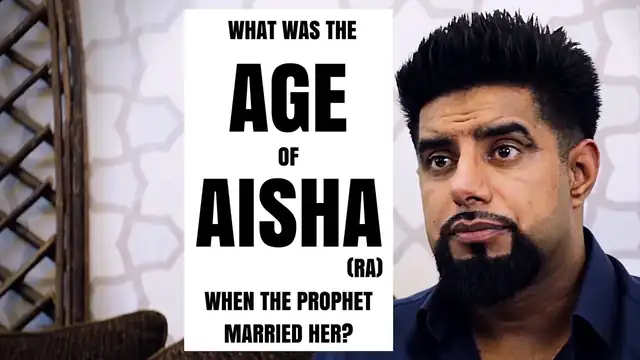 Play from 1:27:41
The video loads from YouTube only when you press play. Click a time in the transcript to seek.
Watch the answer
Open on YouTube at 1:27:41The player starts at 1:27:41, where the answer begins.
This segment1:27:41 to 1:35:34 · 7 min 53 sGeneral teaching
The answer in brief
machinesummary, machine-writtenThe six-and-nine report became prominent as a by-product of hadith absolutism and the later sanctification of Bukhari and Muslim. Ordinary Muslims historically knew only that Aisha was young.
In more detail
Mufti Abu Layth partly disputes the premise, saying that before the recent media attention ordinary Muslims knew only that Aisha was young, while specialists knew the report. He says its present prominence comes with the reactionary affirmation of the Bukhari report and the sanctification of Bukhari, which he traces to hadith absolutism: a view that took hold a few hundred years after the Prophet among hadith scholars who did not distinguish hadith from sunnah as Imam Malik did, reaffirmed against sects questioning hadith, with the sanctification of Sahih al-Bukhari and Sahih Muslim by Ibn al-Salah [?] and others as a by-product. He draws parallels: the rise of tasawwuf after the sixth and seventh centuries made the division of bid'ah into good and bad the standard view though it had been a minority one, and the kalam movement, arising to safeguard Islam, produced fixed dogma where the companions and Imam Malik had listed no creed. He concludes that the report's prominence is a by-product of these phenomena and was not always the mainstream view.
Question as read aloud · questioner not identifiedIf other reports exist, why are the reports that Aisha was six and nine more popular?
- Some terms in this segment are uncertain
Position stated
Mufti Abu Layth says the prominence of the six-and-nine report is a by-product of hadith absolutism and the later sanctification of Sahih al-Bukhari and Sahih Muslim, not the view of the earliest Muslims.
“this view of popularizing these two books was a byproduct to that phenomenon of Hadith absolutism”
Category: historical claim
Kind: general teachingTranscript
machine1:27:41 to 1:35:34 · click a time to seek · dotted terms open the glossary
and that's positive how do you think they will react to criticism when it's criticizing Islam so they say no way on Earth I I don't I don't want to listen but the truth is well let's listen and you're right that that's that's a critical point because this means this means that the prophet sallallah alaihi wasallam is not a perfect role model for Muslims today or for human beings today in this part of the world because people find these actions unacceptable and even Muslims find these actions is unacceptable so Muslims today will not accept to marry
their daughter off at the age of six or 9 and I'm not and neither will people in general I'm not speaking about some you may say well one person here or there but generally speaking people will not tolerate that so this response of engaging this and actually viewing it with the reality and realizing well actually this didn't happen is more in line with the message of the Quran and it serves Humanity as a whole and Muslims
specifically that's definitely a good question why is this uh Hadith of six and N so popular then if we're saying and and other narratives although implicitly there that they're not they're not so they're not that popular well first of all I would disagree to the extent I mean I would partially accept that to be a some truth in that question I don't believe that this data of six and N is necessarily popular at a
whole on a general Muslim scale so Muslims before um before this discourse has become so popular now in the West on media and things like this prior to this if you asked Muslims generally when do they think the prophet married AA they would say yeah she was young but I don't believe Muslims generally I I know the scholars and the Specialists were aware of this tradition but I don't think this was something so popular on a on a ground level okay that's uh that's that's just a point to make but yes it definitely is more popular now with this
whole media approach and people really trying to the reaction the Muslim reactionary approach of kind of like super affirming this uh this narration in bukari and trying to consolidate this view of sanctifying uh bukari and everything so why did this happen now we have to understand this is an extension of the Hadith absolutism approach and that is a view that that said that Hadith in themselves are always authoritative they did not draw distinction between Hadith and Sunnah
like IM Malik and the school of Madina did they believed in just Hadith absolutism and this this kind of attitude this approach really comes uh a few hundred years after the prophet sallallahu alaihi wasallam and then continues to solidify and gain strength uh and most of the people that were on this view initially and gen generally were maab who believed if a Hadith was it was always an authority now yes they did this uh in contrast with certain sectarian movements to kind of quash
certain sectarian uh difficulties that they were facing so some people were questioning Hadith Al together some people were coming up with certain angles certain other sects and denominations so this the M the scholars of Hadith they started to reaffirm this view of Hadith absolutism and as a byproduct you ended up with the the kind of sanctification of books like bukari and Muslim and people likeah uh these people really put this into place and then you have other Salah and other people saying what is in
bukari and Muslim is absolutely certain and conclusive and and all these other M who follow suit do do that but you have to see that this view of popularizing these two books was a byproduct to that phenomenon of Hadith absolutism which in its time as the movement was Rising served a function it was to kind of Safeguard uh the main Orthodox Islam against certain denominations and we see parallels in other in other kind of uh with other movements too so you can see things like uh the rise of the tasw
movement as an example uh you know post I don't know 7th Century Islam it becomes it rises and then becomes almost very common place with it as a byproduct uh the understanding that b there is a division of B that B can be divided into good and bad B I'm not saying people before did not have that view they did but after the rise of tasa generally especially into the 600 7 00 H and onwards this becomes the view to the extent that only Islam is identified through this understanding and you would
think boy there must have never have been a time when Muslims did not accept any Al alternate view yet prior to the 600s and the 500s this you know this was an absolute this was a minority view so similarly we see with the cam phenomenon mut the theologians as certain kind of uh views start to emerge Muslim contact with I don't know with kind of Greek literature and other things as well we see a rise in the whole Theologian phenomenon and Muslims uh you know we
see groups emerging this whole thing of the and these schools of theology emerge and they emerge to safeguard Islam but as a byproduct you end up with dogmatism now now we have a list of fixed dogma and every person must believe this and they must and if you don't believe this you are now uh no longer part of the Orthodoxy of Islam and but I mean prior to that movement prior to this kind of phenomenon people in the early times just believed you know they didn't list out so Imam Malik did not list out his
belief the sahabah did not list out their beliefs the T did not list out their beliefs and so on it was just kind of a natural organic understanding of Islam but once certain problems arose they were met with this Theologian phenomenon the cam kind of movement and it was done to safeguard Islam but as a byproduct it ends up with this so similarly this Hadith absolutism and the movement of the M was done to safeguard the tradition of Islam of mainstream Orthodox Islam and to preserve the the Hadith but as a byproduct it ends up
with the sanctification of certain books like bukari and then some people start to exaggerate in this sanctification especially of that movement people like the absolutist uh the Shafi School in general and Other M Salah and other people start to say well this is absolutely certain anything that is in this in this book it is conclusive and then to the extent that other people become influenced that they they almost forget that there was a time that this was not the mainstream kind of view and so on so I I think you are right that this has become common but
that is as a byproduct of certain phenomena phenomena that had occurred I don't believe that this was always the view you are right that the ethics of a society of a civilization do continue to develop and we definitely 21st century ethics seems very different um from even 20th century ethics let alone 19th 18th century ethics so that is true um the question if we're understanding this well look you're you're saying this today because it doesn't sound right and
Paragraphs overlapping 1:27:41 to 1:35:34. Full text on the recording page.
Cite this segment
Stable id, transcript version and tier are part of the citation. Every change to a transcript is logged.Mufti Abu Layth Archive, segment 2017-01-11-S12, auto-transcribed, may contain errors. https://muftiabulayth.org/r/0ovisexs4ca/s/12/ (accessed 1 November 2026)
- APA 7
Mufti Abu Layth. (2017, January 11). Why is the report that Aisha was six and nine so much better known than the others? [Video, segment 2017-01-11-S12, auto-transcribed, may contain errors]. Mufti Abu Layth Archive. Retrieved November 1, 2026, from https://muftiabulayth.org/r/0ovisexs4ca/s/12/
- Chicago author-date
Mufti Abu Layth. 2017. "Why is the report that Aisha was six and nine so much better known than the others?" Video, segment 2017-01-11-S12, auto-transcribed, may contain errors. Mufti Abu Layth Archive. Recorded January 11, 2017. Accessed November 1, 2026. https://muftiabulayth.org/r/0ovisexs4ca/s/12/
- BibTeX
@misc{abulayth-2017-01-11-S12,
  author = {Mufti Abu Layth},
  title = {{Why is the report that Aisha was six and nine so much better known than the others?}},
  year = {2017},
  month = {1},
  date = {2017-01-11},
  howpublished = {\url{https://muftiabulayth.org/r/0ovisexs4ca/s/12/}},
  url = {https://muftiabulayth.org/r/0ovisexs4ca/s/12/},
  organization = {Mufti Abu Layth Archive},
  urldate = {2026-11-01},
  note = {Segment 2017-01-11-S12, auto-transcribed, may contain errors}
}
Something wrong here?
Tell us what is wrong and it will be checked against the recording. Nothing changes until a person has reviewed it.
Sending a note needs JavaScript, which is off or unavailable in this browser. Nothing has been sent.
No name, email address or account is asked for or stored, and the inbox does not store your IP address. For rate limiting it keeps an unreadable fingerprint of your connection for 48 hours, and our database provider's own logs record connections as every website's do. Only your note, its kind, the page and the moment in the recording are kept, for review.