
Recordings › In Depth: Sulaiman (a.s.), the Throne of Sheba, and Miracles in the Quran -Mufti Abu Layth · 8 Jan 2019 › Segment 2 of 9
If God can do anything, why not take the miracles in Quranic stories literally?
muftis koran quraan al-quran ayah aya ayat ayaat aayah aayatWhy reading the stories as supernatural forces us to ditch reason
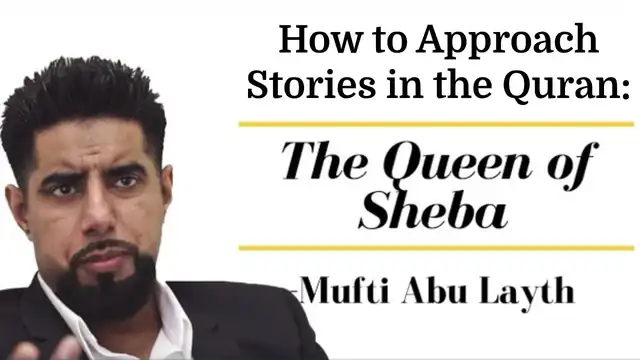 Play from 9:32
The video loads from YouTube only when you press play. Click a time in the transcript to seek.
Watch this part
Open on YouTube at 9:32The player starts at 9:32, the beginning of this part.
This segment9:32 to 15:58 · 6 min 26 sGeneral teaching
What this part covers
machinesummary, machine-writtenReading the stories as suspensions of natural law means ditching reason, which leaves no ground to reject any myth; reason must be all in, though the prophets were real people.
In more detail
Mufti Abu Layth says many Muslims accept reality but suspend it for certain stories, saying for example that Jesus could speak as a baby because God gave him special powers. He says this approach does not correlate with reality and, once one zooms out, everything falls to pieces: by the same logic one could accept the Trinity or Greek and Hindu myths, since God could have done anything. He says reason is either all in or out, that God's laws of nature do not change, citing the verse that one will find no change in God's way, and gives the example of gravity. He says he does believe Adam, Abraham and Noah were real people, and likens the right approach to a detective who distrusts a case that is too convenient.
- Some terms in this segment are uncertain
Position stated
Mufti Abu Layth says reason is either all in or out, and one cannot follow it only ninety per cent of the time.
“reason is either all in or or it's out it doesn't happen like you can't say you know what I'll follow reason 90% of the time”
Category: method
Kind: general teachingTranscript
machine9:32 to 15:58 · click a time to seek · dotted terms open the glossary
becomes so big that he puts him in an ocean he's so big for the ocean that Manu is then told to build a he's told to build out of because he's been so kind he's told to build a boat and he builds a boat and and then a flood comes that drowns the world or people have once again a stark resemblance to the story of Noah in the Bible and the Quran so then the whole point was that here because of his kindness to Vishnu he is then guided and he's on this boat and he's saved and then from him come
mankind now when you read the story of man whom Vishnu or these things or of Prometheus we take them as stories we don't think that these were we you know if we don't we're not trying to be realistic with that the issue is when we read certain stories in the Quran that don't state but imply a supernatural prowess or power or capacity or capabilities how should we be so some Muslims just say no these are supernatural powers and these people had supernatural powers so Jesus for example
would speak as a baby normal people can't do that but it's okay Jesus can speak as a baby because he has special powers he's a you know like a special powerful person so he can do things so what they do is they accept reality but then they just add for this part they will suspend reality and say I know in the real world people can't do this but here they did because God made him do it so this is how many Muslims approach these things the problem with this approach of them taking a very
supernatural is it doesn't correlate with reality and he has huge problems once you zoom out because once you zoom out then people everything can fall to pieces so you know because if you're gonna say well things can't happen and they say yeah but I know they can't happen but God did him yeah so well hmm so that means my god fine so why does anything have to make sense then because God could you know it's like the Trinity you could say well I know normally three doesn't equal
one but God here made three equal one you know you're saying God made a baby talk like grown-ups and you're saying God made a mind fly and do all these things and you're saying this so God and you except it doesn't normally happen so but you know God made it happen here so God made the three Trinity B he made himself B 3 I know it's against reason but you yourself are not accepting reason so you see this becomes the problem that you see if we take the
supernatural the mythological thing as a real then reason has to be ditched if reason is ditched then we have no right to discredit for example the mythologies of Hinduism or Greek mythology's we have no right because God did you know so God did these things so in that case how can we say you know Prometheus didn't create man and he didn't owe fish new wasn't the fish because we'd say yeah I know that doesn't normally happen but hey God
did it you know so what I'm trying to say is reason is either all in or or it's out it doesn't happen like you can't say you know what I'll follow reason 90% of the time that doesn't make any sense right so what I'm trying to say is that align the universe has set laws these laws have to be they have to be they have to be defined Allah says well ant I did a little metal light up you'll never find the laws of God the laws of nature to deviate and change
that they work gravity always works you see if somebody said I know gravity works I won't stand at the edge of a cliff and jump off I wouldn't do that I wouldn't do that to my child I wouldn't do that for myself but yeah on one occasion God allowed one man to defy gravity for example not that that well God allowed a group of men to defy gravity but normally he doesn't this logic it comes it doesn't just shoot you in one foot it completely buries you because you can then no longer find any
fault with any mythology so now that so no so I'm right so now I'm coming back to the stories I'm not saying the stories were mythical I'm not saying that I do believe that these were actually real people I believe all these people were real I do believe that there was an Adam there was an Abraham there was a Noah I believe in all these people the question is what were the sewers exactly saying so we have to visit it with this in mind if we want to take something real away from me if we want to just read it as a story to extract
other lessons and just read it like a narrative then fine but if we want to get real we've got to do a bit of sometimes like it's like we're approaching a scene as a detective I mean this is I'm giving an example okay so imagine a detective comes to a scene and he has a clear open shot case like he has a person and they say look here's the person and you know there's been a homicide it's been a murderer and this person was clearly holding the gun when we got there and it's a clear open shot case but the problem is there is no motive and in fact it's too convenient
the whole thing is way too convenient and it's at these places that detectives will say well you know it's - hmm this is more like it's got I know it immediately he makes sense but when we zoom out it doesn't make sense because this person for example that's the worst way to do it he could have done it in hundred other ways and got away with it why would he do it in such a stupid way and still stand there and do this it doesn't make sense so this in a similar way that kind of thinking cap has to be applied with these surahs that yes we can just read them like this and say super powers
supernatural stuff doesn't matter but when we zoom at there's a problem it doesn't make sense like that okay so let's take a look at for example the story of the throne of the queen of sheba so all the below min ash-shaytani r-rajim now now in this story it's actually very interesting I won't go through the whole story thing but I'll focus on the verses to do with the throne of the queen of sheba now the quran doesn't mention her name but muslim sources generally say her
Paragraphs overlapping 9:32 to 15:58. Full text on the recording page.
Cite this segment
Stable id, transcript version and tier are part of the citation. Every change to a transcript is logged.Mufti Abu Layth Archive, segment 2019-01-08-S02, auto-transcribed, may contain errors. https://muftiabulayth.org/r/zotvtgdumv8/s/2/ (accessed 1 November 2026)
- APA 7
Mufti Abu Layth. (2019, January 8). If God can do anything, why not take the miracles in Quranic stories literally? [Video, segment 2019-01-08-S02, auto-transcribed, may contain errors]. Mufti Abu Layth Archive. Retrieved November 1, 2026, from https://muftiabulayth.org/r/zotvtgdumv8/s/2/
- Chicago author-date
Mufti Abu Layth. 2019. "If God can do anything, why not take the miracles in Quranic stories literally?" Video, segment 2019-01-08-S02, auto-transcribed, may contain errors. Mufti Abu Layth Archive. Recorded January 8, 2019. Accessed November 1, 2026. https://muftiabulayth.org/r/zotvtgdumv8/s/2/
- BibTeX
@misc{abulayth-2019-01-08-S02,
  author = {Mufti Abu Layth},
  title = {{If God can do anything, why not take the miracles in Quranic stories literally?}},
  year = {2019},
  month = {1},
  date = {2019-01-08},
  howpublished = {\url{https://muftiabulayth.org/r/zotvtgdumv8/s/2/}},
  url = {https://muftiabulayth.org/r/zotvtgdumv8/s/2/},
  organization = {Mufti Abu Layth Archive},
  urldate = {2026-11-01},
  note = {Segment 2019-01-08-S02, auto-transcribed, may contain errors}
}
Something wrong here?
Tell us what is wrong and it will be checked against the recording. Nothing changes until a person has reviewed it.
Sending a note needs JavaScript, which is off or unavailable in this browser. Nothing has been sent.
No name, email address or account is asked for or stored, and the inbox does not store your IP address. For rate limiting it keeps an unreadable fingerprint of your connection for 48 hours, and our database provider's own logs record connections as every website's do. Only your note, its kind, the page and the moment in the recording are kept, for review.