
Recordings › In Depth: Sulaiman (a.s.), the Throne of Sheba, and Miracles in the Quran -Mufti Abu Layth · 8 Jan 2019 › Segment 1 of 9
How should Muslims read the stories in the Quran?
muftis koran quraan al-quran salam as-salamu alaykum assalamu alaikum assalamualaikum salaams salam alaykum wa alaykum as-salam peace greetingHow to engage with Quranic stories, and the myths of Prometheus and Manu
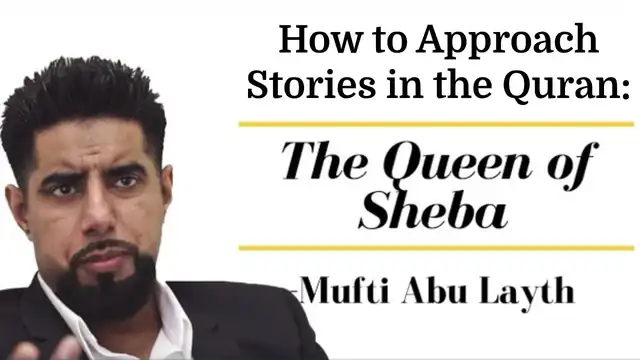 Play from 1:57
The video loads from YouTube only when you press play. Click a time in the transcript to seek.
Watch this part
Open on YouTube at 1:57The player starts at 1:57, the beginning of this part.
This segment0:00 to 9:32 · 9 min 32 sGeneral teaching
What this part covers
machinesummary, machine-writtenQuranic stories can be read as narrative and for lessons, but where they suggest the supernatural we must ask how to read them, unlike myths we never take as real.
In more detail
Mufti Abu Layth says he will use the story of the throne of the Queen of Sheba to discuss how to engage with stories in the Quran, after brushing off a caller on Facebook. He says storytelling is a uniquely human art, and that reading Quranic stories such as Yusuf's as narrative and drawing lessons from them is something he advises. He says some stories suggest, without explicitly saying, supernatural powers and events, and asks how to respond. He retells the Greek myth of Prometheus, who fashions man and steals fire for him, and Pandora's box, noting the parallel with Adam and the fruit, and the Hindu story of Manu and Vishnu as a growing fish, ending with a flood like Noah's. He says people read such stories as myths with lessons, not as reality.
Position stated
Mufti Abu Layth says some stories in the Quran suggest supernatural events without explicitly stating them.
“some of these stories have been mentioned in ways at times that suggest suggest I'm using the word here suggest they don't usually explicitly say so but they tend to suggest a very supernatural”
Category: teaching
Kind: general teachingTranscript
machine0:00 to 9:32 · click a time to seek · dotted terms open the glossary
so what else is going on people what else what's this shall we take a look at this sorry man Ali Salaam and the story of the throne of beauties right so people people people people the throne of beauties the Queen of Sheba all right people all right so what is all of this about and why am I even speaking about these stories so I want us I want to use part of this story the throne of the Queen of
Sheba and I want to really touch a greater discourse and that is how do we handle stories in the Quran how do we engage is a better word with stories in the parameter then they say why does move this way as a joke people is a joke all right so can't believe somebody from Facebook is trying to bloody call me
while some on Facebook life god damn it why do we have to have a disproportionate number of retards in this why why do non-muslims get all the clever people normal people and we get a disproportionate number of challenged anyway so right sorry let me return to where I was how do we engage with the stories in the Quran because I think
there's many ways to engage with stories okay now storytelling is one of the greatest of human arts really it is solely a human trait and it is something we have doing since the cognitive revolution right so human beings have this unique gift to be able to tell stories and bring to life lessons through those stories and and also relates actual stories and accounts as well and this
has been the means for information for you know for so long for millennia and now right ok so there's certain ways when we approach the Quran and this loads of stories in the Quran stories about Moses story about prophets especially about Adam about Jesus about Abraham about Solomon Solomon aleihsalaam about da hood about all these amazing beautiful intense sometimes stories in the Quran and how do we engage with them so at one layer
there is the level of where we're intrigued and that's good so we read it as a story so people read oh that allies telling you know like oh so I like hacen el us us the best of things to be relayed in the story of Joseph and his suffering and how he rises to power and and and that's an amazing story as it as a as a narrative for example then we can extract lessons from this that's amazing as well that's and these are all definitely things which I advise and promote so we could read the story of
Joseph of Yusuf Ali Salaam and we could learn about suffering about consequences about how Allah has a greater plan how things unfold all of these things and we can learn about that and that's things we should do the other then comes the layer that some of these stories have been mentioned in ways at times that suggest suggest I'm using the word here suggest they don't usually explicitly say so but they tend to suggest a very supernatural
thing to them how do we go about what do we do once we read these super suggested we infer so it can imply and we can infer yes so we infer from it's almost supernatural powers and events and how do we respond to that how do we engage that one way of engaging it is to say well oh well that means these people all had super powers like in myths for example mythologies like we could take the story of the Greek the ancient Greek
kind of people of Zeus Zeus for example and I was relaying a story the other the other day about Prometheus and how Prometheus is the person who fashions man he creates man and he's tasked to do that and he has this affinity with man and and then the gods get upset with you know they don't they feel kind of like they've been done over by prometheus so they take away fire from man and Prometheus he goes and he steals fire and gives it back to mine he redeems it
for them and then he is punished and he's punished in a very painful kind of way where something comes and eats at his liver every day and this carries on for an eternity until he is then saved by by pop man I believe if it's Haraka Haraka lease or whoever it is that comes and saves him now this is a story it's a it's a kind of myth okay and mine I was saying this the other day that man is then you see because man is kind of lonely he sent Pandora the woman and
Pandora brings with her a box so it's really interesting those of you that have heard the term Pandora's box for like a box of evil so the Zeus and the gods had kind of poured oh they had instructed that basically man is done over so he's given this Pandora brings this box and he's told not to open it but then what does mine do he opens it you see very this is a lot of parallels with I suppose the story of Adam and the Garden of Eden and not to eat the fruit and not to open Pandora's box and but he does open it and when man opens the box
our of it comes wrath and disease and illness and ill fate and all these things emerge from Pandora's box and and at the end but the flipside is right at the bottom of the box is hope and that too emerges and and man then has hope but the point is that it's it's an interesting story with parallels in other religions as well obviously I mean this is from the Greek mythology Greek myths but you have my point is how do you approach these stories now this story if I told you you would just
approach it as a myth you'd say yeah in this story these people have superpowers they do all these things but you're not taking it to be real like maybe you can learn lessons from it but you're not taking it as a kind of like oh this is real same thing with Hinduism if he looked in Hindu stories so for example speaking of the first man but there's a story in the I think it's in the Puranas or it's in the old the Hindu kind of Vedic stories about how how Vishnu I believe that the
first man they call manual that's in Hindu method tradition the first man is referred to as manu and then from him come mankind and Vishnu the law or the God appears to him as a fish a kind of struggling fish so Manu helps this fish and he puts him takes him out of his thing and puts him in a larger amount of water and then this phase she feeds him and the fish starts to grow and that's Vishnu growing growing then Manu has a good heart and he realizes look he's struggling let me put him in a greater amount of water and then he starts to struggle there and he grows and grows and then eventually he
becomes so big that he puts him in an ocean he's so big for the ocean that Manu is then told to build a he's told to build out of because he's been so kind he's told to build a boat and he builds a boat and and then a flood comes that drowns the world or people have once again a stark resemblance to the story of Noah in the Bible and the Quran so then the whole point was that here because of his kindness to Vishnu he is then guided and he's on this boat and he's saved and then from him come
mankind now when you read the story of man whom Vishnu or these things or of Prometheus we take them as stories we don't think that these were we you know if we don't we're not trying to be realistic with that the issue is when we read certain stories in the Quran that don't state but imply a supernatural prowess or power or capacity or capabilities how should we be so some Muslims just say no these are supernatural powers and these people had supernatural powers so Jesus for example
Paragraphs overlapping 0:00 to 9:32. Full text on the recording page.
Cite this segment
Stable id, transcript version and tier are part of the citation. Every change to a transcript is logged.Mufti Abu Layth Archive, segment 2019-01-08-S01, auto-transcribed, may contain errors. https://muftiabulayth.org/r/zotvtgdumv8/s/1/ (accessed 1 November 2026)
- APA 7
Mufti Abu Layth. (2019, January 8). How should Muslims read the stories in the Quran? [Video, segment 2019-01-08-S01, auto-transcribed, may contain errors]. Mufti Abu Layth Archive. Retrieved November 1, 2026, from https://muftiabulayth.org/r/zotvtgdumv8/s/1/
- Chicago author-date
Mufti Abu Layth. 2019. "How should Muslims read the stories in the Quran?" Video, segment 2019-01-08-S01, auto-transcribed, may contain errors. Mufti Abu Layth Archive. Recorded January 8, 2019. Accessed November 1, 2026. https://muftiabulayth.org/r/zotvtgdumv8/s/1/
- BibTeX
@misc{abulayth-2019-01-08-S01,
  author = {Mufti Abu Layth},
  title = {{How should Muslims read the stories in the Quran?}},
  year = {2019},
  month = {1},
  date = {2019-01-08},
  howpublished = {\url{https://muftiabulayth.org/r/zotvtgdumv8/s/1/}},
  url = {https://muftiabulayth.org/r/zotvtgdumv8/s/1/},
  organization = {Mufti Abu Layth Archive},
  urldate = {2026-11-01},
  note = {Segment 2019-01-08-S01, auto-transcribed, may contain errors}
}
Something wrong here?
Tell us what is wrong and it will be checked against the recording. Nothing changes until a person has reviewed it.
Sending a note needs JavaScript, which is off or unavailable in this browser. Nothing has been sent.
No name, email address or account is asked for or stored, and the inbox does not store your IP address. For rate limiting it keeps an unreadable fingerprint of your connection for 48 hours, and our database provider's own logs record connections as every website's do. Only your note, its kind, the page and the moment in the recording are kept, for review.