
Recordings › "God did NOT ask Abraham to sacrifice his son" | Mufti Abu Layth · 28 Oct 2020 › Segment 9 of 9
If God never commanded the sacrifice, why do the early sources all say he did?
udhiyah qurbani qurbaani udhiya udhiyya kurbani muftis jahannam jahanam jahannum koran quraan al-quran deen al-din ad-deen ad-dinWhy do no primary sources support this reading? The era, the moral of the story, and the mock execution
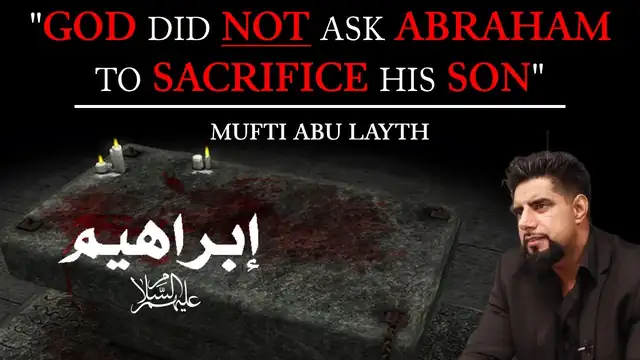 Play from 26:22
The video loads from YouTube only when you press play. Click a time in the transcript to seek.
Watch the answer
Open on YouTube at 26:22The player starts at 26:22, where the answer begins.
This segment25:03 to 29:58 · 4 min 55 sGeneral teaching
The answer in brief
machinesummary, machine-writtenMufti Abu Layth agrees that no primary sources support his reading and explains it by early Muslims absorbing Israelite material, by the brutal environment of the age being projected onto God, and by the absence of anything from the Prophet saying God commanded it. He repeats that a God who stages a mock execution of a child is unacceptable, and that Allah never says the command was his.
In more detail
After a joke about the 'assisted suicide' defence, Mufti Abu Layth says the story's moral was what people needed, so they took the moral and ran with it without contemplating the details. A viewer in the chat says the argument logically checks out but asks why there is no body of primary sources resonating with this view. Mufti agrees that there is none and explains: the material early Muslims digested came from Israelite sources, for whom it made sense that Yahweh, like Baal and the other gods, asked for a sacrifice and then stopped it as a test of willpower; some Muslims accepted it on the grounds that God did not let Ibrahim carry it out; and there is nothing established from the Prophet, who gave the Quran and could easily have said God commanded it. He adds that the environment 1300 years ago was so brutal that such a test seemed acceptable, people being products of their environment who project its harshness onto God, and that in more affluent modern times people have revisited their understanding of God and stripped away such accretions. To a second viewer who offers the moral that God asks whether we are willing to sacrifice what is most beloved, he replies that this is the moral Muslims went with, but that broken down it has God setting up a mock execution and asking a father to murder his child, which God would never do; even a willing father would be damaged by it. He closes by saying Allah clearly did not say it was from him, which to him ends the debate.
Question as read aloud · questioner not identifiedThe argument logically checks out, but how is it that there is no body of primary sources resonating with this view?
Position stated
Mufti Abu Layth holds that the absence of early sources for his reading is explained by early Muslims absorbing Israelite narratives and projecting a brutal environment onto God, that nothing established from the Prophet says God commanded the sacrifice, and that Allah's silence on the command's origin ends the debate.
“it's not from god and allah clearly did not say it was from him and he could have so that to me ends the debate”
Category: method
Kind: general teachingTranscript
machine25:03 to 29:58 · click a time to seek · dotted terms open the glossary
then you know if they carry on like i got into a discussion with someone about it and they said yeah but what's wrong with it god said in fact he said to me no if you think about it god never said to him murder your son uh because the son agreed god said to him assist him in committing suicide oh god the euthanasia advocate [Laughter] i found that so funny
i never said kill him i said convince him you're going to kill him then assist him in suicide oh the the technical barista oh that's so funny man that's all but yeah so that is the um the point and then yes because it became a moral people needed the moral from the story that somebody so they just took the moral and ran with it without actually contemplating the details of the story um i hope that's of some help right
somebody said rami nazim said that look i hear you and it logically checks out but how the hell are they no plethora of primary sources resonating with this view that it's out of the i absolutely agree because and i'll tell you why because in that day and age first of all the material that they were kind of just digesting was coming from israeli sources where it's fine it makes sense because that is yahweh the god of war it makes sense for since baal and these other gods used to ask for sacrifices yahweh asked for it but then he stopped him it was just a test of his willpower
and it makes sense for them now muslims picked up on it but you see this is what i was saying for it's crazy what um the era allows you some muslims kind of picked up on it and they just accepted it on the grounds that look well because god didn't let him carry it out it's okay maybe he did say it and they just run with it and i suppose you have to look at the the environment you know 1300 years ago because there's nothing from the prophet that is established that the prophet said that remember the prophet gave you the quran
he never said that he could have easily said it you know this could have easily been god's word saying that yeah we told him to do this didn't but people accepted it because the environment was so brutal that to them it became acceptable that okay maybe god did test someone like that and you see this is another problem when your environment is so harsh you can you kind of project you are a product of your environment and you project it also onto religion and you project it onto god
in some ways and this is why it's interesting that in modern times now when there is more affluence and prosperity how people have revisited the understanding of god and stripped it away from these environmental factors that people had kind of bolted onto it that because the environment is harsh god must be harsh so yeah i hope that makes sense um somebody said god was asking are you willing to sacrifice that which is most beloved yeah that's the moral of the story that muslims kind of went with then
but the truth is that look when you break it down what is god asking god is asking god is setting up a moxic mock execution he's asking a father to kill to murder his own baby that that god would never do that never that's just crazy that's just absolutely crazy it doesn't matter like that kind of a god is you know it he's got a problem because if he says yeah but i'm just doing it to test if you love me but that kind of a love is unnecessary you know that's like god is asking you to murder someone he said ah but i'm only messing
uh i'll just mess him with you that that's just messing with the with the brain that's you you turn someone crazy like that if you if you ask somebody and even if they were up to it out of sheer love for you to murder their own child can you imagine what the damage that would do to that individual so this it's it's not from god and allah clearly did not say it was from him and he could have so that to me ends the debate
Paragraphs overlapping 25:03 to 29:58. Full text on the recording page.
Cite this segment
Stable id, transcript version and tier are part of the citation. Every change to a transcript is logged.Mufti Abu Layth Archive, segment 2020-10-28-S09, auto-transcribed, may contain errors. https://muftiabulayth.org/r/yruc09ajkeq/s/9/ (accessed 1 November 2026)
- APA 7
Mufti Abu Layth. (2020, October 28). If God never commanded the sacrifice, why do the early sources all say he did? [Video, segment 2020-10-28-S09, auto-transcribed, may contain errors]. Mufti Abu Layth Archive. Retrieved November 1, 2026, from https://muftiabulayth.org/r/yruc09ajkeq/s/9/
- Chicago author-date
Mufti Abu Layth. 2020. "If God never commanded the sacrifice, why do the early sources all say he did?" Video, segment 2020-10-28-S09, auto-transcribed, may contain errors. Mufti Abu Layth Archive. Recorded October 28, 2020. Accessed November 1, 2026. https://muftiabulayth.org/r/yruc09ajkeq/s/9/
- BibTeX
@misc{abulayth-2020-10-28-S09,
  author = {Mufti Abu Layth},
  title = {{If God never commanded the sacrifice, why do the early sources all say he did?}},
  year = {2020},
  month = {10},
  date = {2020-10-28},
  howpublished = {\url{https://muftiabulayth.org/r/yruc09ajkeq/s/9/}},
  url = {https://muftiabulayth.org/r/yruc09ajkeq/s/9/},
  organization = {Mufti Abu Layth Archive},
  urldate = {2026-11-01},
  note = {Segment 2020-10-28-S09, auto-transcribed, may contain errors}
}
Something wrong here?
Tell us what is wrong and it will be checked against the recording. Nothing changes until a person has reviewed it.
Sending a note needs JavaScript, which is off or unavailable in this browser. Nothing has been sent.
No name, email address or account is asked for or stored, and the inbox does not store your IP address. For rate limiting it keeps an unreadable fingerprint of your connection for 48 hours, and our database provider's own logs record connections as every website's do. Only your note, its kind, the page and the moment in the recording are kept, for review.