
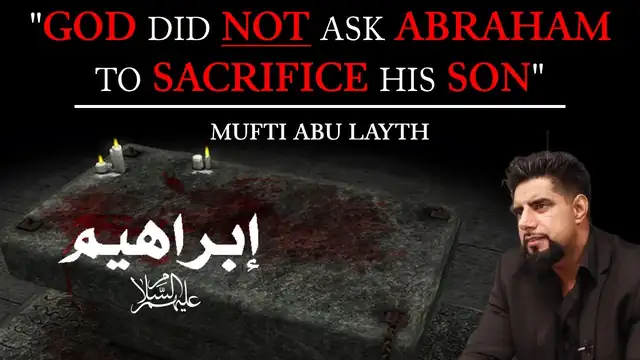
"God did NOT ask Abraham to sacrifice his son" | Mufti Abu Layth
tafseer exegesis tafasir tafaseer commentary udhiyah qurbani qurbaani udhiya udhiyya kurbani muftis hukm ahkam hukum hukam ahkaam shaitan shaytaan iblis iblees shayateen shayatin satan devil jahannam jahanam jahannum koran quraan al-quran sura soorah surat suwar soora ayah aya ayat ayaat aayah aayat wahy wahi wahee ulama ulema ulamaa fitnah fitna fitan strife deen al-din ad-deen ad-din ajr sawab thawab thawaab sawaabvideo · 29:58 · 32,000 views · 28 Oct 2020 · 9 segments · Open on YouTube
 Press play to load from YouTube. Nothing loads until you do.
9 segments
machine9Each block is a segment in time order. Click to open it.All segments · in time order
Transcript
machineauto-transcribed, may contain errors · source: youtube auto · click a time to seek · dotted terms open the glossarylet's talk about people ibrahim alaihissalam this story that is quite common it's very widespread um the story of the sacrifice or the attempted sacrifice of the son of ibrahim al-islam whether it was isaac whether it was ishmael whoever but the child sacrificing the son now what does the quran say about this do we in islam believe
that this commandment came from god it's my chopper people bring it in bring it in [Laughter] ah your commando so this uh right focusing on the question this commandment did not come from god okay now unfortunately it is widespread that it came from god um and i'll explain why people think that but let's first of all just look at the quran that addresses this issue from a purely quranic islamic perspective
so i understand what we're going to say in the judeo-christian tradition but before one looks at that just looking at the quran okay so you have got people uh one of the popular instances that is brought forward uh shaytan regime is in surah sulfate and people present this often this is the popular um verse where ibrahim al-islam is speaking about ibrahim al-islam where he says that i'm he mentions him becoming devoted to allah going off and
it mentions about his child doesn't mention who the child is now he addresses his child his son he says oh a small son a beloved son uh ini film i see in a dream that i am sacrificing you and he's you can tell that ibrahim al-islam is incredibly disturbed by what he's seen he's troubled he's confused about what what does this mean
um is this because he's of the assumption as well that prophets do receive revelation in their dreams as well so he's got that notion and he's thinking you know what does this mean so he asks the child what do you think um he says that uh what what do you see what do you think about this
now the sun here seems to convince him that this is a commandment and you need to you need to see out act out this instruction um you will find me amongst those who are patient now you see this is not something you have to um we'll come back to the verse you have to understand that where does this notion come from this notion is not something that is
unique like all of a sudden it's just ibrahim one day has this understanding you will see that the near east uh the middle east the whole that region of canaan that region of what would have been ancient mesopotamia all of these places would have had as a widespread practice they would have had human sacrifices so now you will see and this was just a paper as an example i've uh and you've got a another one
here this was an uh an essay done on the whole thing now the reason i'd just like to share with you some of these things is for you to understand that this was a a widespread practice and it carried right on right throughout the centuries that people would make offerings to particular gods i mean this is uh moloch which is actually similar shares the similar roots with the arabic
malek or milk king as well molk which comes from there as well now you would have sacrifices were ritually made to certain gods including molok including baal who is one of the gods that you will see sacrifices were made traditionally to these gods and i'm sharing this just so you get an idea and you can see even in the bible it speaks of uh other incidents as well you've got jephthah you've got orgepta who sacrifices his
daughter that's just like one of the absolute uh craziest seriously craziest notions so those of you that are not familiar with it what you had was uh you have this incident where jeff has gone out on a military campaign and he prays that if god grants him victory he will sacrifice the first person that he sees on his return [Laughter]
don't ask that person just you make all the executive decisions so jephthah says i will sacrifice the first person i see and lo and behold as he's victorious and returning home in the bible i uh it mentions i believe it's is it in um right uh right i think that might actually be in judges but uh but there it's also another sacrifice is mentioned jeremiah as well but along comes his daughter running to see her father because the father is victorious he's returned from war so lo and behold people what does the father do
he sacrifices the daughter ah your intelligence intelligence huh so these things that you can see were were practices that used to happen now it's important to know this because this will give you the kind of context to what is going on in that day and age so the in that whole surrounding that the in that region of canaan in ancient mesopotamia prior to that they had these sacrifices where people would often sacrifice
the firstborn so it's when ibrahim alaihissalam is there he's aware of this in the culture it's like if you're part of a culture you even if it's not your original culture but you see that this is what people do and sometimes it can play on your mind on the subconscious and therefore manifest in your dreams so ibrahim al-islam has this dream now in the dream he sees that he is sacrificing his son so so let's now go back to the verse
so here and it's interesting by the way the quran demonstrates it as with a knife although ancient kind of biblical versions are slightly confused on it some portray them as sacrificing with fire the binding and then you set a light and some do go towards the the knife version as well so let's go with how it is in the quran that uh he lays him out and he's preparing him
and allah shows that from his divine intervention allah calls out to as in he hears obviously it's not a physical voice but he hears that allah has addressed him so allah mentions that look we understand that allah is saying that you had a dream and you said you carried it out you were truthful to what you saw yeah
allah does not say we showed you that dream what does this mean so some people thought here this meant oh you're being pious by doing this no this meant that yes you mussin you are a person that is clearly known in the quran abraham was this is how we save them how we reward them by saving them from such a calamity that you would have ended up sacrificing murdering a your your son so we rewarded you by saving you from doing this
now this being a test you see people said oh this must have been from god that's why god said in the heart that this as you see in verse that 106 in so in verse 106 allah is saying that so people assume that oh well if it's a test or this is a trial this is a a calamity like a testing calamity so obviously it's from god but allah didn't say it was from him he said this but what was the this that allah speaking about
that this was that you saw a dream and felt that you had to act out in accordance with it this was indeed testing it's a testing calamity for people so not that god had sent it as a test but this was a testing calamity what they know you see now it's interesting feather is like where you atone and you rescue someone we rescued the the the the to be sacrificed son be behind and we said you know sacrifice of ram if that's what you're going to sacrifice and let it be known from here forth that
nobody should ever be conducting these kind of sacrifices human sacrifices okay so that's um the actual interpretation and you can see here as well this is tafsir samani where he is mentioning that he's got let me just bring this one i have this right so here he mentions oh sorry um
that the the verse which we translated it says that i've been uh commanded that's one understanding of it but he mentions ibn abbas says that this is why he thinks that and it said that you see i saw something in a dream which to me it gave the understanding that i've been commanding not that i have been commanded you understand what reflects or demonstrates to me that
maybe i've been commanded so that's and here you've got a taser of ibn uh the mahara which is where he mentions what in okay so it could be that this what is it that is
that what was a test could be the the you know it could be this he's saying obviously because many and i'm going to come to that many people historically went with that that it was the actual test or it could be that this now relief that he had was very testing for him why was this relief testing for him because there's the understanding that he could have sacrificed he could have murdered his own son so this was very testing upon him now it's important to understand this why now first of all why did people then
if i'm saying this why have people historically said something different now you have to understand that a lot of our early islamic thought has been influenced by the israelites by jewish judeo-christian narratives that have been floating so many early muslims took things from early jewish scribes like
all these people and and obviously in the judeo culture this is what they thought had happened so people are accepting that look there was this this incident with abraham but where did this come from this where did the commandment was it just something he saw himself what did god tell him now i know in the bible they say it as oh god told him but not in the quran the quran never said that and allah could have said that it was so easy to say we told him sacrifice and then we found him to indeed be somebody who lives up to his word so we told him stop but allah never said that
you see now the question is it is look i understand that most muslims have been brought up with this kind of a belief but in all honesty that belief is an absurdity you are saying that god is asking a father to murder his child why because it will make him happy i mean that that is utterly beyond any level of rationality it is so absurdly sadistic
because what what is it that you are actually saying god is asking him to do here now people will say yes but he stopped him before he did it now but that's similar to like a moxic mock execution then you know yeah we're going to just scare you into you're going to think we're going to execute you but then we're going to actually stop a mock execution which are some of the most horrific traumatizing uh incidents that could ever happen i mean from a psychological perspective if you read the studies on mock executions and what they do to people
psychologically so in all honesty i i find this belief even though i'm not look i understand muslims many muslims believe it but this belief in and of itself upon true inspection is blasphemous but i understand the fact that most people just haven't questioned it it's not that they you see they they're following it without actually thinking about it like they've just heard it since they were kids and they never really thought about it what does it actually mean and they just yeah yeah yeah it just makes sense yeah it's just a trial and then god saved him but when you think about it what is it that you're actually saying you're saying that god
gets a kick out of saying to a father who just about had a son like you know what go kill your son for me slit his throat because why because it's gonna make me happy that you do it and then don't do it kill that sheep instead that is utterly absurd that does not sound like a god of you know of this great majesty of the the wonder of the creator of the cosmos that doesn't sound like that that kind
of a god now the jewish people why did they go now you've got to understand something people jewish people the israelites when they came to worshipping one god the name they chose for god was yahweh you have to understand that yahweh was already a god that existed in the middle east yahweh is not the name of god by the way people don't many people may not know this yahweh is from the house of el el is also another name that jewish people call god now l was another god that existed and he had a household of
gods he had like his children and so on now in his household was yahweh yahweh was the god of war now he has a consult by the way yahweh does but what happens is the israelites choose this term for god and they refer to yahweh now the ultimate god as yahweh now i'm not saying that's necessarily um i'm not saying that is a problem per se i feel that people can do that it's not you know words are developed like that they do kind of evolve over time the issue is
when you do that you will carry over some baggage like let me give you an example imagine the vikings who have this god of war odin now imagine they become monotheists and they start to refer to god the ultimate god as odin now what would happen is naturally the the character of odin that they previously knew as odin will spill over in some aspects in this new narrative it will have to because when they speak of
odin odin even if they block out the bulk of it five percent will see pover at least this war element now yahweh is this treacherous not treacherous but this brutal character of uh that existed in the middle east of this god of war that is vengeful that is he's about killing he's about exterminating he's about making sure you know those that oppose him destroying them he's this comes over into their monotheism so when they speak of abraham to them it makes sense that yahweh could have said this
you see but to us it isn't that isn't the case right so yahweh is not allah he's not god and allah keeps reminding us he is so this is not the true image of god and to say that god wanted god wanted a man to kill his son his own son slices you know to slit his throat in front of him just because it will give god a kick like he will get happy out of it uh it's it's this is you know subhanahu wa
yo as allah says in the quran now this is it's never acceptable honestly and i understand that many muslims do believe that because they've just been brought up with the judeo-christian stories and they're just going with it and they're not really thinking about it you know it's like many of those believe it's like when i grew up with it i didn't really think about it i just accepted it and it's only upon introspective kind of analysis that a person thinks that wait a minute this doesn't actually make sense uh and what's interesting the scholars of the past too i have scholars you know sometimes you got
the scholars of the past are discussing all these things on it like and all these other they're debating all these things on it like they'll say hmm so you know like they'll discuss this does this mean that the dream that he saw it or did it come to him in a vision like was it was it so they'll discuss this and then they'll discuss all these other things like okay so there's the ruling that uh can god instruct something and abrogate it before he even uh has you acted out can god this also shows ah it shows the interesting masala of uh akam rulings can come via dreams uh oh another interesting point it covers
the topic this is them the interesting point here that we can discuss uh rulings also come at night time or during sleep and they come out [Laughter] and the elephant in the room the elephant in the room is a cha cha cha so god wanted a dad to kill his son to get a kick out of it does anybody want to discuss this [Laughter] none of them discuss that they'll just go yes so it's really interesting is there anything out any other anything else on the agenda anything you're like
they're like anything no no oh yeah there is there is there is there's a linguistic term we need to debate why was the word uh you know for they now used what uh what was the sheep that that that's an interesting point we before we conclude what was the sheep that was sacrificed was it a ram was it uh [Laughter] uh nobody's discussing the fact that wait a minute god said kill your son i mean
what to make me happy can somebody discuss this nothing nothing else all linguistic any grammatical or grammar done okay so we've concluded this chapter nothing more to discuss here ah right so i think look i'm not blaming muslims who believe in this or look this belief is blasphemous but i'm not saying to individual muslims you guys are blaspheming because i genuinely don't think that they've
thought about it i think they've just been brought up without like the way i was brought up with this belief i never really thought about it so if somebody said to me oh you're blaspheming you unlike the other issues where people are saying things like the prophet beded a child that is clear blaspheming because they're just pushing the gender there but here these are old narrative stories that they've heard since they were kids and they're just regurgitating them without actually thinking over what they're saying but they just you know they're not really thinking what they're saying and if they think about the story they will
then you know if they carry on like i got into a discussion with someone about it and they said yeah but what's wrong with it god said in fact he said to me no if you think about it god never said to him murder your son uh because the son agreed god said to him assist him in committing suicide oh god the euthanasia advocate [Laughter] i found that so funny
i never said kill him i said convince him you're going to kill him then assist him in suicide oh the the technical barista oh that's so funny man that's all but yeah so that is the um the point and then yes because it became a moral people needed the moral from the story that somebody so they just took the moral and ran with it without actually contemplating the details of the story um i hope that's of some help right
somebody said rami nazim said that look i hear you and it logically checks out but how the hell are they no plethora of primary sources resonating with this view that it's out of the i absolutely agree because and i'll tell you why because in that day and age first of all the material that they were kind of just digesting was coming from israeli sources where it's fine it makes sense because that is yahweh the god of war it makes sense for since baal and these other gods used to ask for sacrifices yahweh asked for it but then he stopped him it was just a test of his willpower
and it makes sense for them now muslims picked up on it but you see this is what i was saying for it's crazy what um the era allows you some muslims kind of picked up on it and they just accepted it on the grounds that look well because god didn't let him carry it out it's okay maybe he did say it and they just run with it and i suppose you have to look at the the environment you know 1300 years ago because there's nothing from the prophet that is established that the prophet said that remember the prophet gave you the quran
he never said that he could have easily said it you know this could have easily been god's word saying that yeah we told him to do this didn't but people accepted it because the environment was so brutal that to them it became acceptable that okay maybe god did test someone like that and you see this is another problem when your environment is so harsh you can you kind of project you are a product of your environment and you project it also onto religion and you project it onto god
in some ways and this is why it's interesting that in modern times now when there is more affluence and prosperity how people have revisited the understanding of god and stripped it away from these environmental factors that people had kind of bolted onto it that because the environment is harsh god must be harsh so yeah i hope that makes sense um somebody said god was asking are you willing to sacrifice that which is most beloved yeah that's the moral of the story that muslims kind of went with then
but the truth is that look when you break it down what is god asking god is asking god is setting up a moxic mock execution he's asking a father to kill to murder his own baby that that god would never do that never that's just crazy that's just absolutely crazy it doesn't matter like that kind of a god is you know it he's got a problem because if he says yeah but i'm just doing it to test if you love me but that kind of a love is unnecessary you know that's like god is asking you to murder someone he said ah but i'm only messing
uh i'll just mess him with you that that's just messing with the with the brain that's you you turn someone crazy like that if you if you ask somebody and even if they were up to it out of sheer love for you to murder their own child can you imagine what the damage that would do to that individual so this it's it's not from god and allah clearly did not say it was from him and he could have so that to me ends the debate
Something wrong here?
Tell us what is wrong and it will be checked against the recording. Nothing changes until a person has reviewed it.
Sending a note needs JavaScript, which is off or unavailable in this browser. Nothing has been sent.
No name, email address or account is asked for or stored, and the inbox does not store your IP address. For rate limiting it keeps an unreadable fingerprint of your connection for 48 hours, and our database provider's own logs record connections as every website's do. Only your note, its kind, the page and the moment in the recording are kept, for review.
Cite this recording
Stable id, transcript version and tier are part of the citation. Every change to a transcript is logged.Mufti Abu Layth Archive, auto-transcribed, may contain errors. https://muftiabulayth.org/r/yruc09ajkeq/ (accessed 1 November 2026)
- APA 7
Mufti Abu Layth. (2020, October 28). "God did NOT ask Abraham to sacrifice his son" | Mufti Abu Layth [Video, auto-transcribed, may contain errors]. Mufti Abu Layth Archive. Retrieved November 1, 2026, from https://muftiabulayth.org/r/yruc09ajkeq/
- Chicago author-date
Mufti Abu Layth. 2020. ""God did NOT ask Abraham to sacrifice his son" | Mufti Abu Layth." Video, auto-transcribed, may contain errors. Mufti Abu Layth Archive. Recorded October 28, 2020. Accessed November 1, 2026. https://muftiabulayth.org/r/yruc09ajkeq/
- BibTeX
@misc{abulayth-yRuC09ajKEQ,
  author = {Mufti Abu Layth},
  title = {{"God did NOT ask Abraham to sacrifice his son" | Mufti Abu Layth}},
  year = {2020},
  month = {10},
  date = {2020-10-28},
  howpublished = {\url{https://muftiabulayth.org/r/yruc09ajkeq/}},
  url = {https://muftiabulayth.org/r/yruc09ajkeq/},
  organization = {Mufti Abu Layth Archive},
  urldate = {2026-11-01},
  note = {Auto-transcribed, may contain errors}
}