
Recordings › The Maulana/Madrassa crisis & Why my views appear to be different? - Mufti Abu Layth al-Maliki · 15 Feb 2018 › Segment 1 of 4
Why don't most scholars say what Mufti Abu Layth says?
muftis jahannam jahanam jahannum aalim ulama ulamaa ummah umma ummatWhy don't other ulema say what he says? The maulana monolith and what makes a scholar
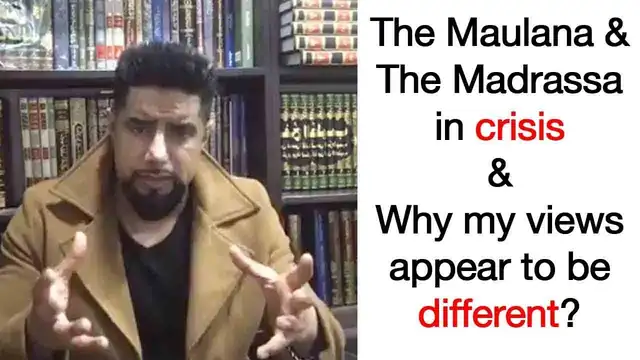 Play from 0:38
The video loads from YouTube only when you press play. Click a time in the transcript to seek.
Watch the answer
Open on YouTube at 0:38The player starts at 0:38, where the answer begins.
This segment0:00 to 5:38 · 5 min 38 sGeneral teaching
The answer in brief
machinesummary, machine-writtenScholars who are articulate leaders able to meet the challenges of the time usually become so in spite of the madrasa system, which does not teach these skills or, in some places, critical thinking.
In more detail
Mufti Abu Layth takes up a question that people put to him: if his views are right, why are they not voiced by many other ulema? He calls this the myth of the maulana monolith and says that to understand it one has to evaluate the situation of the scholars of the late twentieth and twenty-first centuries, stressing that he does not mean to disparage them. After a brief interruption he lists what people expect of an alim beyond knowledge: intelligence, articulacy, oratory and public speaking, charm and people skills, leadership and management, an authoritative personality and the ability to answer the challenges of the time. He says those who turn out like this usually do so in spite of the system, not because of it, since the madrasas do not teach leadership, personality, people skills or public speaking, and some do not emphasise critical thinking. He adds that madrasas produce scholars who replicate them, and that Islamic influence in the UK and the US comes mainly from the Indo-Pak subcontinent and partly from Saudi Arabia, not from places such as Malaysia or Indonesia.
Question as read aloud · questioner not identifiedIf you are saying these things, why are many other ulema not saying them?
- The question was reconstructed from Mufti Abu Layth's restatement; the questioner's own words are not in the recording
Position stated
Mufti Abu Layth says that scholars who turn out articulate, charismatic and able to meet the challenges of the time usually do so in spite of having gone through the madrasa system, not because of it.
“people who turn out like that are usually they turn out like that in spite of having gone through the system not because of having gone through the system”
Category: teaching
Kind: general teachingTranscript
machine0:00 to 5:38 · click a time to seek · dotted terms open the glossary
I'd like to actually answer as well this was asked I mean it was it taps into a theme which maybe at some point I'd like to do maybe a lengthier discussion on and that is the myth of the molana monolith monolith that we have okay this there is an understanding that why is it when I say certain things these views are not the views that are coming from many ulema okay so people may say well okay if you're saying this why are many other am I not saying this now this to
understand that you can understand that but to do so you have to take a step back and evaluate the whole situation you have to shed a bit of light on this molana' situation this the scholars of the 21st century especially in the late 20th century and and why are they thinking in a particular way and this is in no way to to kind of disparage these Olimar may Allah bless them preserve them but it's just shed light on what's going on okay first of all you have to understand what makes a scholar is
something right what makes a scholar in the right okay I'm just gonna sort of people enough to cut off the tour otherwise this is gonna go on forever right so alright I'm sorry about that it's just that would have been in anyway so the point is what makes an island
sometimes people forget okay obviously there's there in the knowledge but then there is a huge expectation of what allama should be so there is an expectation that an island ought to not only be very intelligent but he ought to be somebody who is very articulate okay which once again comes down to linguistic skills he ought to be somebody that is an orator that can speak in front of masses of people he and this also involves the ability to
public speak it involves an element of charm an element of people skills an element of having that kind of attraction that they can attract people to them this and so there's this expectation there's an expectation that he ought to be he ought to be somebody that is a leader in the community that he can he can do things like manage people he can he can delegate he can take control assume control he has an authoritative personality about him that
he can rise to the challenges of the time so there's a challenge going on and the Allium can detect that this is a challenge he can conjure up an effective argument in response to that contemporaneous very current challenge that they face him and he can deal with it now there is a hell of a lot of an expectation from scholars this is why now is it that's what the desired outcome is people who turn out like that are usually they turn out like that in spite of having gone through the system
not because of having gone through the system so that's one thing to top that expectation so for example there's no there's no teaching of how to leave ship skills they don't teach you leadership skills don't teach you how to develop and hone in on your personality how to have people skills how to be a good orator how to effectively speak in front of public speaking they don't teach you how to have charmed how to do these kind of they don't teach you any of these kind of things so the understanding is well all of these just happen to be in spite of having gone through the system that's one thing the
other thing is yes in some of the Madhuri's I do recognize that they don't push they don't put emphasize critical thinking skills okay now that does lead to a particular kind of because what happens is mattresses they produce scholars you go and replicate them so in the UK and the u.s. our majority influence of Islam comes from certain parts of the world only it doesn't come from like Malaysia or Indonesia it comes from the indo-pak world subcontinent and
it comes from partially Saudi Arabia that is it predominantly where our Islamic influences come from now you have to once you get into the mindset you realize okay well there's these challenges going on that there's a whole skill set which either you just happen to have or you will happen to develop or you will not be given them necessarily in the Institute's the other important thing that I want to highlight is the challenges internally with the student of knowledge okay so the scholars who are the scholars in the making because
every year let's say in the UK there's hundreds and hundreds of olam are being produced hundreds probably about 500 ulema not even one of them will perhaps at best one may have some substance now you have to understand why because this ties into this question of why are older man not echoing sometimes when people ask you know you're saying something but olomana echoing that voice you have to get into the mind of the 21st century Milana now to get into his mind you have to understand that most people who are put into mothers right let's just pause this for a moment pause this whole thing
Paragraphs overlapping 0:00 to 5:38. Full text on the recording page.
Cite this segment
Stable id, transcript version and tier are part of the citation. Every change to a transcript is logged.Mufti Abu Layth Archive, segment 2018-02-15-S01, auto-transcribed, may contain errors. https://muftiabulayth.org/r/wl7wikke16q/s/1/ (accessed 1 November 2026)
- APA 7
Mufti Abu Layth. (2018, February 15). Why don't most scholars say what Mufti Abu Layth says? [Video, segment 2018-02-15-S01, auto-transcribed, may contain errors]. Mufti Abu Layth Archive. Retrieved November 1, 2026, from https://muftiabulayth.org/r/wl7wikke16q/s/1/
- Chicago author-date
Mufti Abu Layth. 2018. "Why don't most scholars say what Mufti Abu Layth says?" Video, segment 2018-02-15-S01, auto-transcribed, may contain errors. Mufti Abu Layth Archive. Recorded February 15, 2018. Accessed November 1, 2026. https://muftiabulayth.org/r/wl7wikke16q/s/1/
- BibTeX
@misc{abulayth-2018-02-15-S01,
  author = {Mufti Abu Layth},
  title = {{Why don't most scholars say what Mufti Abu Layth says?}},
  year = {2018},
  month = {2},
  date = {2018-02-15},
  howpublished = {\url{https://muftiabulayth.org/r/wl7wikke16q/s/1/}},
  url = {https://muftiabulayth.org/r/wl7wikke16q/s/1/},
  organization = {Mufti Abu Layth Archive},
  urldate = {2026-11-01},
  note = {Segment 2018-02-15-S01, auto-transcribed, may contain errors}
}
Something wrong here?
Tell us what is wrong and it will be checked against the recording. Nothing changes until a person has reviewed it.
Sending a note needs JavaScript, which is off or unavailable in this browser. Nothing has been sent.
No name, email address or account is asked for or stored, and the inbox does not store your IP address. For rate limiting it keeps an unreadable fingerprint of your connection for 48 hours, and our database provider's own logs record connections as every website's do. Only your note, its kind, the page and the moment in the recording are kept, for review.