
Recordings › The Maulana/Madrassa crisis & Why my views appear to be different? - Mufti Abu Layth al-Maliki · 15 Feb 2018 › Segment 2 of 4
Why do so many maulanas think the way they do?
muftis riba ribaa sood usury ulama ulamaa madrassa madaris madrassah religious schoolInside the mind of the twenty-first-century maulana: upbringing, alienation and inferiority
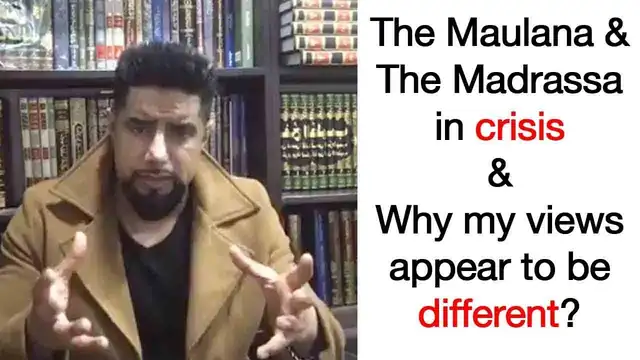 Play from 5:38
The video loads from YouTube only when you press play. Click a time in the transcript to seek.
Watch this part
Open on YouTube at 5:38The player starts at 5:38, the beginning of this part.
This segment5:38 to 15:16 · 9 min 38 sGeneral teaching
What this part covers
machinesummary, machine-writtenMany maulanas grow up mocked, alienated and insecure, are trained in material irrelevant to the real world, and are then made leaders young, and that past shapes their decisions. He says he is shedding light, not disparaging them.
In more detail
Mufti Abu Layth says that of perhaps five hundred ulema produced each year in the UK, at best one may have some substance, and that to see why one has to get into the mind of the twenty-first-century maulana. He poses scenarios, a bullied child who becomes a police officer, someone who knew poverty and becomes a doctor, an abused woman who becomes a family judge, to show that people's past shapes their outlook, and asks why this is not recognised for scholars. He describes the typical student: from a strict religious family of one denomination, spending some eight years in a madrasa learning material irrelevant to the real world, which he likens to studying navigation by the astrolabe; mocked by ordinary Muslims, looked down on as an immigrant by non-Muslims, particularly in small towns, insecure around women and alienated in a hyper-sexualised society, while taught by older teachers from India and Pakistan with a harsh mentality. Then, at twenty or twenty-five, he is put on a pedestal as a leader and women come to him with questions such as whether they may wear nail polish or cut their hair, and Mufti says one would be naive to think that his past does not influence his decisions. He repeats several times that he is only shedding light on the situation, not mocking or disparaging anyone, and adds that many have not been encouraged to think critically.
Position stated
Mufti Abu Layth says one would be naive to think that the past of young maulanas, who hardly interact with women, does not influence their decisions when women come to them with questions.
“is it okay for me to wear nail polish is it okay for me to cut my hair do you not think that their past will influence their decisions you've been naive to think that it doesn't”
Category: teaching
Kind: general teachingTranscript
machine5:38 to 15:16 · click a time to seek · dotted terms open the glossary
it comes from partially Saudi Arabia that is it predominantly where our Islamic influences come from now you have to once you get into the mindset you realize okay well there's these challenges going on that there's a whole skill set which either you just happen to have or you will happen to develop or you will not be given them necessarily in the Institute's the other important thing that I want to highlight is the challenges internally with the student of knowledge okay so the scholars who are the scholars in the making because
every year let's say in the UK there's hundreds and hundreds of olam are being produced hundreds probably about 500 ulema not even one of them will perhaps at best one may have some substance now you have to understand why because this ties into this question of why are older man not echoing sometimes when people ask you know you're saying something but olomana echoing that voice you have to get into the mind of the 21st century Milana now to get into his mind you have to understand that most people who are put into mothers right let's just pause this for a moment pause this whole thing
for a moment I want to ask some questions here the question is if I told you that look let's take a scenario if I told you that a there was a kid who got bullied as a child now he in his later years as I mean as he grows up he becomes a police officer let's say do you think how do you think his behavior will be towards people do you think that bullying will have impacted him let's say I say to you I'll give you another scenario let's say there was a person who saw extreme poverty in their life now they turn out
to become a doctor and as soon as they become a doctor they're given an opportunity to go into the private corporate kind of world of medicine or they can stay within the NHS and the government kind of services but they've seen extreme poverty in their life do you think that will influence the direction they go in let me give you another scenario let's say there's been a let's say there's been let's take a tragic example somebody who's been a victim of abuse let's say a woman who's been a victim of abuse unfortunately and these things do happen you know may
Allah protect people but let's say a woman's been a victim of abuse now she's been brought up she's gone through different abuse or she's a domestic abuse whatever in her later years she becomes a judge who resides over family matters or cases of abuse do you think her perspective will be influenced by her past now most people the reason I put these scenarios out there most people won't take a second to recognize that their current states will be influenced by their past so people will look at certain things based on their own
upbringing now why we suspend that thought when it comes to scholars I have no idea go back to what I was saying most people who enter this kind of domain of seeking knowledge first of all they come from a family which is religious of religious family now religious family already belongs to a particular denomination so this is most people remember not all but most and they have already been brought up in very strict kind of guidelines this is like let's say in the UK so a kid is brought up in Arnall Birmingham
Manchester London now he's already in this kind of the family restrict several things around him they put him in a madrasah in which he learns things for the next let's say eight years which are completely irrelevant to the real world for him so let's say as an example to make this example hit home let me give you guys an example there's something called let's say the what do they used to call it the astrolabe I believe the Astro Astro astrolabe but anyway it was
a study it was a study of how to navigate especially through the Seas using compasses okay and in medieval times this was like Golda's knowing this kind of stuff but these books are still around today let's say I I put somebody I put you in a madrasah I put you in an Institute and they taught you how to navigate using the astrolabe using the certain kind of compasses and things like these not modern technology not modern technology compasses and stuff like this and how to navigate the Seas to most people that is irrelevant like
it doesn't have no relevance to the real world but they can memorize stuff you're memorize coordinates you memorize things you go through let's say six years of study like this also you have to remember these people when they go into madras are they usually madras assigned small towns some are in the largest cities as well but these people will always won most of their day is spent in this institute around it just by let's say just for people who think like them they don't mingle with the normal people as much normal regular Muslims who don't pray who don't do stuff to the normal regular
Muslim these people are like the movies they mock them right so we all know this so they'll say oh look movies come o Molossia they'll mock them right so these people will sort they feel kind of like not intimidated but they feel mocked and ridiculed by common people that's common Muslims and I'm not saying this - I'm just I'm just showing a kind of and I'm just putting a spotlight on this I'm not being critical I'm not trying to disparage the situation or be literally now then these people let's
say they go through city centre they always dress in turbans and we're thugs and wear shalwar kameez so regular non-muslims in the UK will look at these people like who you know like immigrants like who are these immigrants especially in small towns there's a lot more racism yeah so they will be they will be kind of mocked or at least look down on and made to feel inferior as they go about their daily business this is not I'm not knocking people here by the way I'm not I'm just shedding light please don't this is not to laugh or anything like this right so now let's whilst they're
growing up remember normal people when they go home normal guys on the streets as they're doing all they they got their bling-bling you know they're some of the older guys have got smooth cars they're checking girls all these guys have got girlfriends these guys are nothing like that because of the way they look obviously I'm not not too despite but they definitely will feel insecure around women because most girls are not going to be interested in them right so these guys are now let's say this is getting into the mind of the making of mallanna's okay that we have today so
you have a lot of inferiority complexes going on so they so for example they're catching a bus they're seeing this every day the societies we live in a hyper-sexualized they seem people they seem Muslims non-muslims everybody dresses different to them they chill out even when they see girls and guys or they might see a couple kissing on a bus they might see some these things for them are as distant as the movies are like it's not a reality so you have to try to see how are they feeling from inside right so they're feeling very kind of alienated
from the world that they are actually in now they go to madrasah and mothers are once again it's all just their teachers who are older versions of them and who are usually from back home India Pakistan reinforcing and very harsh mentality so this this person develops like this he leaves a Madras and all of a sudden he's given a leader kind of role a pedestal then you get for example like I'm not judging these people but I'm just showing you a picture you will get now for example women that will come to remember these are people who never
hardly interact with women they don't share space with them they spend all their days the only time like let's say they've come across women women don't show any interest in them generally speaking just because of the way our societies are now all of a sudden they become like leaders let's say at the age of twenty twenty-five and you get women coming to them open here dress good whatever asking them hey listen is it okay for me to wear nail polish is it okay for me to cut my hair do you not think that their past will influence their decisions you've been naive to
think that it doesn't these very little chance that first of all these people will go out of their way to accommodate for for this other because that other has usually always been very separate to the movie to the Maulana to the lifestyle right so the thing is I'm just trying to get you inside the mind of these people and then you have to remember a lot of the these people haven't been encouraged to do critical thinking they haven't been encouraged to do these things so they obviously are given this position they don't have those other and then naturally we end up
Paragraphs overlapping 5:38 to 15:16. Full text on the recording page.
Cite this segment
Stable id, transcript version and tier are part of the citation. Every change to a transcript is logged.Mufti Abu Layth Archive, segment 2018-02-15-S02, auto-transcribed, may contain errors. https://muftiabulayth.org/r/wl7wikke16q/s/2/ (accessed 1 November 2026)
- APA 7
Mufti Abu Layth. (2018, February 15). Why do so many maulanas think the way they do? [Video, segment 2018-02-15-S02, auto-transcribed, may contain errors]. Mufti Abu Layth Archive. Retrieved November 1, 2026, from https://muftiabulayth.org/r/wl7wikke16q/s/2/
- Chicago author-date
Mufti Abu Layth. 2018. "Why do so many maulanas think the way they do?" Video, segment 2018-02-15-S02, auto-transcribed, may contain errors. Mufti Abu Layth Archive. Recorded February 15, 2018. Accessed November 1, 2026. https://muftiabulayth.org/r/wl7wikke16q/s/2/
- BibTeX
@misc{abulayth-2018-02-15-S02,
  author = {Mufti Abu Layth},
  title = {{Why do so many maulanas think the way they do?}},
  year = {2018},
  month = {2},
  date = {2018-02-15},
  howpublished = {\url{https://muftiabulayth.org/r/wl7wikke16q/s/2/}},
  url = {https://muftiabulayth.org/r/wl7wikke16q/s/2/},
  organization = {Mufti Abu Layth Archive},
  urldate = {2026-11-01},
  note = {Segment 2018-02-15-S02, auto-transcribed, may contain errors}
}
Something wrong here?
Tell us what is wrong and it will be checked against the recording. Nothing changes until a person has reviewed it.
Sending a note needs JavaScript, which is off or unavailable in this browser. Nothing has been sent.
No name, email address or account is asked for or stored, and the inbox does not store your IP address. For rate limiting it keeps an unreadable fingerprint of your connection for 48 hours, and our database provider's own logs record connections as every website's do. Only your note, its kind, the page and the moment in the recording are kept, for review.