
Recordings › Why did I Choose Maliki Fiqh? -Mufti Abu Layth · 22 Mar 2019 › Segment 1 of 2
What is fiqh, and is it the same as Shari'ah?
fiqah jurisprudence fikh shariat sharee'ah maaliki malikite malikiyyah maliki school muftis ulama ulema ulamaa ibadah ibada ibaadah ibadatWhy Maliki fiqh? First, what fiqh is and how it relates to Shari'ah
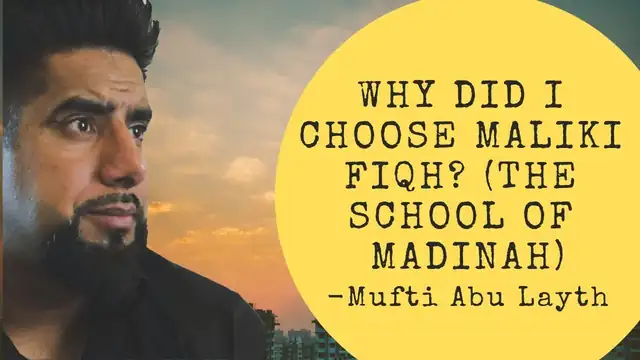 Play from 0:00
The video loads from YouTube only when you press play. Click a time in the transcript to seek.
Watch the answer
Open on YouTube at 0:00The player starts at 0:00, where the answer begins.
This segment0:00 to 2:35 · 2 min 35 sGeneral teaching
The answer in brief
machinesummary, machine-writtenFiqh is our understanding of what is expected of us towards God and towards people. It overlaps with Shari'ah, which people usually keep for the legal side, and it has different ways of deriving rulings.
In more detail
Mufti Abu Layth takes the question of why he chose Maliki fiqh and begins, for viewers who are less expert, with what fiqh is. He jokes about how the word is pronounced, noting that some Arabs today say it differently, while traditionally it is fiqh with a kasra. He defines fiqh as our understanding of what is expected of us towards God and towards people. He says it is partly synonymous with Shari'ah, which people tend to reserve for the legal side, whereas the other term is broader and includes worship and non-legal matters, describing the relationship between the two as one of general and particular [?]. He adds that within fiqh there are different ways of interpreting and extracting Islamic law, which leads into the schools.
Question as read aloud · questioner not identifiedWhy did you choose Maliki fiqh?
- Low audio confidence in the transcript
- Some terms in this segment are uncertain
Position stated
Mufti Abu Layth says fiqh is our understanding of what is expected of us towards God and towards people, partly synonymous with Shari'ah, a word people tend to reserve for the legal side.
“it's our understanding of what is kind of expected from us okay towards God or towards people”
Category: teaching
Kind: general teachingTranscript
machine0:00 to 2:35 · click a time to seek · dotted terms open the glossary
right so why did you choose Maliki [ __ ] why did I choose Maliki [ __ ] Maliki [ __ ] people let's start off with this while people are tuning in Maliki fit okay so first of all for for our less expertise sorry for our less expert viewers fifth simple fact not in case you're thinking war on earth is move this up table
Autobot what the fake is fit some of the Arabs read it as [ __ ] but the Hutt's I disagree with their pronunciation they actually do say that you're gonna hear some of the folk AHA like some of the scholars they like really big beards and everything and in between there let's go you know the [ __ ] the football you'll be like oh ma che no no need for that language mate I only asked an Islamic question no need for that
but they actually pronounce it [ __ ] some of the the Arabs today today as in in this day and age so not but in traditional thick it's called thick with a kisara okay not with a dama dama sorry so the [ __ ] right what is fit so v is basically our understanding of Islam sorry let me rephrase that it's our understanding of what is kind of
expected from us okay towards God or towards people so that is called [ __ ] some it is partially synonymous with Sharia so Sharia people tend to reserved only for the legal aspects and that is more generic so it includes the legal as and non-legal like worship and other things as well so firk is you know this is a MooMoo
sauce that's the relationship that's going on between sherry alpha so thick and then within fact you have different ways of looking at things that interpreting extracting Islamic law how do we understand rulings and everybody you know they've got their own take on it and then people kind of disappeared and these four major schools of law remained I say four because I'm being kind to the humble ease did let's make that the humble ease the the little finger there you go the humbly right there that's that's
Paragraphs overlapping 0:00 to 2:35. Full text on the recording page.
Cite this segment
Stable id, transcript version and tier are part of the citation. Every change to a transcript is logged.Mufti Abu Layth Archive, segment 2019-03-22-S01, auto-transcribed, may contain errors. https://muftiabulayth.org/r/uixtl3pqp-q/s/1/ (accessed 1 November 2026)
- APA 7
Mufti Abu Layth. (2019, March 22). What is fiqh, and is it the same as Shari'ah? [Video, segment 2019-03-22-S01, auto-transcribed, may contain errors]. Mufti Abu Layth Archive. Retrieved November 1, 2026, from https://muftiabulayth.org/r/uixtl3pqp-q/s/1/
- Chicago author-date
Mufti Abu Layth. 2019. "What is fiqh, and is it the same as Shari'ah?" Video, segment 2019-03-22-S01, auto-transcribed, may contain errors. Mufti Abu Layth Archive. Recorded March 22, 2019. Accessed November 1, 2026. https://muftiabulayth.org/r/uixtl3pqp-q/s/1/
- BibTeX
@misc{abulayth-2019-03-22-S01,
  author = {Mufti Abu Layth},
  title = {{What is fiqh, and is it the same as Shari'ah?}},
  year = {2019},
  month = {3},
  date = {2019-03-22},
  howpublished = {\url{https://muftiabulayth.org/r/uixtl3pqp-q/s/1/}},
  url = {https://muftiabulayth.org/r/uixtl3pqp-q/s/1/},
  organization = {Mufti Abu Layth Archive},
  urldate = {2026-11-01},
  note = {Segment 2019-03-22-S01, auto-transcribed, may contain errors}
}
Something wrong here?
Tell us what is wrong and it will be checked against the recording. Nothing changes until a person has reviewed it.
Sending a note needs JavaScript, which is off or unavailable in this browser. Nothing has been sent.
No name, email address or account is asked for or stored, and the inbox does not store your IP address. For rate limiting it keeps an unreadable fingerprint of your connection for 48 hours, and our database provider's own logs record connections as every website's do. Only your note, its kind, the page and the moment in the recording are kept, for review.