
Recordings › In Islam is salvation possible for a non-muslim? | Mufti Abu Layth · 19 Aug 2020 › Segment 1 of 1
Can non-Muslims be saved according to Sunni scholars?
saheeh sahih hadith saheeh hadith sound hadith authentic tafsir tafseer exegesis tafasir tafaseer maaliki malikite malikiyyah maliki school muftis sunna sunnat sunan prophetic practice saheeh muslim imam muslim muslim ibn al-hajjaj kufr kuffar kaafir kufar kaafirun disbelief asharis ashaira asha'irah ashariyyah ash'arite maturidis maturidiyyah maturidite akhirah aakhirah akhirat hereafter janna jannat paradise jahanam jahannum koran quraan al-quran mufassirun mufassireen quran commentator ayah aya ayat ayaat aayah aayat hifz hafidh haafiz hifdh huffaz hafiza memorisation ahl al-sunnah ahl as-sunnah ahlus sunnah ahl al-sunna sunnis sufis sufism soofi 'alim aalim ulama ulema ulamaa shaykh shaikh sheik shuyukh shaykhs rahma rahmat ajr sawab thawab thawaab sawaabSalvation for non-Muslims and hell in the Sunni tradition
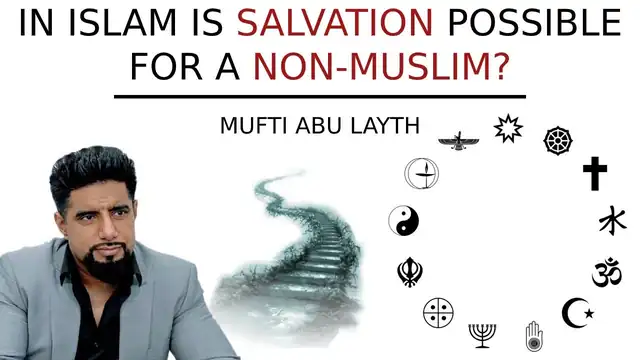 Play from 0:03
The video loads from YouTube only when you press play. Click a time in the transcript to seek.
Watch this part
Open on YouTube at 0:03The player starts at 0:03, the beginning of this part.
This segment0:03 to 4:50 · 4 min 47 sGeneral teaching
What this part covers
machinesummary, machine-writtenMufti Abu Layth says broad views on salvation for non-Muslims and on hell, while not necessarily right, are all part of the Sunni tradition.
In more detail
Mufti Abu Layth quotes a great mufassir and theologian of the Maturidi and Ash'ari tradition, named in the captions as al-Baydawi [?], as saying that a kafir who strives to find the truth, even if he remains a kafir, is hoped to be forgiven and saved. Mufti then presents the view of a great Sufi scholar that the word 'adhab comes from 'adhb, sweetness, so that hell is a lesser reward rather than pure punishment, supported by the verse about the wall with a door whose inside is mercy. Mufti says he is not asking people to believe these views and is not saying they are necessarily right, but that they, together with the views that hell will end, that Allah need not send anyone to hell, and Ibn Rushd's [?] view of the afterlife, are all part of the Sunni tradition. Mufti cites the report in which the Prophet told a man who prayed for mercy for only the two of them that he had restricted something vast.
- Some terms in this segment are uncertain
Position stated
Mufti Abu Layth says that, without saying any of them are necessarily right, these broad views on salvation and hell are all part of the understanding within the Sunni tradition.
“i'm not saying that any of these are necessarily right but what i'm saying is there are all parts of the the understanding that we have within our tradition”
Category: teaching
Kind: general teachingTranscript
machine0:03 to 4:50 · click a time to seek · dotted terms open the glossary
now the great who is a great mufasir of the quran he's a great fakie he's an usually he's a theologian within the the maturity generally and broader ashari understanding now he has a very famous and uh statement where he writes that even the kafir and these are his words words he says and this is in his mata he mentions this and it's quoted by maliki scholars like al-hafiz in his commentary upon qadhafi's commentary on sahih muslim
he they quote that badawi says the al-kafir who does ichthy had in trying to find the truth even if he stays as a kafir with what he does with his ichthy heart he says we hope that he will still be forgiven okay and that he is still saved so look at this broad wow this this encompassing understanding and he's a great sunni scholar i mean you could take a look at another and this these are all opinions of allah like look at the great
sufi scholar went to the understanding that even the when we say hell he said actually comes from the word because in arabic it comes from the word uber sweetness so he said ada jahannam is actually a still a reward but it's only a punishment in comparison to the reward that the people of jannah will get that it's a lack of a a lacking or a lesser
reward and therefore it's an azab respectively because he said the word adhab meant sweet it came from azuba from a sweetness and he uses and look i'm not saying you have to believe that but i'm just presenting to you he's still part of the sunni tradition is he not i mean he's people call himself the great you know sheikh of all time like the sufi [ __ ] he used a verse of the quran that on the day of judgment those people who disbelieve the monarchy that they will say that wait like give us respite or wait for us
that there is a door that is struck between these people the believers and the disbelievers that there is this wall and a door barrier that is struck between them but allah says that was he says that from within it's actually a mercy but apparently it looks like another now he used this verse of the quran to say now i'm not doing this he is doing it
it's not me it's he said that look this verse of the quran is hinting to this that really the azab is a rahmah that's an understanding i'm just saying it's still is it not part of the sunni tradition i would say it is it's still part of the sunni tradition as is saying that hell will freeze over that's you know still part of the sunni tradition as is saying look allah doesn't have to send anybody to hell as is uh ibn rust who says the akhira is
really just a sense of kind of consciousness and that kind of uh are these not all part of the sunni tradition they are so why limit you know when the person said to the prophet that you know may allah have mercy on just me and you and the prophet said that he said you the mercy of god is so vast and you've restricted it so much so that's what i'm saying i'm not saying that any of these are necessarily right but what i'm saying is there are all parts of the the understanding that we have within our tradition
of sunnah now we have a popular approach but these are all parts of the approach right so let's move
Paragraphs overlapping 0:03 to 4:50. Full text on the recording page.
Cite this segment
Stable id, transcript version and tier are part of the citation. Every change to a transcript is logged.Mufti Abu Layth Archive, segment 2020-08-19b-S01, auto-transcribed, may contain errors. https://muftiabulayth.org/r/pyi4tbajcmi/s/1/ (accessed 1 November 2026)
- APA 7
Mufti Abu Layth. (2020, August 19). Can non-Muslims be saved according to Sunni scholars? [Video, segment 2020-08-19b-S01, auto-transcribed, may contain errors]. Mufti Abu Layth Archive. Retrieved November 1, 2026, from https://muftiabulayth.org/r/pyi4tbajcmi/s/1/
- Chicago author-date
Mufti Abu Layth. 2020. "Can non-Muslims be saved according to Sunni scholars?" Video, segment 2020-08-19b-S01, auto-transcribed, may contain errors. Mufti Abu Layth Archive. Recorded August 19, 2020. Accessed November 1, 2026. https://muftiabulayth.org/r/pyi4tbajcmi/s/1/
- BibTeX
@misc{abulayth-2020-08-19b-S01,
  author = {Mufti Abu Layth},
  title = {{Can non-Muslims be saved according to Sunni scholars?}},
  year = {2020},
  month = {8},
  date = {2020-08-19},
  howpublished = {\url{https://muftiabulayth.org/r/pyi4tbajcmi/s/1/}},
  url = {https://muftiabulayth.org/r/pyi4tbajcmi/s/1/},
  organization = {Mufti Abu Layth Archive},
  urldate = {2026-11-01},
  note = {Segment 2020-08-19b-S01, auto-transcribed, may contain errors}
}
Something wrong here?
Tell us what is wrong and it will be checked against the recording. Nothing changes until a person has reviewed it.
Sending a note needs JavaScript, which is off or unavailable in this browser. Nothing has been sent.
No name, email address or account is asked for or stored, and the inbox does not store your IP address. For rate limiting it keeps an unreadable fingerprint of your connection for 48 hours, and our database provider's own logs record connections as every website's do. Only your note, its kind, the page and the moment in the recording are kept, for review.