
Recordings › My Thoughts on Mohammed Hijab & His Approach | Mufti Abu Layth · 12 Dec 2019 › Segment 4 of 4
Is al-wala wal-bara, loving and hating for the sake of Allah, part of Islam?
aqidah aqeedah aqida creed aqeeda aqaid hambali hanbalite hanbali school muftis bid'ah bida biddat bidaa kufr kuffar kafir kaafir kufar kaafirun kalam ilm al-kalam kalaam koran quraan al-quran salafis salafism wahabi wahhabism ulama ulema ulamaa barakah barakat barkat baraqah blessingAl-wala wal-bara: loving and hating for the sake of God as a Wahhabi invention
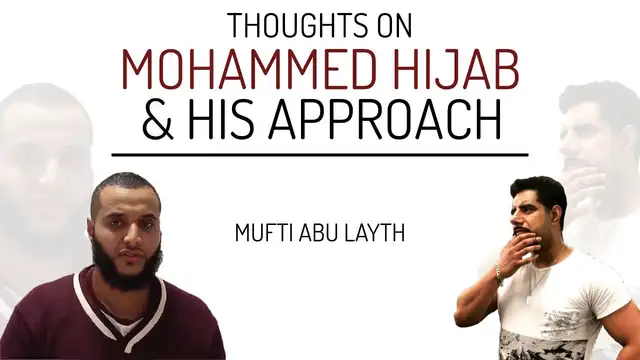 Play from 7:52
The video loads from YouTube only when you press play. Click a time in the transcript to seek.
Watch this part
Open on YouTube at 7:52The player starts at 7:52, the beginning of this part.
This segment7:52 to 10:49 · 2 min 57 sGeneral teaching
What this part covers
machinesummary, machine-writtenThe doctrine of loving and hating for the sake of God (al-wala wal-bara) is a Wahhabi invention spread with Gulf money and not part of the tradition. The Quranic bara'a means detachment of association, not hatred.
In more detail
Finishing the point that the Hanbalis were harsh but never geniuses of philosophy or theology, Mufti Abu Layth says the idea of loving and hating for the sake of God, al-wala wal-bara, does not exist in the tradition and is a Wahhabi invention that spread through mass advertising, petroleum money and glossy literature until everyone had heard the term. He says it is mainly a Hanbali and Wahhabi notion on which Muhammad ibn Abd al-Wahhab based his whole movement and insurgency, using it as a justification to kill other Muslims, and that if one checks, al-wala wal-bara is written about only by Saudi, Gulf and Wahhabi scholars. He allows that one might extract such words from other contexts, but says nobody spoke of it as a belief construct. He notes that the Quran says Allah does not like disbelief or the plot of the disbelievers, and declares that Allah and His Messenger are free of association with those who broke the covenant, and says this is what bara'a means in essence, a detachment of association, not hatred. He concludes that the doctrine of loving and hating for the sake of God is an innovation and nothing but Salafi and Wahhabi propaganda, and tells viewers not to buy into it.
- Some terms in this segment are uncertain
Position stated
Mufti Abu Layth says the doctrine of loving and hating for the sake of God, al-wala wal-bara, does not exist in the tradition but is a Wahhabi innovation written about only by Saudi, Gulf and Wahhabi scholars, and that the Quranic bara'a means detachment of association rather than hatred.
“for the sake of God is it's an innovation in Islam and it is nothing but kind of selfie stroke Wahhabi propaganda”
Category: teaching
Kind: general teachingTranscript
machine7:52 to 10:49 · click a time to seek · dotted terms open the glossary
use Martone the arguments because those were the people historically in in muslim sciences who argued for theology the humble ease didn't they were you know just like a literalist textualist people they were I mean they were very harsh but they were never really geniuses of philosophy or theology or things like this but yeah so I wanted to say that and I think it's worth noting here that you know this whole thing I wanna walbro Nilla this is a selfie Wahhabi thing right that this thing of we love and we hate for the sake of God
this does not exist in our tradition this is a a hobby invention that through mass kind of advertising and a lot of you know petroleum dollars behind this that were they've managed to spread a lot of glossy literature throughout the world that everybody today has heard of this term Al walbro Lilla this al wala wala Bora is some humble ease mainly wahhabis it's the thing that people like Muhammad ibn Abdul Wahab bases his whole release a movement his
insurgency on where he goes around and uses that as a justification to kill other Muslims so you see this thing if you check this up I'll wallop walbro it's only written by Saudi scholars and Gulf scholars and Wahhabi scholars nobody else spoke about this kind of thing like this I mean maybe if they were speaking about in a different context and you could kind of extract a thing like a word from there and give it a little but they never spoke like by the way we have Al Walla Walla bara Lilla we hate for the sake of Allah we do this we'd like has a belief construct
I'm not saying you may find certain things that weren't being said like that but you could see these words in like so for example Allah saying that he doesn't like disbelief he doesn't like the plot of the disbelievers he doesn't in using words like Cora but even then and you'll find Allah saying in the Quran that he's buried that the messenger is but it is Baraka that they have no association with the with the people who've gone against the Covenant and so on and this is what Barak means in essence like you
a detachment of Association it does not mean hatred okay but this new thing that we have that oh you must love and hate for the sake of God is it's an innovation in Islam and it is nothing but kind of selfie stroke Wahhabi propaganda so do not buy into things like that so if you see things like that
okay cool so
Paragraphs overlapping 7:52 to 10:49. Full text on the recording page.
Cite this segment
Stable id, transcript version and tier are part of the citation. Every change to a transcript is logged.Mufti Abu Layth Archive, segment 2019-12-12-S04, auto-transcribed, may contain errors. https://muftiabulayth.org/r/oxtsv9fn3ze/s/4/ (accessed 1 November 2026)
- APA 7
Mufti Abu Layth. (2019, December 12). Is al-wala wal-bara, loving and hating for the sake of Allah, part of Islam? [Video, segment 2019-12-12-S04, auto-transcribed, may contain errors]. Mufti Abu Layth Archive. Retrieved November 1, 2026, from https://muftiabulayth.org/r/oxtsv9fn3ze/s/4/
- Chicago author-date
Mufti Abu Layth. 2019. "Is al-wala wal-bara, loving and hating for the sake of Allah, part of Islam?" Video, segment 2019-12-12-S04, auto-transcribed, may contain errors. Mufti Abu Layth Archive. Recorded December 12, 2019. Accessed November 1, 2026. https://muftiabulayth.org/r/oxtsv9fn3ze/s/4/
- BibTeX
@misc{abulayth-2019-12-12-S04,
  author = {Mufti Abu Layth},
  title = {{Is al-wala wal-bara, loving and hating for the sake of Allah, part of Islam?}},
  year = {2019},
  month = {12},
  date = {2019-12-12},
  howpublished = {\url{https://muftiabulayth.org/r/oxtsv9fn3ze/s/4/}},
  url = {https://muftiabulayth.org/r/oxtsv9fn3ze/s/4/},
  organization = {Mufti Abu Layth Archive},
  urldate = {2026-11-01},
  note = {Segment 2019-12-12-S04, auto-transcribed, may contain errors}
}
Something wrong here?
Tell us what is wrong and it will be checked against the recording. Nothing changes until a person has reviewed it.
Sending a note needs JavaScript, which is off or unavailable in this browser. Nothing has been sent.
No name, email address or account is asked for or stored, and the inbox does not store your IP address. For rate limiting it keeps an unreadable fingerprint of your connection for 48 hours, and our database provider's own logs record connections as every website's do. Only your note, its kind, the page and the moment in the recording are kept, for review.