
Recordings › Does criticising Hadith transmission mean criticising the Quran tranmssion? | Mufti Abu Layth · 28 Sep 2019 › Segment 1 of 3
If some hadith are unreliable, doesn't that make the Quran unreliable too?
salat salaah namaz salaat namaaz as-salah al-salah salawat hadeeth ahadith ahaadeeth hadis hadees ahaadith saheeh sahih hadith saheeh hadith sound hadith authentic imam bukhari sahih bukhari saheeh al-bukhari saheeh bukhari imam al-bukhari ramadhan ramzan ramazan ramadaan tarawih prayer taraweeh prayer muftis quraan al-quran tilawah tilawat tilaawah sahabah sahaba sahabi sahabiyyah sahabiyat 'alim aalim ulama ulema ulamaa dawat da'ee invitation fitrat natural dispositionDoes questioning hadith undermine the Quran? How the Quran was transmitted
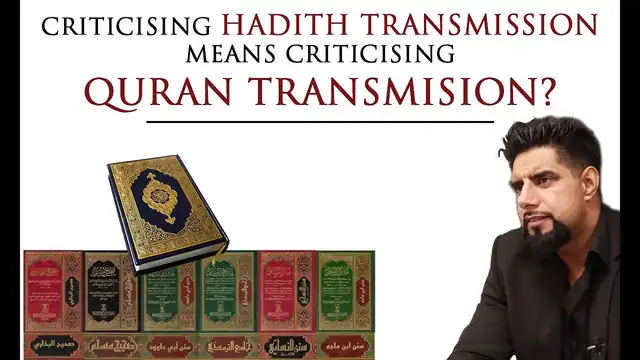 Play from 1:58
The video loads from YouTube only when you press play. Click a time in the transcript to seek.
Watch the answer
Open on YouTube at 1:58The player starts at 1:58, where the answer begins.
This segment0:01 to 7:38 · 7 min 37 sGeneral teaching
The answer in brief
machinesummary, machine-writtenNo: the Quran was passed on en masse as a recited living tradition, so doubts about particular hadith chains do not carry over to it.
In more detail
Mufti Abu Layth says he does not throw away Sahih al-Bukhari but treats it like any other hadith book, judging each hadith on its merits and accepting it if it does not clash with reason, the Quran, the living tradition or an Islamic principle. He says people have sent him clips, including one of a Pakistani scholar whose name the captions garble and one of Dawah Man [?], whom he says is not a scholar, arguing that weakening hadith weakens the Quran because the same people transmitted both. He says those making this argument have not understood how the Quran was transmitted, and calls it cowardly to throw the Quran under the bus to save al-Bukhari. He explains that the Quran was transmitted en masse as part of the living tradition, taught by parents to children and neighbours before any institutionalisation, and that as a recitation with a rhythmic essence it was preserved in memory and recited in prayer and tarawih.
Question as read aloud · questioner not identifiedIf you claim there are systemic issues with how some hadith were transmitted, why can't the same be said about the Quran?
- Some terms in this segment are uncertain
Position stated
Mufti Abu Layth says those who argue that weakening hadith weakens the Quran have not truly understood how the Quran was transmitted.
“not truly understood how the Koran was transmitted okay these people who are saying this they have just been institutionalized”
Category: method
Kind: general teachingTranscript
machine0:01 to 7:38 · click a time to seek · dotted terms open the glossary
let's tackle a question that is immensely important okay so it is to do with this hadith and Quran okay I've had quite a few people say to me that you see you problematize Sahil Bihari which I do I don't say throw Sahil Bihari away but I say treat it like any other book of hadith and so each hadith must be judged upon its own merits if it contradicts if it clashes Milam you by email mark all it doesn't go against reason well I'm you knock Adel well let
me Holly filmin all it does not clash with the Quran or the living tradition Wellum are you naka de la Sol and it does not approach an Islamic principle then we will accept it so that's my point I believe that we need to scrutinize the mutton the much more than we have been doing the actual content of a hadith now some people have said well because you claim these systemic issues with some of the hadith are being transmitted why can't you say that about or on now and I've been sent a few different videos by different
people saying this by the way so I was sent a video by a scholar who usually I mean I find his stuff usually quite amusing and good it's he's I believe his name is Mawlana or it may be Musti monser Mengel from pakistan where he's got a a clip where he's speaking about where he says or what or Pirani sorry hwacha hadith II homra water Quran where he says that the people who transmitted the hadith all the people who transmitted the whole path so if you are going to weaken hadith then they by you
have weakened Quran this is the argument somebody sent me a clip by Dawa man saying the same thing which really that the old man is not a scholar so it's not that's not even irrelevant but some weights the same argument and we've heard quite a few other scholars saying this I've heard a few scholars saying this now so I want to address this point you see anybody who says this people first of all there's there's a few important points to make one is that these people have
not truly understood how the Koran was transmitted okay these people who are saying this they have just been institutionalized and they don't realize they haven't deeply actually fathomed how the Quran and how Islam and its tradition was transmitted and I will go through that in just a moment secondly I feel that it's such a shame such a shame that these people feel that they can strongarm somebody who questions who questions the authenticity
of certain hadith based on sound reason by throwing the Koran under the bus now I find that to be such a an act of cowardice that way you could not substantiate those particular hadith that are being questioned or you are being presented by a narrative of realism that look you thereby your only response is to throw the entire Quran under the bus in an attempt to save
Buhari I mean that is the most I find despicable and cowardly act done by Muslim scholars who truly lack an understanding of how this tradition was transmitted okay so so I'd like to clarify I'd like to expand allow me to elucidate expand elucidate see if I don't use these words people
say yah da Mosta couch but by me people will accuse me of not even being educated so one must resort to an expansive reply so right so okay so let's take a look at how was how was the Quran transmitted how was the Quran so people Islam when the Prophet lived amongst people and the Companions after him
there was a living tradition of Islam if we can call that a living tradition okay living tradition is what people will just teach parents will teach their children they will be it will just become a kind of folk practice it will just permeate through communities and societies it is part and parcel of the living tradition now the Quran was transmitted on mass like people you know they just taught it they taught it to their children they taught it to their neighbors they taught it to their
friends people conveyed the message of the Quran before the arrival or advent of institutionalization so as a natural as a Dean of fitrah the Quran was being transmitted so if I knew the Quran I would read it in my Salah I would read the Quran in my daily praise I would teach it to my children I might sometimes have a discussion on me this was just a natural living practice that people were passing on the Quran one could say from father to child okay
there was not an institutionalization to it it was just a natural tradition the other thing is and this is something nobody would really deny that Muslims were doing this I mean even non-muslim historians they acknowledge that yes they had this scripture they had this thing called the Koran secondly the horn by its nature ontologically by its essence okay is a Koran it's a recitation it's a recital of something it's not it's not prose it's not
something like here's a book right it's not a book like you just read like I'm just reading this book it was a recitation which meant it had a rhythmic essence to it so people would recite and we know that the Quran was preserved by memory so people would recite the Quran they would read it in in this Allah they would read it in during Ramadan in taraweeh it was being conveyed it was just being taught and this is how it
permeates through the communities it was just part and parcel of the living tradition of Islam now we have to pause that the pause posit people buzzing now we're going to come to this question of people who corrupt a message right so when people decide to interpolate when people decide to add to fabricate to manufacture a message there may be many motivations behind this many motivations
Paragraphs overlapping 0:01 to 7:38. Full text on the recording page.
Cite this segment
Stable id, transcript version and tier are part of the citation. Every change to a transcript is logged.Mufti Abu Layth Archive, segment 2019-09-28-S01, auto-transcribed, may contain errors. https://muftiabulayth.org/r/nndcs2uhoqe/s/1/ (accessed 1 November 2026)
- APA 7
Mufti Abu Layth. (2019, September 28). If some hadith are unreliable, doesn't that make the Quran unreliable too? [Video, segment 2019-09-28-S01, auto-transcribed, may contain errors]. Mufti Abu Layth Archive. Retrieved November 1, 2026, from https://muftiabulayth.org/r/nndcs2uhoqe/s/1/
- Chicago author-date
Mufti Abu Layth. 2019. "If some hadith are unreliable, doesn't that make the Quran unreliable too?" Video, segment 2019-09-28-S01, auto-transcribed, may contain errors. Mufti Abu Layth Archive. Recorded September 28, 2019. Accessed November 1, 2026. https://muftiabulayth.org/r/nndcs2uhoqe/s/1/
- BibTeX
@misc{abulayth-2019-09-28-S01,
  author = {Mufti Abu Layth},
  title = {{If some hadith are unreliable, doesn't that make the Quran unreliable too?}},
  year = {2019},
  month = {9},
  date = {2019-09-28},
  howpublished = {\url{https://muftiabulayth.org/r/nndcs2uhoqe/s/1/}},
  url = {https://muftiabulayth.org/r/nndcs2uhoqe/s/1/},
  organization = {Mufti Abu Layth Archive},
  urldate = {2026-11-01},
  note = {Segment 2019-09-28-S01, auto-transcribed, may contain errors}
}
Something wrong here?
Tell us what is wrong and it will be checked against the recording. Nothing changes until a person has reviewed it.
Sending a note needs JavaScript, which is off or unavailable in this browser. Nothing has been sent.
No name, email address or account is asked for or stored, and the inbox does not store your IP address. For rate limiting it keeps an unreadable fingerprint of your connection for 48 hours, and our database provider's own logs record connections as every website's do. Only your note, its kind, the page and the moment in the recording are kept, for review.