
Recordings › Ponderings on the Holy Quran › Hadith Studies
Does criticising Hadith transmission mean criticising the Quran tranmssion? | Mufti Abu Layth
salat salaah namaz prayer salaat namaaz as-salah al-salah salawat haj pilgrimage hadj ahadith ahaadeeth hadis ahaadith imaam imams prayer leader ramadhan ramzan ramazan ramadaan tarawih tarawih prayer taraweeh prayer shafi'i shafei shafiite shafi'i school muftis hukm ahkam hukum hukam ahkaam riba ribaa sood usury iman imaan eemaan eeman quraan al-quran sura soorah surat suwar soora chapter ayah aya ayat ayaat aayah aayat tilawah tilawat tilaawah sahabah sahaba sahabi sahabiyyah sahabiyat shiah shiite shi'i twelver ithna ashari 'alim aalim ulama ulema ulamaa da'wah dawat da'ee invitation ummah umma ummat niyyah niyah niyat niyya niyyat fitrat natural disposition ajr sawab thawab thawaab sawaabvideo · 23:45 · 17,000 views · 28 Sep 2019 · 3 segments · Open on YouTube
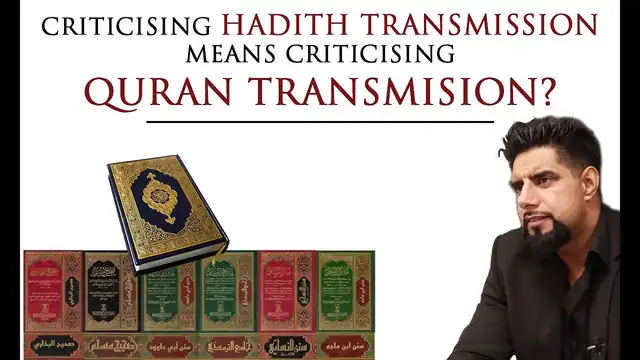 Press play to load from YouTube. Nothing loads until you do.
3 segments
machine3Each block is a segment in time order. Click to open it.All segments · in time order
Transcript
machineauto-transcribed, may contain errors · source: youtube auto · click a time to seek · dotted terms open the glossarylet's tackle a question that is immensely important okay so it is to do with this hadith and Quran okay I've had quite a few people say to me that you see you problematize Sahil Bihari which I do I don't say throw Sahil Bihari away but I say treat it like any other book of hadith and so each hadith must be judged upon its own merits if it contradicts if it clashes Milam you by email mark all it doesn't go against reason well I'm you knock Adel well let
me Holly filmin all it does not clash with the Quran or the living tradition Wellum are you naka de la Sol and it does not approach an Islamic principle then we will accept it so that's my point I believe that we need to scrutinize the mutton the much more than we have been doing the actual content of a hadith now some people have said well because you claim these systemic issues with some of the hadith are being transmitted why can't you say that about or on now and I've been sent a few different videos by different
people saying this by the way so I was sent a video by a scholar who usually I mean I find his stuff usually quite amusing and good it's he's I believe his name is Mawlana or it may be Musti monser Mengel from pakistan where he's got a a clip where he's speaking about where he says or what or Pirani sorry hwacha hadith II homra water Quran where he says that the people who transmitted the hadith all the people who transmitted the whole path so if you are going to weaken hadith then they by you
have weakened Quran this is the argument somebody sent me a clip by Dawa man saying the same thing which really that the old man is not a scholar so it's not that's not even irrelevant but some weights the same argument and we've heard quite a few other scholars saying this I've heard a few scholars saying this now so I want to address this point you see anybody who says this people first of all there's there's a few important points to make one is that these people have
not truly understood how the Koran was transmitted okay these people who are saying this they have just been institutionalized and they don't realize they haven't deeply actually fathomed how the Quran and how Islam and its tradition was transmitted and I will go through that in just a moment secondly I feel that it's such a shame such a shame that these people feel that they can strongarm somebody who questions who questions the authenticity
of certain hadith based on sound reason by throwing the Koran under the bus now I find that to be such a an act of cowardice that way you could not substantiate those particular hadith that are being questioned or you are being presented by a narrative of realism that look you thereby your only response is to throw the entire Quran under the bus in an attempt to save
Buhari I mean that is the most I find despicable and cowardly act done by Muslim scholars who truly lack an understanding of how this tradition was transmitted okay so so I'd like to clarify I'd like to expand allow me to elucidate expand elucidate see if I don't use these words people
say yah da Mosta couch but by me people will accuse me of not even being educated so one must resort to an expansive reply so right so okay so let's take a look at how was how was the Quran transmitted how was the Quran so people Islam when the Prophet lived amongst people and the Companions after him
there was a living tradition of Islam if we can call that a living tradition okay living tradition is what people will just teach parents will teach their children they will be it will just become a kind of folk practice it will just permeate through communities and societies it is part and parcel of the living tradition now the Quran was transmitted on mass like people you know they just taught it they taught it to their children they taught it to their neighbors they taught it to their
friends people conveyed the message of the Quran before the arrival or advent of institutionalization so as a natural as a Dean of fitrah the Quran was being transmitted so if I knew the Quran I would read it in my Salah I would read the Quran in my daily praise I would teach it to my children I might sometimes have a discussion on me this was just a natural living practice that people were passing on the Quran one could say from father to child okay
there was not an institutionalization to it it was just a natural tradition the other thing is and this is something nobody would really deny that Muslims were doing this I mean even non-muslim historians they acknowledge that yes they had this scripture they had this thing called the Koran secondly the horn by its nature ontologically by its essence okay is a Koran it's a recitation it's a recital of something it's not it's not prose it's not
something like here's a book right it's not a book like you just read like I'm just reading this book it was a recitation which meant it had a rhythmic essence to it so people would recite and we know that the Quran was preserved by memory so people would recite the Quran they would read it in in this Allah they would read it in during Ramadan in taraweeh it was being conveyed it was just being taught and this is how it
permeates through the communities it was just part and parcel of the living tradition of Islam now we have to pause that the pause posit people buzzing now we're going to come to this question of people who corrupt a message right so when people decide to interpolate when people decide to add to fabricate to manufacture a message there may be many motivations behind this many motivations
amongst them for examples there could be good there could be beneficent believe it or not they could be kind of like kind-hearted motivation so people think I know I'm going to invent a teaching I think more Muslims should do hatch for example so I'm going to invent something about the benefits for Hajj and believe it or not people have done this it's like some of them used to say that we don't fabricate again the profit we fabricate for the profit
Lenexa aleyhi next people la who we don't lie against him we life for him yeah one to go for this this are not nice so this is what some people were doing right so they were so there's many reasons why people fabricate things they bring things in it could be that there's misunderstanding they could be false memories so these are all kind or benevolent kind of non humph I mean I don't know if that's the right word but
let's say if we call them you know kind hearted kind of manufacturing of of Islamic teachings it could be because people have got a good intention it could be because it's a false memory a person actually thinks oh here wasn't this also part of the teaching and he gets it wrong that could be then they could be negative you know like malignant kind of intentions bad intentions where people are they want to corrupt a faith they want to kind of mess it up for people all they want
people so that could be one reason they want to corrupt the faith they wanna or that they have a personal vested interest so somebody wants to I don't know somebody they sell vegetables or to buy their vegetables so they start saying do you know that that Islam encourages eating vegetables now that's believe it or not actually happened as well you had somebody who fabricated a hadith to do with bad engine buzzing John is what we call in Auto bayman
you apologize for the disconnection disconnect their way back so there were people who invented hadith to say that we invented teachings to say anybody who
eats the aubergine a plant has will have such in such a reward you know the being and the merits of the bingham but this is so sometimes there's a vested interest sometimes there's political interests so people's sectarian so there's a lot of teachings that were fabricated to to create an uprising against the State against the Omega dynasty for example which a lot of the Shia people did and hence they really pushed the whole messianic vision that there will be a messiah that will
come and a maddie will come and all these things and then there were a lot of teachings fabricated to consolidate the state so the omega dynasty came up with a lot of rulings that would help them like when they wanted to take over india it's it's very convenient that all of a sudden is a hadith that the prophet said all the great battle of india so these things were just teachings of convenience so there's a lot of reasons why people fabricate something so now this is important that we clarify that now let's just pause that for a moment
it's come back to come back to the working working board here people what is the problem I ask you what is the problem or the challenge is a better word with trying to push your false teachings into the floor and what do you think would be the problem if if you were a person pretend you are a person who is intentionally because if we take the the worst-case scenario first we can deal with the other cases but by extension easily so those people who are
intentionally premeditating an attempt to corrupt the faith they want to mess up the teachings of Islam what would be your challenges if you would to add verses into the Quran you know very well that that will not fly it would be so difficult why number of reasons one or an is so widespread people are reciting it all the time so if I wanted I don't know say add a
ruling into the Quran I have to match the entire context of the Quran so let's say I want to invent some hadith to support the state of Bani Omega the Umayyad dynasty now I can't just add a verse of the Quran saying hey and they will be a great dynasty call Bernie Omega because the Quran it's not its style to speak like that so this becomes very difficult the other thing is the Quran does not often delve into tiny
issues it seems to have a very universal approach it's speaking about things universally and fabricating a universal is very meaningless like you know if I want to fabricate a universal ruling the problem is so many people read the Quran in different parts of the world all these people read it it's part and parcel of the tradition I have to then make sure this thing matches the exact style it matches the context it doesn't go against the overall message of the Quran so some people did try this with the Satanic Verses
and it flopped why did it flop because it clashed with the overall message and people spotted it as a contradiction and so that the return on investment here is very little it's not worth trying to corrupt the Quran in that in that you know with that in mind because you're not going to get much back out of it okay this however is not the same with hatty the hadith don't have account the hadeeth were not being taught from father to child they were not part of
this living tradition unless you know maybe a one-off story may have been but hadith weren't had he'd start to get documented almost a hundred years after the Prophet by that time many false hadith are in circulation for me to make up a hadith all I have to say is the Prophet said whosoever doesn't watch Monday nights with Musti has lost out on a great big fortune for example that's it trying to add that in the Quran is
impossible next to impossible why because one the Quran doesn't talk about things like this in general so people will spot it - I have to match the rhythm that nothing the flow of the Quran I have to choose a particular surah to add it into then people are all reciting that surah in different parts of the world it wouldn't really fly so this is why people did not corrupt the Quran in that way it wasn't it wasn't a project that they could see a return on investment in so when people say are but
if you problematize hadith then you by default problematize the Quran no you don't at all the Quran was never transmitted through a soul transmitter it was just taught on mass that's it now yes when the hadith culture takes off the hadith project becomes so powerful that it has it posed in to many other aspects of Muslim tradition so the way in hadith you have a chain so this chain and everything started to get documented
over a hundred years after the Prophet so when hadith were first documented in the time of Omar Abdullah zis hadith the chains weren't being documented but then within a decade or two after him people start to document the chains and then they started say well that person were not so sure if he's reliable or that person and that way and they did a great job of trying to scrutinize the chains but it's not infallible okay so it's still susceptible to error it's prone to error it still does have some mistakes
that's why whenever a hadith clashes with the Quran or clashes with the principles of Islam we abandon that hadith because there's no way could have clashed with this now later on this hadith project becomes so fashionable that people start to have chains in everything you see becomes the thing it's not like it's like like I give an example you know snapchat for example has stories had stories which were so
the stories that you have the 24-hour stories which are still they became so fashionable that all other social media outlets started to adopt stories you know a Facebook Messenger has a story instagram has a story bloody everything you know Microsoft Excel I would probably have a story so my everybody just takes up something that starts to really take off now in a similar way once the Hadees project became a dominating project which it did you see everybody even if you're learning Arabic grammar which is not nothing think about it what is Arabic grammar got to do with
a chain of transmission but all of a sudden they to now have chains of transmission oh I took this from my teacher who took it from far ah who took it from cursory you took it from I mean it's nothing to do with you know who cares it's grammar but no we're gonna have a chain of transmission in it oh where did you learn this from I learnt it from here where did you learn this poetry from I took it from him who took it from him who took it from this Imam Shafi is poem so this chain of transmission is not just as a superfluous event not as something carrying actual meaning as a
trend it trickles into all other sciences which were just normal teaching normal thing and some were part of the living tradition so thick for example people say well if you don't have hadith how do you know how to pray because it was part of the living tradition see the living tradition predates the documentation of thick it was just what the parents taught their children and it was part and parcel of the Muslim community so this fit now all of a sudden people start to have a chain in
it oh where did you get it from I got it from him who got it from him oh wow I like this chain don't get me and don't get it I don't want you misunderstand me I like this as a as a kind of as a décor something decorative of our legacy I like it too I obtained recently in the last few years a chain of transmission in in fact even though fit is really the chain doesn't mean really anything but it's it's nice it's a collector's item to people who are part and parcel of this tradition so
what started to happen is the Quran to people started to transmit in chains late you got it from this guy okay I'm gonna take his name I'm gonna take his name now some people centuries later naively began to assume that the Quran was you
to kind of write Southie I don't know why this is happening just bear with me people but so some people naively thought that because the Quran has a chain as well now oh so it must have been taught only through chains the way hadith was taught that is a mistake on their part that's like saying because Arabic grammar had a chain so everybody who ever knew Arabic grammar knew it because he must have studied it all through this one guy who taught it through a chain that's ridiculous
so I hope that shed some clarity on this on this kind of fallacy that the way hadith was transmitted is how the Quran was transmitted it was not the Quran was transmitted as part of the living tradition was transmitted on mass hadith was transmitted as a tea as an institution so people sat down and taught it so cool so I hope that explains that I did feel that that was very important to kind of cover let's
let's move on people
Something wrong here?
Tell us what is wrong and it will be checked against the recording. Nothing changes until a person has reviewed it.
Sending a note needs JavaScript, which is off or unavailable in this browser. Nothing has been sent.
No name, email address or account is asked for or stored, and the inbox does not store your IP address. For rate limiting it keeps an unreadable fingerprint of your connection for 48 hours, and our database provider's own logs record connections as every website's do. Only your note, its kind, the page and the moment in the recording are kept, for review.
Cite this recording
Stable id, transcript version and tier are part of the citation. Every change to a transcript is logged.Mufti Abu Layth Archive, auto-transcribed, may contain errors. https://muftiabulayth.org/r/nndcs2uhoqe/ (accessed 1 November 2026)
- APA 7
Mufti Abu Layth. (2019, September 28). Does criticising Hadith transmission mean criticising the Quran tranmssion? | Mufti Abu Layth [Video, auto-transcribed, may contain errors]. Mufti Abu Layth Archive. Retrieved November 1, 2026, from https://muftiabulayth.org/r/nndcs2uhoqe/
- Chicago author-date
Mufti Abu Layth. 2019. "Does criticising Hadith transmission mean criticising the Quran tranmssion? | Mufti Abu Layth." Video, auto-transcribed, may contain errors. Mufti Abu Layth Archive. Recorded September 28, 2019. Accessed November 1, 2026. https://muftiabulayth.org/r/nndcs2uhoqe/
- BibTeX
@misc{abulayth-nndcs2uHoqE,
  author = {Mufti Abu Layth},
  title = {{Does criticising Hadith transmission mean criticising the Quran tranmssion? | Mufti Abu Layth}},
  year = {2019},
  month = {9},
  date = {2019-09-28},
  howpublished = {\url{https://muftiabulayth.org/r/nndcs2uhoqe/}},
  url = {https://muftiabulayth.org/r/nndcs2uhoqe/},
  organization = {Mufti Abu Layth Archive},
  urldate = {2026-11-01},
  note = {Auto-transcribed, may contain errors}
}