
Recordings › Monday Nights with Mufti #200| Q&A Unscripted & Unrestricted! 😉 | Mufti Abu Layth · 2 Feb 2021 › Segment 6 of 27
Is rejecting embarrassing hadith about the Prophet just whitewashing history?
hadeeth ahadith ahaadeeth hadis hadees ahaadith muftis iman imaan eemaan eemanIs rejecting controversial hadith a whitewash? Asking about motives
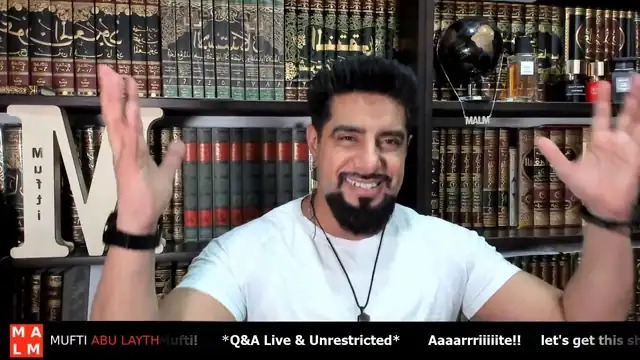 Play from 32:00
The video loads from YouTube only when you press play. Click a time in the transcript to seek.
Watch the answer
Open on YouTube at 32:00The player starts at 32:00, where the answer begins.
This segment31:34 to 37:45 · 6 min 11 sGeneral teaching
The answer in brief
machinesummary, machine-writtenMufti Abu Layth says the 'they would not invent it' argument is cogent at face value, but a fair critic must also ask who had a motive to fabricate a report.
In more detail
A super chat asks how to answer non-Muslims who say that disregarding controversial hadith about the Prophet whitewashes Islamic history. Mufti Abu Layth grants that their argument, that Muslims would only have recorded embarrassing reports because they were true, is cogent at face value. He says a fair analysis must also ask whether anyone had a motive to fabricate the report, which critics do not do fairly. Mufti tells of a non-Muslim academic, once hostile to Islam, who is writing a PhD on the age of Aisha and with whom he talked for hours; the academic's turning point was realising he could think of reasons why people would invent the report. Mufti says modern neo-traditionalists use the same reasoning in a simpler form.
Question as read aloud · questioner not identifiedHow would you respond to non-Muslims who say that disregarding any controversial hadith about the Prophet is an attempt to whitewash Islamic history?
Position stated
Mufti Abu Layth says that, to be fair, one must ask whether one can think of any motive for people to have fabricated a hadith, which critics do not do or do not do fairly.
“But can I as a person think of any motive for people to have fabricated that hadith? And you see this is what they don't do or they don't do fairly.”
Category: method
Kind: general teachingTranscript
machine31:34 to 37:45 · click a time to seek · dotted terms open the glossary
things I definitely that's my take on mangi I you know what I I haven't I I don't really know much about it's a her I take it yeah I don't really know much about her I'll have to um I'll have to check out some stuff and then comment on mangi Right.
But I I have years ago I think I saw some some clips. I can't even remember what they were about. So yeah, some said one more super chat. I'm I'm getting to it. How would you respond to non-Muslims who say that disregarding any controversial hadith about the prophet is an attempt to whitewash Islamic history?
Yeah, that's a very good good question because yes, of course, um it it could be seen like that, you know, from their perspective, it [snorts] could be seen that um you know, when you find something um when you find something when you find blemishes, flies in the ointment, the only reason they're there because they're true.
this is their um assumption and in fact uh I think the the way it's argued by uh people you know like Shah and and other people is that the fact that Muslims mentioned them shows that they're true because otherwise they would have been motivated to hide them.
So this is a a reason and to be fair from a you know a um at face value that's a valid sense of um analysis that's you know that that's a to look at something from that perspective you're obviously ascribing you're trying to uh assume understand motives and you're thinking well you know this person why would he mention something that is problematic for Islam and the only reason he would do so is because it must have been true
and that sounds uh as a very you know that's quite a cogent argument to the at face value. However, aha. You see, upon closer inspection, if you're going to be fair, what you have to do is you have to think that that's true.
But can I as a person think of any motive for people to have fabricated that hadith? And you see this is what they don't do or they don't do fairly. I I mentioned a while back there's an academic I'm in touch with.
Haven't spoken to him now for a little while. I should reach out again. But we had an amazing discussion on the age of Aisha and he isn't a Muslim. He's not a Muslim but he's doing his PhD on the age of Aisha. and we had a discussion for maybe about three four hours. We spoke incredibly insightful discussion. I did ask him to come on to mine trap but I think at this stage he wanted to keep a a very low profile.
So this person he actually began as I don't want to misrepresent him but I as as a as an Islamophobe. It began as somebody picking holes in Islam, going for the the the general arguments, you know, Islam bashing. But, uh, it's amazing, you know, it's amazing that, um, you, you know, one who gets fixated with Islam, [laughter] it's interesting.
Islam has an ability, a kind of prowess to to pull in those who even if for negative reasons become fixated on it. And I I think that's actually an incredible feature of the faith. But still this person he after a while many years and he knew all these arguments you know these kind of hide what are those uh the the hide park debating argument he knew all of that stuff okay why did Muhammad do this then why did he do that why did
he marry a six-year-old girl it's in Bkari it's in this he knew all of this stuff now he said he reached a certain stage he started to academically study all of this and He did his masters and then he started and then later his PhD. But it's only before his PhD that he he realized one day he kind of he had this internal dialogue where he asked himself could I because he would follow this line of reasoning as well that this has to be true.
The prophet married a child has to be true because why would Muslims make it up? because it's an insult to Islam. It's an insult to the prophet. So for Muslims to make it up would mean that you know they wouldn't do that. So if anything they would hide it. the same reasoning that Shah and others have have kind of uh and this is actually surprisingly the same reasoning from a different perspective but that these modern-day neotraditionalists have these um you know these kind of selfieminded people that this is but they have it in a more simplistic way but the same kind of
thing. So he said, "I started thinking about this and and I thought that look actually I can think of reasons why people would make it up and and this is what initi this this moment of epiphany is what led him to then dig deeper and research profoundly this topic.
Paragraphs overlapping 31:34 to 37:45. Full text on the recording page.
Cite this segment
Stable id, transcript version and tier are part of the citation. Every change to a transcript is logged.Mufti Abu Layth Archive, segment 2021-02-02b-S06, auto-transcribed, may contain errors. https://muftiabulayth.org/r/ijwbevcc6o8/s/6/ (accessed 1 November 2026)
- APA 7
Mufti Abu Layth. (2021, February 2). Is rejecting embarrassing hadith about the Prophet just whitewashing history? [Video, segment 2021-02-02b-S06, auto-transcribed, may contain errors]. Mufti Abu Layth Archive. Retrieved November 1, 2026, from https://muftiabulayth.org/r/ijwbevcc6o8/s/6/
- Chicago author-date
Mufti Abu Layth. 2021. "Is rejecting embarrassing hadith about the Prophet just whitewashing history?" Video, segment 2021-02-02b-S06, auto-transcribed, may contain errors. Mufti Abu Layth Archive. Recorded February 2, 2021. Accessed November 1, 2026. https://muftiabulayth.org/r/ijwbevcc6o8/s/6/
- BibTeX
@misc{abulayth-2021-02-02b-S06,
  author = {Mufti Abu Layth},
  title = {{Is rejecting embarrassing hadith about the Prophet just whitewashing history?}},
  year = {2021},
  month = {2},
  date = {2021-02-02},
  howpublished = {\url{https://muftiabulayth.org/r/ijwbevcc6o8/s/6/}},
  url = {https://muftiabulayth.org/r/ijwbevcc6o8/s/6/},
  organization = {Mufti Abu Layth Archive},
  urldate = {2026-11-01},
  note = {Segment 2021-02-02b-S06, auto-transcribed, may contain errors}
}
Something wrong here?
Tell us what is wrong and it will be checked against the recording. Nothing changes until a person has reviewed it.
Sending a note needs JavaScript, which is off or unavailable in this browser. Nothing has been sent.
No name, email address or account is asked for or stored, and the inbox does not store your IP address. For rate limiting it keeps an unreadable fingerprint of your connection for 48 hours, and our database provider's own logs record connections as every website's do. Only your note, its kind, the page and the moment in the recording are kept, for review.