
Recordings › Monday Nights with Mufti #200| Q&A Unscripted & Unrestricted! 😉 | Mufti Abu Layth · 2 Feb 2021 › Segment 18 of 27
What does the raven in the story of Cain and Abel mean?
udhiyah qurbani qurbaani udhiya udhiyya kurbani muftis koran quraan al-quran sura soorah surat suwar soora chapter ayah aya ayat ayaat aayah aayat taqwa taqwaa muttaqi pietyCain and Abel in Surah al-Ma'idah: the sacrifice and two readings of the raven verse
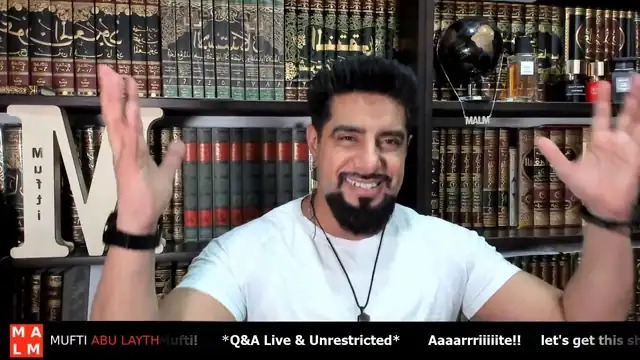 Play from 1:48:21
The video loads from YouTube only when you press play. Click a time in the transcript to seek.
Watch this part
Open on YouTube at 1:48:21The player starts at 1:48:21, the beginning of this part.
This segment1:48:21 to 1:57:04 · 8 min 43 sGeneral teaching
What this part covers
machinesummary, machine-writtenMufti Abu Layth reads the Cain and Abel verses as allowing more than one grammatical reading, and takes God to be the one teaching Cain.
In more detail
Mufti Abu Layth turns to the verses in Surah al-Ma'idah on the two sons of Adam. He notes that the Quran does not name them, that the sacrifice 'was accepted' in the passive, and suggests the acceptance was read through some ritual sign they associated with it. He describes one brother refusing violence and Cain murdering him, then the raven God sends to scratch the earth so that Cain learns to cover his brother's body. Mufti explains that the verse allows different readings of whom the verbs refer to, the raven or God as teacher, and the raven or Cain as the one covering a brother; in his understanding it is God who teaches. He says Ibn Ashur also notes both readings as valid.
Position stated
Mufti Abu Layth says that, in his understanding, the one teaching Cain in the verse is God, though some have understood it as the raven.
“who's trying to teach here. In my understanding, this is talking about God. Um, but some people have understood from it the raven.”
Category: teaching
Kind: general teachingTranscript
machine1:48:21 to 1:57:04 · click a time to seek · dotted terms open the glossary
So, I'd been asked about this. I thought, look, let me shed some light. This is those of you that don't know to do with the verse in Surah Maida, I believe it's verse 31, uh speaking about the two sons of Adam. Now, Allah doesn't mention who they are, but Abel and Cain, the the classic story that you have right there, and it's followed by Cain murdering Abel.
And so Allah mentions regimen and narrate onto them the story of the two sons of Adam um rightfully so when they both offered a sacrifice but it was accepted from one now it's interesting that here even Allah uses the word in the what is uh the passive sense that it was accepted.
Not saying that um we accepted it even though that's obviously the understanding here that Allah accepted it. But it's interesting that what did acceptance mean? They were obviously associating a meaning with it. But that acceptance would have been some kind of ritual that they would have come up with. You understand? So they both do something and then whether one of them this happens to it, one of them floats, the other sinks or one this happens, one that happens.
You see they would have been meanings that they would be naturally associating. Obviously ultimately Allah is you know the ultimate planner of things in that sense. So, but it's interesting that Allah mentions he said I will kill you. He said God accepts from those who have God consciousness.
Now here he says he said look one of the brothers he demon like he refuses to take up violence. He says look if you extend your your hand to me with harm I will not meet you with harm. So I won't fight back. Um he said that I fear God you know that should I be responsible for bloodshed.
He says, he said, "I would rather that you, you know, you take the sin or you take the responsibility, this crime, if that's what you want to do, and you bear its responsibility and you will suffer damnation for that. But I'm not going to kill you in return or fight back." Now,
So he Cain Mo obviously doesn't mention here but the general story is it's Cain he his he justified to himself murdering his brother like his his self got the better of him and he killed his brother and he became of those who have lost or who have suffered loss in this world.
Now this part here it mentions. So here then Allah mentions a crow, a raven comes.
Allah says he sends it. Now obviously here in the sense that Allah is ultimately in control of things. This raven seems to search about or do something with the earth. Okay. Now, so this so Kane can learn from this or he comes to learn from this event of what this raven is doing that how to cover up the ugly state of his brother.
He and he says to himself, he has this internal dialogue that what have I done that, you know, he says that can I not be at least like this raven, this crow that you can see here? Um, could I not at least be like like that and cover up the ugly state of my brother? Now, first of all, right, just mentioning here one moment.
So, just to kind of sum up what's going on and then I'm going to go into certain insights. You see, this verse mentions that a raven turns up. It's not too clear. The verse is not it's not totally ambiguous, but it leaves a lot. It leaves room for different interpretation, different readings of what is happening with an overall similarity like there's a huge overlap in what's happening but the detail there's so much room for interpretation.
I I don't just mean interpretation but in how to read it. So it could be read as an example that you read that this raven turns up and it says which actually means to kind of search in the in the earth. So it's doing something to the soil and it says now so he may or it may show him.
Now we know it may show Cain. But who may show Cain? the raven or god may showc who's trying to teach here. In my understanding, this is talking about God. Um, but some people have understood from it the raven. Now then it mentions he the raven is doing this so that he [snorts] or it may cover the ugly state of his or its brother.
So once again is it that the raven there was a dead raven there and this other raven comes and it's doing something it's observing and it's doing this. Is this in a way so that the raven may cover the other raven? Or is it that Cain learns from this so he may cover his own brother? Once again, because the verb doesn't mention the subject, you could be reading it as the raven.
You could be reading it as um as Cain. Both readings are equally valid. They're not like one is invalid. These are these are not interpretations. These are readings. how to read the actual verse. Who is it going back to? And you can see here that as I uh will show you that look um oh right no right no right so um Ashur highlights these differences as
well that I've that I've mentioned by the way he mentions this um And he highlights that look this is uh you can take either of these meaning he says look either is valid but it most this so this is the understanding that I'm looking at okay that they've had this this fight he's killed his brother he's he's left him in a very ugly state because it mentions so that this ugly state to look at is called so in Arabic and he's there.
Paragraphs overlapping 1:48:21 to 1:57:04. Full text on the recording page.
Cite this segment
Stable id, transcript version and tier are part of the citation. Every change to a transcript is logged.Mufti Abu Layth Archive, segment 2021-02-02b-S18, auto-transcribed, may contain errors. https://muftiabulayth.org/r/ijwbevcc6o8/s/18/ (accessed 1 November 2026)
- APA 7
Mufti Abu Layth. (2021, February 2). What does the raven in the story of Cain and Abel mean? [Video, segment 2021-02-02b-S18, auto-transcribed, may contain errors]. Mufti Abu Layth Archive. Retrieved November 1, 2026, from https://muftiabulayth.org/r/ijwbevcc6o8/s/18/
- Chicago author-date
Mufti Abu Layth. 2021. "What does the raven in the story of Cain and Abel mean?" Video, segment 2021-02-02b-S18, auto-transcribed, may contain errors. Mufti Abu Layth Archive. Recorded February 2, 2021. Accessed November 1, 2026. https://muftiabulayth.org/r/ijwbevcc6o8/s/18/
- BibTeX
@misc{abulayth-2021-02-02b-S18,
  author = {Mufti Abu Layth},
  title = {{What does the raven in the story of Cain and Abel mean?}},
  year = {2021},
  month = {2},
  date = {2021-02-02},
  howpublished = {\url{https://muftiabulayth.org/r/ijwbevcc6o8/s/18/}},
  url = {https://muftiabulayth.org/r/ijwbevcc6o8/s/18/},
  organization = {Mufti Abu Layth Archive},
  urldate = {2026-11-01},
  note = {Segment 2021-02-02b-S18, auto-transcribed, may contain errors}
}
Something wrong here?
Tell us what is wrong and it will be checked against the recording. Nothing changes until a person has reviewed it.
Sending a note needs JavaScript, which is off or unavailable in this browser. Nothing has been sent.
No name, email address or account is asked for or stored, and the inbox does not store your IP address. For rate limiting it keeps an unreadable fingerprint of your connection for 48 hours, and our database provider's own logs record connections as every website's do. Only your note, its kind, the page and the moment in the recording are kept, for review.