
Recordings › Deen of Hope NOT Hate - Mufti Tariq Masood | Mufti Abu Layth · 29 Sep 2024 › Segment 4 of 5
Why is lanasfa'an in Quran 96:15 written with an alif, and is it a mistake?
muftis koran quraan al-quran ayah aya ayat ayaat aayah aayat as-salaf salaf al-salih salaf us-salih al-salaf early generations aalim scholar rahmah rahma rahmatWhy lanasfa'an in Quran 96:15 is written with an alif
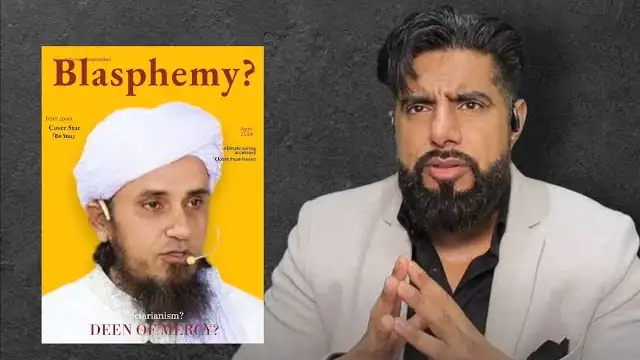 Play from 14:51
The video loads from YouTube only when you press play. Click a time in the transcript to seek.
Watch this part
Open on YouTube at 14:51The player starts at 14:51, the beginning of this part.
This segment14:51 to 20:58 · 6 min 07 sGeneral teaching
What this part covers
machinesummary, machine-writtenIt is not a mistake: Mufti Abu Layth shows from Sibawayh that the emphatic nun becomes an alif when stopping on it, so the alif spelling is the traditional one.
In more detail
Mufti Abu Layth turns to the orthography in question, the word lanasfa'an in the verse 'we will seize him by the forelock', which the mushaf writes with an alif rather than a nun. Mufti explains that this is the emphatic nun, which makes the same sound whether written as a nun or as tanwin. He reads from what he calls the most authoritative book of Arabic grammar, the Kitab of Sibawayh [?], the student of al-Khalil ibn Ahmad [?], in its fourth volume, where Sibawayh says that when one stops on the light emphatic nun it turns into an alif. Mufti likens this to the rules for an exclamation mark in English punctuation, and says that writing it with an alif is the traditional way, while later generations popularly wrote it with a nun.
- Some terms in this segment are uncertain
Position stated
Mufti Abu Layth says that writing the emphatic nun of lanasfa'an with an alif is the traditional way of writing it.
“that is actually the traditional way of writing it now as time developed and generations became much more a writing people they popularly started to write it the other way”
Category: teaching
Kind: general teachingTranscript
machine14:51 to 20:58 · click a time to seek · dotted terms open the glossary
falls on them and they're stuck now you know uhoh I'm in trouble so I'm going to now get AMA to come out and say this and I'm going to justify as an Alim or a Muti but what about all the poor individuals who are getting executed nobody's speaking for them because they don't have to speak for them they don't have M to speak for them they and and this is part of a broader backdrop a culture that needs to change that this is a dean of Rah a de of Mercy
you know drum this into the people repetition repeat it educate educate educate right and I wanted to bring up with that um this so you can see here that this was that's this was the verse
from that if he should he not refrain we will seize him and you can see the there is written with Ania now this in Arabic is known as an emphatic noon so you would either write it as a or you would write tan because it makes the same sound Tan in Arabic which means having the an in unow it means making a noon sound you know wi comes from the word to
make a know like like the at the end so and this is a the most authoritative book of grammar in the entire uh you know Islamic World known asab the student of Ahmed the first person to author the dictionary so he's from the era of the salaf and you you can see here that this um it begins with this is the noon that comes as an emphasis and
you'll see there that he actually brings within under this discussion the verse and you can see there he's writing it with the noon that that's how it that's how people would assume to write it he's saying but the actual grammar he does bring is there that in the and this if you've um if you've got the actual book yourselves or for right sorry alab and that's in the fourth
volume here it's actually it begins with that so it says um it says and he begins this and you can see um as he goes into this discussion you've got what if you had a and you stopped on it how would it be read and he
says that this is of one origin he goes right through through this mentioning that he says that that's what you do if you're stopping on it you would say if you wanted to say but you stopped on it so you don't then pronounce the noon you turn it into an alif
and you can see that there um he's mentioning the I'll bring it up on this as well I'll just put that down there that you've got um right
right so you can see that there I'll if I bring this up there right at the bottom that you would say if you intended one person and you decided to stop on this so this is the actual grammar okay so this is not um this is the most authoritative text written within Arabic um called Al and he highlights that that the
actual grammar of the orthography you know the how to write it would have been traditionally speaking when you stop on this emphatic no it's almost like an an exclamation mark like that so think of it like exclamation How we have rules of where can you put a full stop but if you're using an exclamation mark then you don't use a full stop and so on so similarly these if you were using this uh this this emphasis of saying like um you know go for example but now I wanted to
stop on it I'm not carrying on I would say so with an alif so that is how the verse is actually written with that top in there so it is the same thing and that is actually the traditional way of writing it now as time developed and generations became much more a writing people they popularly started to write it the other way so this is actually the traditional way inab how we write this especially if we stop on it now that was just to clarify the masah
the most important thing here is that this theme is one of Love and Hope okay the prophet sallallahu alaihi wasallam is he is and Allah is always and we must spread this message of Love whatever we do and I really want to just finish on this thought that that we don't realize sometimes and I
Paragraphs overlapping 14:51 to 20:58. Full text on the recording page.
Cite this segment
Stable id, transcript version and tier are part of the citation. Every change to a transcript is logged.Mufti Abu Layth Archive, segment 2024-09-29-S04, auto-transcribed, may contain errors. https://muftiabulayth.org/r/hmurvu2c9yq/s/4/ (accessed 1 November 2026)
- APA 7
Mufti Abu Layth. (2024, September 29). Why is lanasfa'an in Quran 96:15 written with an alif, and is it a mistake? [Video, segment 2024-09-29-S04, auto-transcribed, may contain errors]. Mufti Abu Layth Archive. Retrieved November 1, 2026, from https://muftiabulayth.org/r/hmurvu2c9yq/s/4/
- Chicago author-date
Mufti Abu Layth. 2024. "Why is lanasfa'an in Quran 96:15 written with an alif, and is it a mistake?" Video, segment 2024-09-29-S04, auto-transcribed, may contain errors. Mufti Abu Layth Archive. Recorded September 29, 2024. Accessed November 1, 2026. https://muftiabulayth.org/r/hmurvu2c9yq/s/4/
- BibTeX
@misc{abulayth-2024-09-29-S04,
  author = {Mufti Abu Layth},
  title = {{Why is lanasfa'an in Quran 96:15 written with an alif, and is it a mistake?}},
  year = {2024},
  month = {9},
  date = {2024-09-29},
  howpublished = {\url{https://muftiabulayth.org/r/hmurvu2c9yq/s/4/}},
  url = {https://muftiabulayth.org/r/hmurvu2c9yq/s/4/},
  organization = {Mufti Abu Layth Archive},
  urldate = {2026-11-01},
  note = {Segment 2024-09-29-S04, auto-transcribed, may contain errors}
}
Something wrong here?
Tell us what is wrong and it will be checked against the recording. Nothing changes until a person has reviewed it.
Sending a note needs JavaScript, which is off or unavailable in this browser. Nothing has been sent.
No name, email address or account is asked for or stored, and the inbox does not store your IP address. For rate limiting it keeps an unreadable fingerprint of your connection for 48 hours, and our database provider's own logs record connections as every website's do. Only your note, its kind, the page and the moment in the recording are kept, for review.