
Recordings › On the David Wood and Muhammad Hijab Debate: Reflections & Review -Mufti Abu Layth · 24 Dec 2018 › Segment 7 of 9
Did the Prophet teach a creed about God's attributes, and when did the Muslim creed emerge?
aqeedah aqida aqeeda aqaid averroes ibn rushd al-hafid imaam imams prayer leader shafi'i shafei shafiite shafi'i school muftis sunna sunnat sunan prophetic practice imaan eemaan eeman kalam ilm al-kalam kalaam jahannam jahanam jahannum koran quraan al-quran hijaab hejab hijabi alhamdulilah al-hamdu lillah alhumdulillah alhamdulillaah hamdulillahFaith, not creed: the Prophet taught iman, the formal aqidah came centuries later
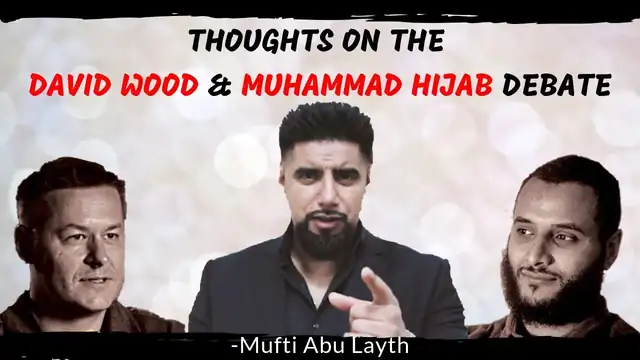 Play from 17:38
The video loads from YouTube only when you press play. Click a time in the transcript to seek.
Watch this part
Open on YouTube at 17:38The player starts at 17:38, the beginning of this part.
This segment17:38 to 21:22 · 3 min 44 sGeneral teaching
What this part covers
machinesummary, machine-writtenThe Prophet taught faith, not a formal creed; the Muslim creed emerged two to three hundred years later, and its doctrine of attributes 'neither God nor other than God' is, in Mufti Abu Layth's view, irrational and unfounded in the Quran and Sunnah. Ordinary Muslims do not know this material, which is why Wood's objections did not land.
In more detail
Finishing the previous point, Mufti Abu Layth says that on a few occasions Wood's objections that some Muslims had said certain things were in fact true, though not of all Muslims, and Hijab simply denied them. He then says that if one is going to hold Christians to the Nicene creed as a formal creed, the same test applies to Muslims, which is why he has never favoured such formulations and always distinguishes aqidah from iman: the Prophet came to teach faith, not creed, because creed is always institutionalised, and the Muslim creed itself is at least two to three hundred years younger than the Prophet. He says the Prophet taught very little about what Muslims must believe about God beyond the very basics, such as that God is one, whereas today Muslims are taught a creed of attributes that he calls irrational, nonsensical and not based in the Quran and Sunnah, leading to contradiction: many push the doctrine that Allah has attributes which are neither Him nor other than Him, a formula found in many theology books, of which Ibn Rushd the philosopher said its proponents must be drunk on something. The plus side, he says, which Wood's points inadvertently showed, is that despite the clergy's efforts to institutionalise everyone into creed the common Muslim has never heard of this material, so Wood's objections did not resonate and Hijab could easily dismiss them. He closes that Wood's genuine challenge remains: Muslims must be consistent in appealing to reason all the way, or not at all, and he moves on to how the debate was conducted.
Position stated
Mufti Abu Layth holds that the Prophet came to teach faith rather than creed, that the Muslim formal creed emerged two to three hundred years after him, and that the doctrine of divine attributes that are neither God nor other than God is irrational and not based in the Quran and Sunnah.
“I always make a distinction between our teeth and Iman the Creed and faith that the Prophet came to teach faith not to teach Creed because with Creed it's always institutionalized”
Category: teaching
Kind: general teachingTranscript
machine17:38 to 21:22 · click a time to seek · dotted terms open the glossary
he win well either I'm not sure if Imam Shafi he really said the hell if he did maybe in his day and age nowadays it's all drama titta sort it up right this it's all about winning so I understand that Muhammad hijab you know would and it's you know he would do what fair enough just because the main point is to win and you know so he did dismiss a lot of these things and saying that these there is no such thing Muslims have never said stuff like this but Muslims have said unfortunately not that we agree with
them I don't agree with those Muslims that say things like that as you know these kind of body parts or these kind of things and but they have been unfortunately Muslims that have said things like that so there was a bit of kind of there were some occasions where he was saying things dr. wood was putting objections in saying some Muslims have said this this and he Muhammad he jab did kind of just say no that's not true at all whereas in a few of those occasions it was actually true that but it's not may not be true of all people the other
thing is that Muslim creed you see I will achieve that as well like if you're gonna take the nice see enough either our up either - if we're gonna use formal Creed you see this is why I'm kind of never really in favor of these kind of RT the things I always make a distinction between our teeth and Iman the Creed and faith that the Prophet came to teach faith not to teach Creed because with Creed it's always institutionalized and even the Muslim Creed is like what at least 300 years old after the Profi it's not like you know at least two to three hundred years
after the Prophet it's not like something that was emerged at the time of the Prophet in fact surprisingly the Prophet taught very little things on how what Muslims must believe about God except the very basic like God is one and things like that but he didn't you know what today Muslims teach his Creed oh you must believe this and God has these attributes and these attributes are like this that is actually very I think irrational nonsensical not based in the Quran and Sunnah and he actually does lead to a contradiction because many Muslims today do push this creed that Allah has say fact he has
attributes the attributes are not him and they not other than him so what on earth is that there you know la Lisa what is it laughs whoa well a label that's the term they use in a lot of the theory books that they are not God and they are not other than God this is why even Irish the most philosopher said you guys must be drunk on something that's what on earth does this stuff even mean that you're pushing so Muslims do but the plus side is that and I think dr.
would highlighted this but it served as a strength that despite the efforts of Muslim clergy to push this stuff the common Muslims don't know about this stuff so despite the fact that the clergy have tried hard in getting everybody institutionalized into Creed but alhamdulillah the common Muslim doesn't really know this stuff and I've probably never even heard of it so when dr.
wood or these kind of people are saying these things it doesn't resonate with people so because they saw this thing and what on earth is he on about so once again it's easy to just dismiss and you know it was quite easy in or not easy but it was then Mohammed hijab would then just destroy his points because a lot of people wouldn't understand them anyway so that is a but there was some genuine kind of like tough challenges he did present I think like the that you guys yourself need to then either be consistent in appealing
to reason all the way or you don't and so I think that's a overall coming moving on to the way they conducted it I do think that it's unbeatable I mean it's actually very clear Muhammad hijab himself says that look I'm during this debate I'm not going to show any respect to dr. David Ward or whatever David would that's an interesting you see I don't I don't know I was in a bit of a dilemma about this because on one hand I could see that because he justifies he Muhammad he chapters and he says look
Paragraphs overlapping 17:38 to 21:22. Full text on the recording page.
Cite this segment
Stable id, transcript version and tier are part of the citation. Every change to a transcript is logged.Mufti Abu Layth Archive, segment 2018-12-24b-S07, auto-transcribed, may contain errors. https://muftiabulayth.org/r/gyrfzzzca8g/s/7/ (accessed 1 November 2026)
- APA 7
Mufti Abu Layth. (2018, December 24). Did the Prophet teach a creed about God's attributes, and when did the Muslim creed emerge? [Video, segment 2018-12-24b-S07, auto-transcribed, may contain errors]. Mufti Abu Layth Archive. Retrieved November 1, 2026, from https://muftiabulayth.org/r/gyrfzzzca8g/s/7/
- Chicago author-date
Mufti Abu Layth. 2018. "Did the Prophet teach a creed about God's attributes, and when did the Muslim creed emerge?" Video, segment 2018-12-24b-S07, auto-transcribed, may contain errors. Mufti Abu Layth Archive. Recorded December 24, 2018. Accessed November 1, 2026. https://muftiabulayth.org/r/gyrfzzzca8g/s/7/
- BibTeX
@misc{abulayth-2018-12-24b-S07,
  author = {Mufti Abu Layth},
  title = {{Did the Prophet teach a creed about God's attributes, and when did the Muslim creed emerge?}},
  year = {2018},
  month = {12},
  date = {2018-12-24},
  howpublished = {\url{https://muftiabulayth.org/r/gyrfzzzca8g/s/7/}},
  url = {https://muftiabulayth.org/r/gyrfzzzca8g/s/7/},
  organization = {Mufti Abu Layth Archive},
  urldate = {2026-11-01},
  note = {Segment 2018-12-24b-S07, auto-transcribed, may contain errors}
}
Something wrong here?
Tell us what is wrong and it will be checked against the recording. Nothing changes until a person has reviewed it.
Sending a note needs JavaScript, which is off or unavailable in this browser. Nothing has been sent.
No name, email address or account is asked for or stored, and the inbox does not store your IP address. For rate limiting it keeps an unreadable fingerprint of your connection for 48 hours, and our database provider's own logs record connections as every website's do. Only your note, its kind, the page and the moment in the recording are kept, for review.