
Recordings › Why converting the Hagia Sophia to a mosque is a mistake | Mufti Abu Layth · 16 Jul 2020 › Segment 2 of 9
Does Islam allow converting churches and other places of worship into mosques?
salat salaah namaz salaat namaaz as-salah al-salah salawat zakah zakaat zakah al-mal zakat al-mal obligatory charity haj pilgrimage hadj masjed masaajid muftis koran quraan al-quran sura soorah surat suwar soora chapter ayah ayat ayaat aayah aayat sahabah sahaba sahabi sahabiyyah sahabiyat as-salaf salaf al-salih salaf us-salih al-salaf early generations madinah madina al-madinah madeenah yathrib ibadah ibada ibaadah ibadatShould places of worship be converted into mosques? Umar in Jerusalem and Surah al-Hajj 22:40-41
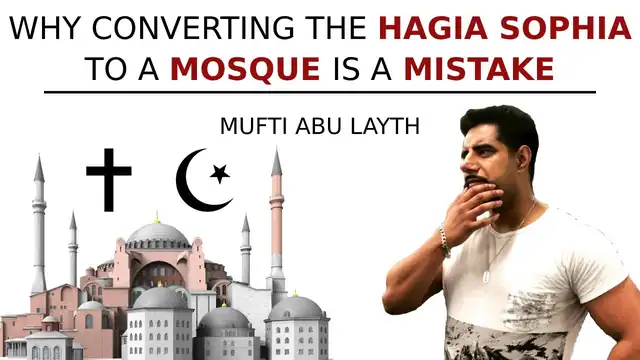 Play from 2:43
The video loads from YouTube only when you press play. Click a time in the transcript to seek.
Watch this part
Open on YouTube at 2:43The player starts at 2:43, the beginning of this part.
This segment2:43 to 7:58 · 5 min 15 sGeneral teaching
What this part covers
machinesummary, machine-writtenIslam never set out to convert other religions' holy sites: Umar left Jerusalem's churches alone, and Quran 22:40 counts monasteries, churches and synagogues among places where Allah's name is glorified and which He protects. The Hagia Sophia's conversion happened, but it was not what Islam encourages.
In more detail
Mufti Abu Layth frames two questions: whether places of worship should be converted into mosques at all, and whether something should now be reconverted into a mosque. He says that in the time of the salaf and the Companions rulers did not do this: when Umar conquered Jerusalem, with no resistance to his entry, he did not convert the Church of the Holy Sepulchre or the other holy sites, and that was never the objective of Islam. He says the Hagia Sophia was converted in the time of Sultan Mehmed al-Fatih, some claiming he paid Christians for it; whether or not they did, it happened. He does not think Islam encourages converting holy sites into mosques, and cites Surah al-Hajj: verse 41 describes those given power in the land as people who establish prayer, pay zakat, command good and forbid harm, and verse 40 says that had Allah not set up one people to resist another, monasteries, churches, synagogues and mosques would have been destroyed, places in which Allah's name is glorified often. He stresses that Allah says His name is glorified in monasteries and synagogues, that this is a Madinan passage describing how Muslims given dominion should behave, and concludes that Islam does not set out to convert holy sites into mosques.
Position stated
Mufti Abu Layth says Islam never set out to convert other religions' holy sites into mosques: Umar did not convert Jerusalem's churches, and Quran 22:40 counts monasteries, churches and synagogues among the places where Allah's name is glorified and which He protects.
“i don't think islam encourages you to convert holy sites into masjids so for example if we look at the the quran”
Category: teaching
Kind: general teachingTranscript
machine2:43 to 7:58 · click a time to seek · dotted terms open the glossary
the largest in christendom if not at least um in the eastern part of the whole christian world the byzantine dynasty and which was uh the kind of roman dynasty in the east so that's what it was up until uh he conquers and then they convert it into a masjid so the question is first of all should we be converting places of worship into masajid this is one question we want to look at
secondly okay even i mean that's secondly should we in now be reconverting something to a masjid so first is the original conversion and then the reconversion to a masjid what are our thoughts on all of this that's the backdrop to it i would say uh and adding to that in the time of the salaf when we look at the sahaba's time many of them did not uh like when you look at the rulers like um when he conquered jerusalem
he didn't convert the holy sites into masjids and even though he was given an opportunity and there wasn't there was no resistance to said umar's entrance to jerusalem he did not convert the you know the church of the holy sepulchre or other uh or other kind of holy sites to chris to muslim holy sites he didn't do that and that was never the objective of islam okay now this thing of the aya sofia this
was converted in sultan fateh time some people claim he even paid some christians for it and i think historically whether they did it or not is something which whether they did it or not it happened khalas it happened i don't think islam encourages you to convert holy sites into masjids so for example if we look at the the quran we will have in suratul hajj allah speaks about people who
are given power so allah in verse 41 he mentions who these people are they are people who have been given power people whom if we gave them dominion over a certain land or in the earth they established the salah they established worship for people they established a welfare system for people zakat they commanded kindness and goodness
and prevented that which was harmful and indeed to allah belongs the end of this fear or of all affairs but the verse before that uh allah speaks uh so the one just preceding that leading into that mentions of allah if allah had not set up a certain people to resist against another group of people
was so to repeat that lola if allah had not set up a a group of people to resist an opposing group
monasteries um places of worship beer on people say synagogues or salawatun and areas for restricted or restricted areas for prayer one masajit that these things would have all been destroyed in all of these places allah's name is glorified often now notice allah says about sawanya about christian monasteries allah's name is glorified in them so and synagogues
allah does not say and this is you know suratul hajj this is speaking this is in medina allah is speaking about how uh muslims should be because he goes on to say who are these people these are those people who if we give them dominion this is what they do that they would prevent such things tragedies from happening so islam does not set out to convert holy sites to mosques it's never that's never been the goal of islam but
Paragraphs overlapping 2:43 to 7:58. Full text on the recording page.
Cite this segment
Stable id, transcript version and tier are part of the citation. Every change to a transcript is logged.Mufti Abu Layth Archive, segment 2020-07-16-S02, auto-transcribed, may contain errors. https://muftiabulayth.org/r/bgsfy-umsa4/s/2/ (accessed 1 November 2026)
- APA 7
Mufti Abu Layth. (2020, July 16). Does Islam allow converting churches and other places of worship into mosques? [Video, segment 2020-07-16-S02, auto-transcribed, may contain errors]. Mufti Abu Layth Archive. Retrieved November 1, 2026, from https://muftiabulayth.org/r/bgsfy-umsa4/s/2/
- Chicago author-date
Mufti Abu Layth. 2020. "Does Islam allow converting churches and other places of worship into mosques?" Video, segment 2020-07-16-S02, auto-transcribed, may contain errors. Mufti Abu Layth Archive. Recorded July 16, 2020. Accessed November 1, 2026. https://muftiabulayth.org/r/bgsfy-umsa4/s/2/
- BibTeX
@misc{abulayth-2020-07-16-S02,
  author = {Mufti Abu Layth},
  title = {{Does Islam allow converting churches and other places of worship into mosques?}},
  year = {2020},
  month = {7},
  date = {2020-07-16},
  howpublished = {\url{https://muftiabulayth.org/r/bgsfy-umsa4/s/2/}},
  url = {https://muftiabulayth.org/r/bgsfy-umsa4/s/2/},
  organization = {Mufti Abu Layth Archive},
  urldate = {2026-11-01},
  note = {Segment 2020-07-16-S02, auto-transcribed, may contain errors}
}
Something wrong here?
Tell us what is wrong and it will be checked against the recording. Nothing changes until a person has reviewed it.
Sending a note needs JavaScript, which is off or unavailable in this browser. Nothing has been sent.
No name, email address or account is asked for or stored, and the inbox does not store your IP address. For rate limiting it keeps an unreadable fingerprint of your connection for 48 hours, and our database provider's own logs record connections as every website's do. Only your note, its kind, the page and the moment in the recording are kept, for review.