
Recordings › My Thoughts on Sheikh Imran Hosein | Mufti Abu Layth · 9 Nov 2019 › Segment 1 of 1
What does Mufti Abu Layth think of Shaykh Imran Hosein?
hadeeth ahadith ahaadeeth hadis hadees ahaadith sahih saheeh sahih hadith saheeh hadith sound hadith muftis al-dajjal dajjaal ad-dajjal sheikh shaikh sheik shuyukh shaykhs deen al-din ad-deen ad-dinThoughts on Imran Hosein: apocalypse culture versus an Islam of optimism
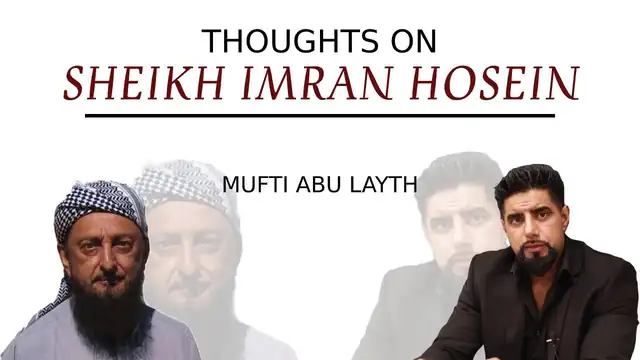 Play from 0:00
The video loads from YouTube only when you press play. Click a time in the transcript to seek.
Watch the answer
Open on YouTube at 0:00The player starts at 0:00, where the answer begins.
This segment0:00 to 5:31 · 5 min 31 sGeneral teaching
The answer in brief
machinesummary, machine-writtenMufti Abu Layth has not watched much of Imran Hosein but finds him preoccupied with doomsday culture, which he opposes. Islam, he says, is about optimism and seizing the day, as the hadith about carrying on planting when the Hour comes shows, and doom and gloom can fuel death cults.
In more detail
Mufti Abu Layth reads a question asking what he thinks of Imran Hosein and confirms from the spelling whom is meant. He says he has not closely watched much of his material and that his take may be inaccurate, but his impression is that Imran Hosein is preoccupied with apocalypse and doomsday culture, in which everything is about the end of times, the Dajjal, the return of Isa and an ascetic call to give up the world. He says he is very opposed to that mindset: Islam has never been about doom and gloom but about optimism, seizing the day and fulfilling one's potential. He does not deny that what has a beginning has an end and that the cosmos may one day collapse, but argues against becoming obsessed with it, citing the hadith that if the Hour comes while someone is planting, he should carry on planting, which he reads as being about mindset rather than the plant. He adds the saying that the days are three, a yesterday that cannot be recaptured, a tomorrow one may not reach, and a today in which to act, which he says is probably not authentic as a hadith but whose message Islam resonates with. He closes by saying doom and gloom culture also fuels death cults, while stressing that not everyone who subscribes to it is part of one.
Question as read aloud · questioner not identifiedWhat do I think of Shaykh Imran Hosein?
Position stated
Not yet double-checkedA summary of the view expressed is published here only after a second, independent review has found the sentence in the transcript where he says it. Until then, the transcript and the recording speak for themselves.
Kind: general teachingTranscript
machine0:00 to 5:31 · click a time to seek · dotted terms open the glossary
mother yeah what do I think of Imran Naseer Hussain hmm that's right I take it we're talking about with that spelling of Hussain we're talking about Imran share Imran who's saying from I think is he from Trinidad or somewhere you see my perspective on chef Imran I've not kind of I've not closely
watched a lot of his material I've seen some and I've got the kind of gist of all my personal take on him it may be inaccurate but you see I feel that he's very preoccupied with the kind of the apocalypse' culture you know the kind of doomsday culture that that everything is very doom and gloom in the perspective of people like chef Imran Hosein in my that's my take that's my understanding you know I could be wrong
about this but that's what I feel chef Imran Hosein preaches he everything is to do at the end of times it's all to do with the Antichrist or I know he has a different take as well on the Antichrist and that the return of Jesus and things like this but but everything is about that kind of ascetic you know give up the world do this do that and I'm very opposed to that kind of a mindset I believe that religion and Islam especially is not and has never
been about this kind of doom and gloom approach to me Islam is about optimism it's about kind of seizing the day it's about living fulfilling your potential it's not about this kind of all gonna die the world's gonna be destroyed and the cosmos is gonna collapse and it's not about that I mean whether that happens or not I mean obviously look what has a beginning will have an end okay
thus all you know has fate decreed matters so I'm not challenging that I'm not saying the cosmos will not collapse someday presumably will matter will return to being energy but my point is that should we become obsessed with this kind of a very doom and gloom approach I would argue absolutely not and I can't
emphasize enough I can't emphasize enough the hadith of the prophet salallahu alayhi wa sallam where he said that if the hour was to come upon you and you are planting a plant oh you are eating a bite of food a morsel of food that continue to do so you know man Kahneman come you sorrowful USERRA let him continue to plant why I mean if if the world was coming to an end why would you be so worried about a plant and it's
not about that it's about the mindset okay it's about that kind of carpe diem that kind of you know seize it that's this a they say hadith although it's it's probably not authentic as a hadith but the meaning is still very true where it says that a yama Salathe that days are three that yeomen mother that a day which has gone and lentils recommend who she and you will never be able to recapture while yamaha teen and tomorrow you know latter three aspherical
Amla you do not know whether you shall read or not well human anta fee and a day in which you are here present the present first animal sees it and that is a to me an amazing message you know even if it's not even if that's not a hadith but I feel that that message is resonated by Islam so yeah to me I'm not about that do gloom kind of culture I feel that we need to be more optimistic because the
problem with this doom and gloom culture is it also it does fuel death cults and I'm not saying everybody who subscribes to a doom and gloom culture is part of the death cult I'm not saying that but this definitely this definitely does support that
Paragraphs overlapping 0:00 to 5:31. Full text on the recording page.
Cite this segment
Stable id, transcript version and tier are part of the citation. Every change to a transcript is logged.Mufti Abu Layth Archive, segment 2019-11-09-S01, auto-transcribed, may contain errors. https://muftiabulayth.org/r/2cei2vntjes/s/1/ (accessed 1 November 2026)
- APA 7
Mufti Abu Layth. (2019, November 9). What does Mufti Abu Layth think of Shaykh Imran Hosein? [Video, segment 2019-11-09-S01, auto-transcribed, may contain errors]. Mufti Abu Layth Archive. Retrieved November 1, 2026, from https://muftiabulayth.org/r/2cei2vntjes/s/1/
- Chicago author-date
Mufti Abu Layth. 2019. "What does Mufti Abu Layth think of Shaykh Imran Hosein?" Video, segment 2019-11-09-S01, auto-transcribed, may contain errors. Mufti Abu Layth Archive. Recorded November 9, 2019. Accessed November 1, 2026. https://muftiabulayth.org/r/2cei2vntjes/s/1/
- BibTeX
@misc{abulayth-2019-11-09-S01,
  author = {Mufti Abu Layth},
  title = {{What does Mufti Abu Layth think of Shaykh Imran Hosein?}},
  year = {2019},
  month = {11},
  date = {2019-11-09},
  howpublished = {\url{https://muftiabulayth.org/r/2cei2vntjes/s/1/}},
  url = {https://muftiabulayth.org/r/2cei2vntjes/s/1/},
  organization = {Mufti Abu Layth Archive},
  urldate = {2026-11-01},
  note = {Segment 2019-11-09-S01, auto-transcribed, may contain errors}
}
Something wrong here?
Tell us what is wrong and it will be checked against the recording. Nothing changes until a person has reviewed it.
Sending a note needs JavaScript, which is off or unavailable in this browser. Nothing has been sent.
No name, email address or account is asked for or stored, and the inbox does not store your IP address. For rate limiting it keeps an unreadable fingerprint of your connection for 48 hours, and our database provider's own logs record connections as every website's do. Only your note, its kind, the page and the moment in the recording are kept, for review.