
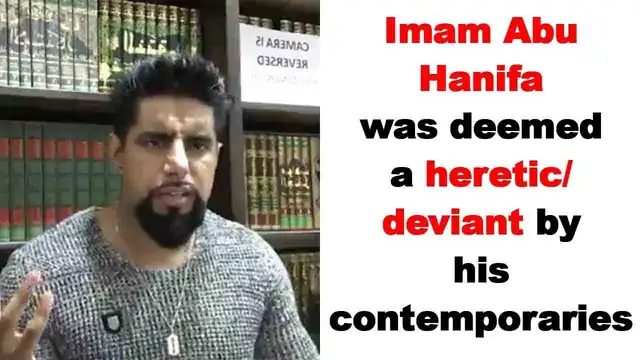
Recordings › Imam Abu Hanifa was deemed a heretic/deviant by his contemporaries - Mufti Abu Layth al-Maliki · 20 Apr 2018 › Segment 1 of 2
Was Abu Hanifa considered a deviant by the scholars of his time?
salat salaah namaz prayer salaat namaaz as-salah al-salah salawat hadeeth ahadith ahaadeeth hadis hadees ahaadith madhab mazhab school of law madhahib mazahib madhaahib malik ibn anas malik bin anas imam maalik imam malik ibn anas imaam imams prayer leader hanafite hanafiyyah shafi shafei shafiite shafi'i school muftis dalil daleel adillah adilla proof hasan hadith hasan li-ghayrihi hasan li-dhatihi hasan sahih sahabah sahaba sahabi sahabiyyah sahabiyat khalifah khalifa caliph khulafa khilafah khilafat khilafa shiah shiite shi'i twelver ithna ashari sufis sufism soofi 'alim aalim ulama ulema ulamaa deen al-din ad-deen ad-dinAbu Hanifa deemed a deviant in his time, and how the Hanafi school rose through power
 Play from 0:00
The video loads from YouTube only when you press play. Click a time in the transcript to seek.
Watch this part
Open on YouTube at 0:00The player starts at 0:00, the beginning of this part.
This segment0:00 to 3:57 · 3 min 57 sGeneral teaching
What this part covers
machinesummary, machine-writtenMany leading scholars of Abu Hanifa's time considered him misguided. His school rose to dominance because his student Abu Yusuf became chief judge and appointed only Hanafis, which Mufti Abu Layth says shows that power, not evidence, often decides which views prevail.
In more detail
Mufti Abu Layth reads a quote someone sent him: Abu Bakr ibn Abi Dawud al-Sijistani [?], son of Abu Dawud, asked his students what they would say of a matter on which Malik, al-Shafi'i, al-Awza'i [?], al-Hasan ibn Salih [?], Sufyan al-Thawri and Ahmad ibn Hanbal, each with his companions, had all agreed; when they said nothing could be sounder, he told them that all of these had agreed on the misguidance of Abu Hanifa. He then quotes Ibn al-Jarud [?], as brought by Ibn Abd al-Barr, listing Abu Hanifa in a book on rejected and weak transmitters, saying most of his hadith were error and that there was disagreement about whether his Islam was valid. Mufti says that in his own time Abu Hanifa was deemed an absolute deviant, that Imam Malik respected him but found his ways unacceptable, as did the other scholars. He argues that the Hanafi school became acceptable and then the most powerful because Abu Hanifa lived in Iraq, the seat of the caliphate, and although he refused the post of chief judge, his student Abu Yusuf accepted it and appointed only Hanafi judges, so its rise rested on power rather than evidence or objectivity. He compares this with Iran, which he says was largely Shafi'i until about four or five hundred years ago and became Shia through the politics of its Shah.
- Some terms in this segment are uncertain
Position stated
Mufti Abu Layth says Abu Hanifa was considered a deviant by many scholars of his time and that the Hanafi school became dominant because his student Abu Yusuf, as chief judge, appointed only Hanafi judges, so that its rise rested on power rather than evidence.
“now you tell me is that based on studies is that based on evidences is that based on objectivity or is it based on power positions is based on power positions”
Category: historical claim
Kind: general teachingTranscript
machine0:00 to 3:57 · click a time to seek · dotted terms open the glossary
check this out people I read out to your quote which will shock you right that this is an interesting quote and it will it will show you actually what I'm talking about check this out I was coming across this the other day somebody sent it to me is really interesting speaking about Iijima obukhov Nevada who the sillustani abu dawood son a great scholar Yahoo Leah's hobby he Morocco Luna theme as a Latina Tata alaihe Malik was Hubbell was chef he was able while I was there I was Istanbul well has an egg masala was hobble what
Sufi an authority was hobble Mohammed Amin humble was hobble he he said what he said to his students what would you say about an issue in which Malik and his companions agreed upon Shelfari and his companions all agreed upon oh sorry and all his companions agreed upon sophie-anne authority and all his companions agreed upon hassan in a Salah and all his companions agreed upon a humble and all his companions agreed upon so they said yeah but let's economist Illuminati they said oh work and he was a great Mahadev there is no mass Alamo soundin that and check what he said this
is he said for Karl aha una y : he said all of these have said it tougher oh they agreed that Todd Lee Lee abu hanifa upon the misguidance of abu hanifa and look at that look check this out Abe no Jared if nabbed Albert brings this in his book about Abu Hanifah linty ignore Jared was a great scholar leaning into a surfer he sought and a great mom had this wrote in his book at door of our master Luke in those who are rejecting writers he said I'm not - Abbot abu hanifa and he is from the rejected and
weak transmitters not Manila sahabat above hanifa check this a jewel or hadith eOne the majority of his hadith is just an illusion and then he said waka deliver he Islamic oh my god he said this and there's a disagreement about his Islam whether his Islam is valid or not now check that out that some quotes about imam abu hanifa in his time he was deemed an absolute deviant by people Imam Malik although had respect for him but considered his ways unacceptable
all the scholars considered his ways unacceptable now because he happened to live in Iraq where the capital city was where the Muslim Caliphate was the caliphs asked him to become the Imam the supreme judge he refuses but because his student becomes the supreme judge of the Muslim world the kadhi Aquabot he refuses to appoint any judges anywhere unless they Hanafy all of a sudden the hanafi madhhab becomes acceptable and it becomes the most powerful method now you tell me is that based on studies is that
based on evidences is that based on objectivity or is it based on power positions is based on power positions so this is how you see in in fact is an interesting study into how iran about three hundred years ago became shia because iran pre if you go look at the history of Iran or Persia pre let's say four hundred five hundred years ago and going backwards it was not Shia it was actually suddenly heavily Scheffer how does it become suddenly Shia so it's interesting
and they go sir it becomes suddenly she had just through politics because of the Shah and so on converting and having his beef with the the the other rulers and so on so in religion things on seldom based on pure objectivity they usually based on power positions so that's that's the the kind of thing but yeah I thought that's definitely worth mentioning but it was an interesting and amazing conversation and I think it I'd like to say that look the reason I also made an article Shir doc in Ron's article sorry his facebook
Paragraphs overlapping 0:00 to 3:57. Full text on the recording page.
Cite this segment
Stable id, transcript version and tier are part of the citation. Every change to a transcript is logged.Mufti Abu Layth Archive, segment 2018-04-20b-S01, auto-transcribed, may contain errors. https://muftiabulayth.org/r/zn1-wlbys2i/s/1/ (accessed 1 November 2026)
- APA 7
Mufti Abu Layth. (2018, April 20). Was Abu Hanifa considered a deviant by the scholars of his time? [Video, segment 2018-04-20b-S01, auto-transcribed, may contain errors]. Mufti Abu Layth Archive. Retrieved November 1, 2026, from https://muftiabulayth.org/r/zn1-wlbys2i/s/1/
- Chicago author-date
Mufti Abu Layth. 2018. "Was Abu Hanifa considered a deviant by the scholars of his time?" Video, segment 2018-04-20b-S01, auto-transcribed, may contain errors. Mufti Abu Layth Archive. Recorded April 20, 2018. Accessed November 1, 2026. https://muftiabulayth.org/r/zn1-wlbys2i/s/1/
- BibTeX
@misc{abulayth-2018-04-20b-S01,
  author = {Mufti Abu Layth},
  title = {{Was Abu Hanifa considered a deviant by the scholars of his time?}},
  year = {2018},
  month = {4},
  date = {2018-04-20},
  howpublished = {\url{https://muftiabulayth.org/r/zn1-wlbys2i/s/1/}},
  url = {https://muftiabulayth.org/r/zn1-wlbys2i/s/1/},
  organization = {Mufti Abu Layth Archive},
  urldate = {2026-11-01},
  note = {Segment 2018-04-20b-S01, auto-transcribed, may contain errors}
}
Something wrong here?
Tell us what is wrong and it will be checked against the recording. Nothing changes until a person has reviewed it.
Sending a note needs JavaScript, which is off or unavailable in this browser. Nothing has been sent.
No name, email address or account is asked for or stored, and the inbox does not store your IP address. For rate limiting it keeps an unreadable fingerprint of your connection for 48 hours, and our database provider's own logs record connections as every website's do. Only your note, its kind, the page and the moment in the recording are kept, for review.