
Recordings › Reaction to Yasir Qadhi on mens jewellery | Mufti Abu Layth · 9 Dec 2020 › Segment 1 of 1
Is it haram for men to wear necklaces, rings or earrings?
muftis haraam forbidden akhirah akhira aakhirah akhirat hereafter janna jannat koran quraan al-quran sheikh shaikh sheik shuyukh shaykhs adab aadaab adaab mannersMufti Abu Layth on Yasir Qadhi's answer on men wearing necklaces and rings
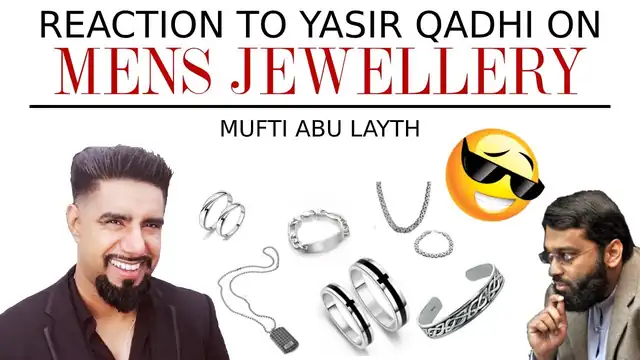 Play from 1:15
The video loads from YouTube only when you press play. Click a time in the transcript to seek.
Watch this part
Open on YouTube at 1:15The player starts at 1:15, the beginning of this part.
This segment0:00 to 8:38 · 8 min 38 sGeneral teaching
What this part covers
machinesummary, machine-writtenMufti Abu Layth disagrees with Yasir Qadhi that men's jewellery is effeminate, saying men have always worn it and Western executives are no benchmark for Islamic etiquette.
In more detail
Mufti Abu Layth plays a snippet in which Yasir Qadhi, asked about fade haircuts and chains and rings for men, says he will not call them haram but that men wearing jewellery such as necklaces and earrings opens a door better kept shut because it is still somewhat effeminate. Mufti reports that Yasir Qadhi goes on to say men's necklaces are masculine in North Africa but '50/50' in America, and mocks the claim, asking how a necklace is more effeminate than the robe, kohl and sandals worn by many religious men. Mufti says men have worn necklaces, earrings and bracelets for thousands of years, and argues the Quran's image of men in paradise wearing gold bracelets only makes sense if men could relate to it. Mufti then objects to Yasir Qadhi's point that CEOs and politicians do not wear earrings, asking why upper-middle-class Western propriety should become the benchmark of Islamic etiquette when non-Muslims' views are dismissed elsewhere, and calls this a double standard.
- Guest speech overlaps this segment
Position stated
Waiting for the speaker checkA guest speaks in this segment and the captions do not say who said what. The view found here is held back until the speaker-separated transcript confirms the words are his, or the channel verifies it. The transcript and recording are published in full.
Kind: general teaching Speakers: host and guest; guest speech is labelled and excluded from positionsTranscript
machine0:00 to 8:38 · click a time to seek · dotted terms open the glossary
A guest speaks in this segment. Guest speech is labelled and is excluded from the positions layer.
as well whilst we were on the note of yasser here was a video there's a question about i think it's the male fashion question it says uh are fade haircuts allowed and is wearing chain necklaces and rings haram for men which is why i am not saying it is haram i'm gonna say the least that can be said is that you're opening up a door that is better to be shut at this stage and i would not want uh men to start wearing jewelry that is still
somewhat effeminate the necklace in the earring and it's reminding him of the of the gentler sex [Laughter] i genuinely don't understand these people who say that a necklace or there this is it's that's a snippet from his reply
his in his reply he goes on to say that i do recognize that in some parts of the world like i don't know why he says this he says in north africa men wear necklaces there it's masculine but he says in america it's still 50 50. it's not clear whether it's effeminate or not i think shaykh is just hanging around too many gay bars
because when men wear it generally it's very clear there's nothing effeminate about it i mean i don't know what he's on about he's like you know it makes them effeminate a cha cha cha cha it makes it how does it you know the shocking thing is wearing a frock like how you know the arab thobe today wearing a frog putting kahal in your eyes which a lot of the religious folk do
and walking around in sandals with [Laughter] how is that not effeminate then you know if anything you know if you had a choice between saying well you know a guy with an uh a fade hiccup and a guy with a necklace or you've got a guy in a frock and sandals and we're in gohan i mean if anything you would think well you know i mean you know if i had to pick
[Laughter] i'd probably pick the frock and the eyeliner as trying to be effeminate rather than saying a necklace for god's sake men have always wore necklaces men have always for thousands of years wore earrings in some cultures more than others so i don't see why men have always worn bracelets even in the prophet's time why would the quran be enticing us about the afterlife in the imagery saying or that people in jannah having assa with having bracelets
you hellona that the men will be wearing bracelets of gold if unless it was a concept that men could relate to otherwise that would be like telling men oh yeah in general you can wear high heels made out of gold i mean most men would be thinking like you know with that okay you've got high heels for of gold
and you're like um [Laughter] something else this is uh [Laughter] so that's exactly so why would the quran say unless they could identify with it so the fact that they could identify
it's crazy and this is my point when yasser adi was saying and this is a recent video is released so if he just said a couple of hours before in his video and he released them i think or a day apart or something saying i'm a very academic person j smith and all these people are not academic i do everything academically thoroughly and then he makes such a dumb response by saying you know these things are still really kind of effeminate you know and he says well look i don't see politicians or ceos wearing earrings
so uh you know islam uh prides itself on nobility yeah but i you see i want to say something if that's the case why is it that you see you are taking your standards you're taking your standards of nobility and dignity from the middle class of the western world why are your etiquettes of what is dignified coming from that to an elitist western capitalistic culture of like what is you know like because you could go you could say what about the
uh yogis of the east you know you're not going to look to them you're not looking to the yogis and the swamis or the sun uh you know these kind of sadhu-sans of the east you're looking at ceos the example he gives is a ceo of a uh of a you know huge company wouldn't generally wear an earring and you think well but what's islam got to do with that you know it's like islam the ceo of a company you know wouldn't be muslim anyway so what what
does the the example you're giving or he said these prime ministers of these countries wouldn't wear uh so i i find that incredibly fascinating that when it suits you these ceos and politicians and parliamentarians all of a sudden become the benchmark of islamic etiquette and adap and and then when it comes to your other things uh oh no tattoos or when it comes to other things it's haram so if these ceos do say certain things are fine you'll say yeah but what do they know they're not muslim
so why are they why is middle class or upper middle class kind of western culture all of a sudden the benchmark for islamic values i'm not against you know western upper middle class culture but i'm trying to say what what how does it dictate islam to us sure it's a propriety issue i get that you know i'm not saying turn up to your meeting in bermuda shorts you know i'm not saying that every place has its propriety and i get that that's fine you can say that but why are you placing islamic values on just what ceos would do and nowadays
a lot of ceos are hip anyway some of them they do you know some of these millionaire people do try to come out with all this kind of stuff so yeah so i find it very hypocritical that's all i find it very you know the double standards that these uh these kind of this is why you know it annoys me when i below it says stuff like this like all of a sudden the double standards in it but yeah so
Paragraphs overlapping 0:00 to 8:38. Full text on the recording page.
Cite this segment
Stable id, transcript version and tier are part of the citation. Every change to a transcript is logged.Mufti Abu Layth Archive, segment 2020-12-09-S01, auto-transcribed, may contain errors. https://muftiabulayth.org/r/z06drwxqxge/s/1/ (accessed 1 November 2026)
- APA 7
Mufti Abu Layth. (2020, December 9). Is it haram for men to wear necklaces, rings or earrings? [Video, segment 2020-12-09-S01, auto-transcribed, may contain errors]. Mufti Abu Layth Archive. Retrieved November 1, 2026, from https://muftiabulayth.org/r/z06drwxqxge/s/1/
- Chicago author-date
Mufti Abu Layth. 2020. "Is it haram for men to wear necklaces, rings or earrings?" Video, segment 2020-12-09-S01, auto-transcribed, may contain errors. Mufti Abu Layth Archive. Recorded December 9, 2020. Accessed November 1, 2026. https://muftiabulayth.org/r/z06drwxqxge/s/1/
- BibTeX
@misc{abulayth-2020-12-09-S01,
  author = {Mufti Abu Layth},
  title = {{Is it haram for men to wear necklaces, rings or earrings?}},
  year = {2020},
  month = {12},
  date = {2020-12-09},
  howpublished = {\url{https://muftiabulayth.org/r/z06drwxqxge/s/1/}},
  url = {https://muftiabulayth.org/r/z06drwxqxge/s/1/},
  organization = {Mufti Abu Layth Archive},
  urldate = {2026-11-01},
  note = {Segment 2020-12-09-S01, auto-transcribed, may contain errors}
}
Something wrong here?
Tell us what is wrong and it will be checked against the recording. Nothing changes until a person has reviewed it.
Sending a note needs JavaScript, which is off or unavailable in this browser. Nothing has been sent.
No name, email address or account is asked for or stored, and the inbox does not store your IP address. For rate limiting it keeps an unreadable fingerprint of your connection for 48 hours, and our database provider's own logs record connections as every website's do. Only your note, its kind, the page and the moment in the recording are kept, for review.