
Recordings › BukhariGate Part 1: Sahih Bukhari is NOT so Sahih -Mufti Abu Layth · 30 Aug 2018 › Segment 9 of 17
Imam Bukhari's own practice: transmission by meaning, hidden names, a Khariji narrator
hadeeth ahadith ahaadeeth hadis hadees ahaadith saheeh sahih hadith saheeh hadith sound hadith authentic tafsir tafseer exegesis tafasir tafaseer al-bukhari sahih al-bukhari sahih bukhari saheeh al-bukhari saheeh bukhari imam al-bukhari imaam imams prayer leader muftis halal halaal lawful haraam forbidden mubah mubaah dalil daleel adillah adilla proof mawdu' mawdoo maudu mawdhu raawi ruwat rijal sahih muslim saheeh muslim muslim ibn al-hajjaj shaytan shaitan shaytaan iblis iblees shayateen shayatin devil jahannam jahanam jahannum hifz hafidh haafiz hifdh huffaz hafiza memorisation sahabah sahaba sahabi sahabiyyah sahabiyat 'alim aalim ulama ulema ulamaa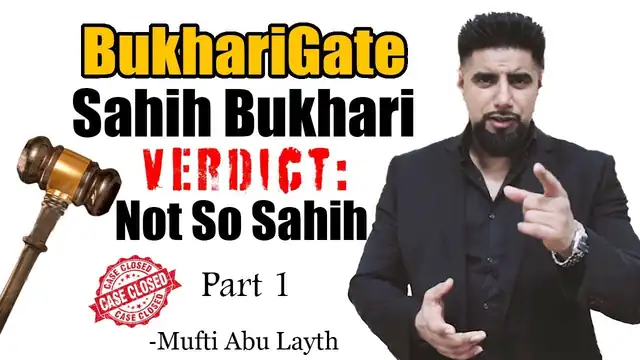 Play from 47:51
The video loads from YouTube only when you press play. Click a time in the transcript to seek.
Watch this part
Open on YouTube at 47:51The player starts at 47:51, the beginning of this part.
This segment47:51 to 58:29 · 10 min 38 sGeneral teaching
What this part covers
machinesummary, machine-writtenImam Bukhari set a gold standard but did not always apply it: he transmitted by meaning, hid the names of problematic teachers and narrated from a Khariji who praised Ali's killer. Mufti Abu Layth's quarrel is not with Bukhari himself but with how the book is treated.
In more detail
Turning to Imam Bukhari himself, Mufti Abu Layth shows a page of Siyar A'lam al-Nubala where the governor of Bukhara asks Bukhari whether hadith he heard in one region and wrote down in another were recorded verbatim, and Bukhari falls silent; the margin notes that he permitted transmission by meaning. From al-Dhahabi's Mizan al-I'tidal he cites that Bukhari concealed the names of teachers others found problematic, referring to Muhammad ibn Yahya [?] simply as Muhammad or by a grandfather's name, so that the reader cannot tell which Muhammad is meant, a practice he says is noted in volume twelve page 275 of the same author [?] and for which Imam Muslim criticised him. He says his quarrel is not with Bukhari, whose requirement that two narrators be shown to have met he admires as a gold standard, but that Bukhari did not always apply it: al-Daraqutni's work on Bukhari's lapses [?] finds around 217 hadith that fall short of sahih, and Bukhari narrates from Imran ibn Hittan [?], a Khariji who praised the killer of Ali in poetry. He rejects the argument of Abu Dawud and others that Khawarij are reliable because they regard lying as a sin, noting that Ibn Abi Hatim records Khawarij admitting that they fabricated hadith when it suited them, and says anyone who justifies murder will not baulk at lying.
- Some terms in this segment are uncertain
Position stated
Mufti Abu Layth says Imam Bukhari set a gold standard for authenticity but did not always apply it himself, since he transmitted by meaning, concealed the names of problematic teachers and narrated from a Khariji, so the narrators of his book are not all beyond question.
“my problem per se is not with imam buhari imam buhari even though he didn't stick by his rules and to be fair he also bent the rules just like people before him”
Category: method
Kind: general teachingTranscript
machine47:51 to 58:29 · click a time to seek · dotted terms open the glossary
we are now suffering the hadith about women lacking intellect the hadith about women being uh majority of the inhabitants of the hellfire that was actually in there so you you've got and i've shown this previously that right so that this is this is exactly why people then have a problem with islam because they're like see that's that hadith that i stood on the on the door on the gates of hell and i saw the majority of those who the inhabitants of the hellfire were women what nonsense
why women let's be honest like the majority of crime and the majority of warfare bloodshed all of these things is done by men so these kind of hadith you can clearly see people have fabricated them they or they've misunderstood them now that's just touching up on imam bukhari himself there's some important points to note you see first of all imam bukhari himself used to allow bill he would allow people to transmit hadith with meaning and he would do that himself as well
so this is a page from sir alam in nubula there's the reference where you have the governor of bukhara he's having a discussion ibn jaffar with uh imam buhari and he tells him look imam bukhari says hadith in s but i wrote them when i reached sham so entirely different region and many a hadith i heard in shan sham is like where palestine syria jordan these parts are he says many a hadith i heard in
sham but i wrote them in egypt so he says i said was that with its entirety like did you actually remember it spot on verbatim and he says he went silent so he became um like kind of like so here in the commentary writes that this is very clear sorry in the hamish in the margin
you see he sees that it is permissible and that's as you can see that's in sierra alam in in volume 21 page four double one now that's an example that bukhari did used to see these things as permitted and that does add to part of the problem another thing is even bukhari himself saw it permissible if the motivation was there to to kind of do tadlis to hide the names of people so the the reader can't tell who he's talking about now this is an example of uh
this is from mizanle of imam the habi right there is now there's an example of uh the egyptian is a person says in you've got here in volume 2 page 440 to 442 he says he did transmit from him in his
he used to just say abdullah wouldn't give his full name because he knew people would find problems with him then zahabi goes on to say zahabi goes on to say one of his teachers who is very famous [Music] who became a bit problematic because some people started also deeming him for a moment as a deviant as well so imam bukhari would transmit from him
he would get so much he would transmit from him in some places over 30 times his name was muhammad yahya now but check this out how imam bukhari would actually refer to him so he would refer to him he would use the name either just muhammad so you don't know which muhammad it was because he's got many teachers as muhammad or muhammad abdullah which was his grandfather's name and he wasn't known by that name or muhammad which was a greater grandfather
now so when he would just say muhammad so he would use his grandfather his great-grandfather's name because nobody knew uh who that was when he would use the name muhammad you would have no idea is he talking about muhammad ibn yahya is he talking a muslim muhammad mohammed [Music]
these are all muhammads that he transmits from so when he's saying just muhammad you don't know who he's talking about and he would do that on purpose that be said as you can see that look he would do that allah okay and that's in his volume 12 page two 275 of allah so even imam buhari didn't always stick by his rules okay so you've got to remember that now imam muslim this is why he criticizes him as well
but that said my problem per se is not with imam buhari imam buhari even though he didn't stick by his rules and to be fair he also bent the rules just like people before him um but by and large he he he his theory came up with a gold standard okay like he he said that for a hadith to be sahih he added these extra layers these conditions by by saying that you can't just say like he said that basically when you have two people in a chain like let's say abdullah heard from umar how do we know because they're
contemporaries he said that's not enough we have to have evidence that they actually met and heard from each other which is amazing which is amazing i i i like that standard he brought although he didn't always apply it he didn't always apply let me give you an example this is this book uh is a book by dar khutni it is known as zamat people disagree whether there were two books or one book but the point is they're written together published together in here you will see now darkne brings he finds problematic
probably over about 217 or over around approximately that many hadith inside bukhari which he says are massively uh problematic and invalid so he and then there's some debate in some are worse than others and some may not be that bad but he finds them all to have fallen short of being sahih okay so these are some of the the problems another thing you see is imam bukhari's teacher so who is imam bukhari taking from as well so some occasions he would take from people who were really weird like he would take like so one of his teachers as you can see here
this is page 403 in his uh that uh bukhari took from the teacher uh imran ibn um so so he takes from sorry from this rawi from uh ibn umar now this is a person who he uses sorry um as an acceptable rawi so people what i'm trying to highlight here are is that imam bukhari himself didn't always live up to his conditions why because this person imran ibn was a an extremist khawaris were those people who were savage they were like literally like isis to the power of ten they in that age i mean they are the
forefathers of ice they were ruthless they hated uh most of the companions they declared them kaffir they said if anybody committed a sin they would kill them they were literally like that so this person imran ibn is a hariji and you see what's interesting is you've got here from hafiz as well even though they say he himself didn't participate in the killing but he was one of the key sympathizers and used to write poetry uh praising them and encouraging them and even
hafiz here mentions um you've got he he says which one of the hawaiis they were kana i'm who praised the murderer of satan ali in poetry and then and yet the scholar said but we accept him in hadith because some scholars like abu dawud and others said you know these khawaris they're so upstanding when it comes to hadith
because they believe this to be a sin that's stupid because anybody who can justify murder how on earth what on earth is is a lie if you can justify murder nothing else matters i mean lying it doesn't even it's not even a blip on the radar but wait there even under this person's commentary that what abu dawood said that the hawari because they used to see lying as haram we accept their hadith he said that doesn't that's not true because ibn bihatim
transmits from some of the scholars like ibn he and others that that they openly admitted later on if they desired something had ethan look that they actually used to make up hadith and duh that's no surprise i mean i don't know why they're so shocked about that if if i if i if i can justify murder lying is a piece of cake so that is to show that first of all even imam buhari himself yes his standard did beat the other
Paragraphs overlapping 47:51 to 58:29. Full text on the recording page.
Cite this segment
Stable id, transcript version and tier are part of the citation. Every change to a transcript is logged.Mufti Abu Layth Archive, segment 2018-08-30-S09, auto-transcribed, may contain errors. https://muftiabulayth.org/r/x6sffyrljey/s/9/ (accessed 1 November 2026)
- APA 7
Mufti Abu Layth. (2018, August 30). Imam Bukhari's own practice: transmission by meaning, hidden names, a Khariji narrator [Video, segment 2018-08-30-S09, auto-transcribed, may contain errors]. Mufti Abu Layth Archive. Retrieved November 1, 2026, from https://muftiabulayth.org/r/x6sffyrljey/s/9/
- Chicago author-date
Mufti Abu Layth. 2018. "Imam Bukhari's own practice: transmission by meaning, hidden names, a Khariji narrator." Video, segment 2018-08-30-S09, auto-transcribed, may contain errors. Mufti Abu Layth Archive. Recorded August 30, 2018. Accessed November 1, 2026. https://muftiabulayth.org/r/x6sffyrljey/s/9/
- BibTeX
@misc{abulayth-2018-08-30-S09,
  author = {Mufti Abu Layth},
  title = {{Imam Bukhari's own practice: transmission by meaning, hidden names, a Khariji narrator}},
  year = {2018},
  month = {8},
  date = {2018-08-30},
  howpublished = {\url{https://muftiabulayth.org/r/x6sffyrljey/s/9/}},
  url = {https://muftiabulayth.org/r/x6sffyrljey/s/9/},
  organization = {Mufti Abu Layth Archive},
  urldate = {2026-11-01},
  note = {Segment 2018-08-30-S09, auto-transcribed, may contain errors}
}
Something wrong here?
Tell us what is wrong and it will be checked against the recording. Nothing changes until a person has reviewed it.
Sending a note needs JavaScript, which is off or unavailable in this browser. Nothing has been sent.
No name, email address or account is asked for or stored, and the inbox does not store your IP address. For rate limiting it keeps an unreadable fingerprint of your connection for 48 hours, and our database provider's own logs record connections as every website's do. Only your note, its kind, the page and the moment in the recording are kept, for review.