
Recordings › Shaykh Omar Baloch | Cynicism, Consumerism & the Catch 22 of Riba | Mindtrap with Mufti #30 · 10 Jul 2020 › Segment 15 of 38
Is humanity better off today than ever before?
muftis koran quraan al-quran amanah amana amaanah amanatClash of civilisations or end of history? Prosperity and trust in the future
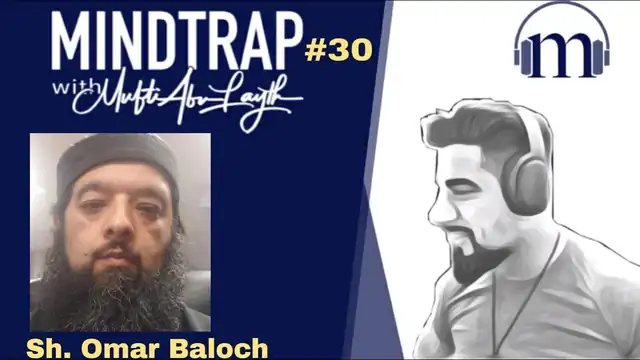 Play from 52:47
The video loads from YouTube only when you press play. Click a time in the transcript to seek.
Watch this part
Open on YouTube at 52:47The player starts at 52:47, the beginning of this part.
This segment52:47 to 58:31 · 5 min 44 sGeneral teaching
What this part covers
machinesummary, machine-writtenMufti Abu Layth argues that humanity lives in unmatched prosperity built on trust in the future; the guest doubts people have become any less greedy.
In more detail
Mufti Abu Layth says intellectuals also note that humans today live in the greatest prosperity; the guest sets out Samuel Huntington's clash of civilisations, influential after 9/11, against Francis Fukuyama's end of history, which he says many now doubt. Mufti says he is not claiming democracy is the end, but that humanity unquestionably lives in an era of prosperity, affluence, amenities and freedoms unmatched in history. The guest says that from the Quran he does not expect much good from our better selves, since people are not less greedy. Mufti answers that humans are more trusting in a future as a species, and that loans, banking, contracts and money rest on that psychosocial trust in tomorrow, distinguishing it from the 1973 oil-for-dollars deal the guest raises with Henry Kissinger. Mufti suggests earlier powers such as the Ottomans did not chase discovery because they felt they had reached a pinnacle, and says humanity has since become exponentially better through industrial, technological and scientific revolutions.
- Guest speech overlaps this segment
Position stated
Waiting for the speaker checkA guest speaks in this segment and the captions do not say who said what. The view found here is held back until the speaker-separated transcript confirms the words are his, or the channel verifies it. The transcript and recording are published in full.
Kind: general teaching Speakers: host and guest; guest speech is labelled and excluded from positionsTranscript
machine52:47 to 58:31 · click a time to seek · dotted terms open the glossary
A guest speaks in this segment. Guest speech is labelled and is excluded from the positions layer.
won't happen no but I mean yeah but what I'm trying to say the way these so for example certain batteries are powered electrical energy it is I mean it's a never-ending source I mean it's in I mean we get it from light it's not something that's going to disappear what I'm trying to say don't you feel that humans were just discover yes you can go in many different directions most of if you take a you know game have you heard of game theory yeah it came through yeah okay if you take game theory and look at what are the positive and negative
outcomes of the current situation we're in and you look at the what the intellectuals are saying you'll see majority of it is negative whether you look at climate change perspective whether you look at resources perspective whether you look at it from a war perspective whether you look at it from a from majority of them are saying something else will go wrong right and so the point I'm trying to make here is they also don't they also say that we today as human beings are living in the greatest like kind of prosperity and affluence yes generally speaking than
human Frank Frank is Fukuyama said he wrote the book at the end of his oh ok intellectuals you could say the big ones right ok so that one theory is of clash of civilization which is Samuel Huntington right so he became the big political scientist which from the time of George Bush jr. yeah after 9/11 he became the big his views were very much considered and his view of where we are going in history is we're in a clash of civilizations ok ok and we can see that really literally happening in front of us and if you read the rand reports we also seem to be going in that direction
ok now the other opinion is of Francis Fukuyama Francis Fukuyama wrote the book oh yeah my people fuku yeah it sounds less re what did you say oh no I was quoting in an academic ok said he wrote a book called end of history and basically his idea was you know that look this democracy what we have this is it and wherever this takes us it's gonna be this is the system that's gonna take us to where wherever we go this is the end of history democracy is it and you know recently I heard somebody at some universities saying I would like to ask Francis Fukuyama if he still agrees with that opinion considering everything that's
happening well I mean I you see I'm not saying democracy is the end of of everything what I'm saying is that we unquestionably as human beings right now live in an EVA that has seen unprecedented like I mean with out the kind of prosperity the kind of affluence the kind of luxuries the amenities the freedoms despite whatever is going on in the world this has been unmatched throughout human history like and I understand that things aren't necessarily always amazing and perfect but the fact that the way our lifestyle
the human era right now is it's it's like light years ahead of what human beings were previously so yeah one of the places that see the history can go in many different ways but what I see specifically in the Quran is that we are we are not in a position to expect much good to come out of our better selves I mean our better selves you know are we more nicer today are we more less greedy today are we because those that's what it's gonna take to make things better right I'll tell you what we are we are
more trusting in a future we are more trusting in a future of what in a future like as a human being as a species so we historically the fact that we have allowed so many psychosocial constructs to prevail the fact that we've allowed loans and a banking system and we have all these things and contracts and transactions is because of the psychosocial trust we have of a tomorrow the whole system we have is based upon one contract yeah okay and that is it
happened in 1973 a Kissinger went to Saudi Arabia and he said that you will only sell oil in dollars no I don't mean that little contract I mean with the thing that is not this predates Thatcher it predates the I'm talking about the whole concept of money the whole concept of taking it away like so why was then why was this kind of prosperity why didn't it occur hundreds of years ago I know put aside the fact that you're gonna say well obviously there's the Industrial
Revolution but even the concept of money proliferating of loans of things like this because there was no trust that tomorrow would be better than today and secondly human beings felt that they had pretty much achieved you know they'd kind of hit that pinnacle so if you go to the medieval ages like you said the Ottoman ages why weren't they you know there's an interesting discussion that why did the Ottomans or those people not for example participate in the discovery of America why did they not do why was the world not so thirsty about these things because human beings felt that you know
we've pretty much like you know we've got cannons we've got these things we've got this is like we're at the top like this isn't it isn't gonna really get any significantly better basically nobody did but it but nobody it massively got better no but what I mean is human beings are not the Ottomans per se but as a species it goes man are exponentially better I mean that you had a whole Industrial Revolution you're a technological revolution a scientific revolution human beings have gone you know like light-years from where they were right what I'd like to share with you is something is some studies in
mark is is the very definition of modernity okay the premises of the idea of modernity is that what is today is necessarily better than what was yesterday and the premises of modernity is that what will be tomorrow is necessarily better than what is today okay this is the very idea of meaning of the word modern modern means I'm skeptical of the past and I hold that we are in a better place today than previously and I hold that we will be in a better place tomorrow than we are today this is like if you take if you study
Paragraphs overlapping 52:47 to 58:31. Full text on the recording page.
Cite this segment
Stable id, transcript version and tier are part of the citation. Every change to a transcript is logged.Mufti Abu Layth Archive, segment 2020-07-10-S15, auto-transcribed, may contain errors. https://muftiabulayth.org/r/wce73zqci_i/s/15/ (accessed 1 November 2026)
- APA 7
Mufti Abu Layth. (2020, July 10). Is humanity better off today than ever before? [Video, segment 2020-07-10-S15, auto-transcribed, may contain errors]. Mufti Abu Layth Archive. Retrieved November 1, 2026, from https://muftiabulayth.org/r/wce73zqci_i/s/15/
- Chicago author-date
Mufti Abu Layth. 2020. "Is humanity better off today than ever before?" Video, segment 2020-07-10-S15, auto-transcribed, may contain errors. Mufti Abu Layth Archive. Recorded July 10, 2020. Accessed November 1, 2026. https://muftiabulayth.org/r/wce73zqci_i/s/15/
- BibTeX
@misc{abulayth-2020-07-10-S15,
  author = {Mufti Abu Layth},
  title = {{Is humanity better off today than ever before?}},
  year = {2020},
  month = {7},
  date = {2020-07-10},
  howpublished = {\url{https://muftiabulayth.org/r/wce73zqci_i/s/15/}},
  url = {https://muftiabulayth.org/r/wce73zqci_i/s/15/},
  organization = {Mufti Abu Layth Archive},
  urldate = {2026-11-01},
  note = {Segment 2020-07-10-S15, auto-transcribed, may contain errors}
}
Something wrong here?
Tell us what is wrong and it will be checked against the recording. Nothing changes until a person has reviewed it.
Sending a note needs JavaScript, which is off or unavailable in this browser. Nothing has been sent.
No name, email address or account is asked for or stored, and the inbox does not store your IP address. For rate limiting it keeps an unreadable fingerprint of your connection for 48 hours, and our database provider's own logs record connections as every website's do. Only your note, its kind, the page and the moment in the recording are kept, for review.