
Recordings › Neanderthals, Sapiens & Adam (a.s.) - Mufti Abu Layth · 10 Nov 2018 › Segment 1 of 1
Did Adam come from Neanderthals?
muftis hijrah hijra hijrat hijriNeanderthals, Homo sapiens and Adam as father of the cognitive revolution
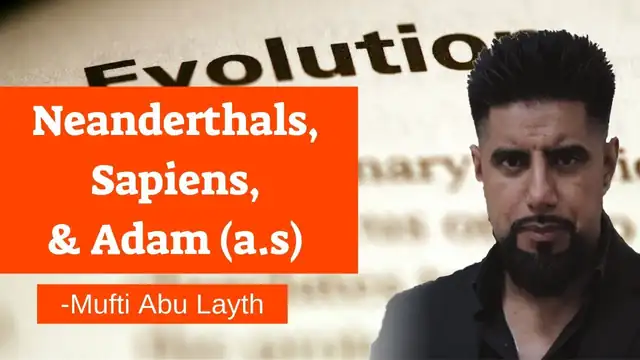 Play from 0:01
The video loads from YouTube only when you press play. Click a time in the transcript to seek.
Watch the answer
Open on YouTube at 0:01The player starts at 0:01, where the answer begins.
This segment0:01 to 7:11 · 7 min 10 sGeneral teaching
The answer in brief
machinesummary, machine-writtenNo: Neanderthals were cousins of Homo sapiens, not ancestors. He believes Adam was the father of the cognitive revolution about 70,000 years ago.
In more detail
Asked whether Dr Abd al-Sabur Shahin [?] says Adam developed in a Neanderthal womb, Mufti Abu Layth says no: Neanderthals are cousins of Homo sapiens sharing common ancestors, not their forefathers, as the genome projects showed. He says Shahin's research suggests Homo sapiens already existed, with science now dating them to about 300,000 years after a fossil find in Morocco, while a cognitive revolution happened around 70,000 years ago, bringing art and the migration out of Africa. He says he believes Adam was the father of that cognitive revolution, meaning a level of consciousness that allows planning, constructing new knowledge and passing it on. He illustrates with a book he calls The Illusion of Knowledge [?]: no single person fully knows a Boeing aeroplane, and students who rated their knowledge of bicycles highly could not draw a working one. Citing Aristotle and the saying that man is social by nature, he says this ability to build and pass on knowledge gave Adam's offspring the upper hand over Neanderthals.
Question as read aloud · questioner not identifiedDoes Dr Abd al-Sabur Shahin say that Adam developed in a Neanderthal womb?
- Some terms in this segment are uncertain
Position stated
Mufti Abu Layth says he believes Adam was the father of the cognitive revolution of about 70,000 years ago.
“what they call the cognitive revolution I believe that was Adam Adam was that the father of that the cognitive revolution”
Category: teaching
Kind: general teachingTranscript
machine0:01 to 7:11 · click a time to seek · dotted terms open the glossary
does dr. Abdul sabor Shahin say the Adam developed in the Neanderthal womb no yahoo Neanderthals are not the forefathers of Homo sapiens so Neanderthals are like cousins to homo sapiens they share common ancestors but they're not from each other so Neanderthal genes are very close to homo sapiens but they are not identical so we have the the Neanderthal genome project was complete I think by 2010 they completed it and I think in the early 2000s the human genome project was
complete so they managed to decipher the whole DNA for human the human DNA and then with whatever they could with Neanderthals and show within a decade that we are not actually from Neanderthals however we like cousins to Neanderthals okay can't you tell with the blue you know if you go past Alan rock which in Birmingham quarry tell that we're cousins with Neanderthals did this any person's me well we've seen it
Oh bro any cosy so yeah so we're like cousins with Neanderthals okay so yeah so up the support Shahin is saying that Homo sapiens already existed as this is what you can kind of take from his research and from other people who've gone down this road they say that and today science supports that homo sapiens have existed maybe for three hundred thousand years so recently they found that the the fossil from in Morocco actually was it that's just in
recent times they just found that which pushed back the homo sapien because they thought homo sapiens were probably 100 250 thousand years old but it pushes it back to about 300 thousand years that said the cognitive revolution in Homo sapiens occurs around 70,000 years ago approximately so Homo sapiens for some reason about 70,000 years ago start behaving very differently all of a sudden they get art they stop you know they start painting in walls and and doing certain things and communicating in certain ways and setting out the Out of Africa kind of
journey to dissipate across the globe and Homo sapiens just behave very differently so what this what they call the cognitive revolution I believe that was Adam Adam was that the father of that the cognitive revolution it wasn't just being clever but it was having the level of consciousness that we have so consciousness is there by other like animals have consciousness to some extent but it's like degrees the way we can plan the way we can construct new knowledge the way we can pass on
knowledge to other people so human in fact there's a very good book actually people I a very interesting book called the illusion of knowledge and it's a very and in this book the person highlights how there is an illusion of how much knowledge we think we have we don't actually have that much knowledge compared to what we think we have as individuals that knowledge is a communal asset that human beings share the asset of knowledge and hence they can push it forth one human being cannot his
knowledge is too limited so as an example in the book the author highlights that there isn't a single human being alive today that has complete knowledge of like a Boeing jet an aeroplane not a single human being has absolute technical knowledge of the entirety of a Boeing aeroplane whereas there so there will be somebody who has complete knowledge of the aerodynamics another person who has complete knowledge of the electrics another person who has complete knowledge of maybe the kind of engineering another person who
but not one person would have the complete knowledge of the entire the entire knowledge of a Boeing aeroplane in a similar way like if there's many things that we think we take for granted and there was a this a reach there's some research that the author in this book the illusion of knowledge draws on one example is we a researcher this this lady the professor she gave her students after asking them how well do they think the knowledge is of bicycles of bikes and they said well yeah yeah of course
of course you know yeah yeah so what she did is she gave them all a piece of paper that had certain structures of a bicycle that was incomplete so I just had like their handles and he just had some actually asked them can you draw the rest can you complete the bike in its picture can you do even if it's a it doesn't have to be very artistic but just draw it surprisingly or whether you may anticipate this or not the majority of the people in that classroom could not draw the bike in its entirety for it
to work so they would either put the chains the chain on the bike wrong they would not connect the wheels they would not connect like the bike that they drew just would not work in the real world as a bike despite them rating their knowledge when they were asked that how would you rate your knowledge of bikes as in to ride a bike the design of a bike would you say it's pretty good you understand how bikes work so they most people rated themselves much higher than they actually were this illusion of knowledge that we rate ourselves as knowing much more than we actually do
exists so in that sense there there is this so we as human beings are social creatures I'll even hold on said I mean as Aristotle said before but you know Allen san Madden even be Taba that we are social creatures by Nature we rely on each other to kind of survive so that's the so I believe that this ability to create knowledge from scratch and then to be able to pass this this was the unique ability that Homo Sapien modern Homo sapiens the Adam aleihsalaam
had that his offspring have that gave them the upper hand against Neanderthals and other creatures on earth
Paragraphs overlapping 0:01 to 7:11. Full text on the recording page.
Cite this segment
Stable id, transcript version and tier are part of the citation. Every change to a transcript is logged.Mufti Abu Layth Archive, segment 2018-11-10-S01, auto-transcribed, may contain errors. https://muftiabulayth.org/r/rje0sl67qzm/s/1/ (accessed 1 November 2026)
- APA 7
Mufti Abu Layth. (2018, November 10). Did Adam come from Neanderthals? [Video, segment 2018-11-10-S01, auto-transcribed, may contain errors]. Mufti Abu Layth Archive. Retrieved November 1, 2026, from https://muftiabulayth.org/r/rje0sl67qzm/s/1/
- Chicago author-date
Mufti Abu Layth. 2018. "Did Adam come from Neanderthals?" Video, segment 2018-11-10-S01, auto-transcribed, may contain errors. Mufti Abu Layth Archive. Recorded November 10, 2018. Accessed November 1, 2026. https://muftiabulayth.org/r/rje0sl67qzm/s/1/
- BibTeX
@misc{abulayth-2018-11-10-S01,
  author = {Mufti Abu Layth},
  title = {{Did Adam come from Neanderthals?}},
  year = {2018},
  month = {11},
  date = {2018-11-10},
  howpublished = {\url{https://muftiabulayth.org/r/rje0sl67qzm/s/1/}},
  url = {https://muftiabulayth.org/r/rje0sl67qzm/s/1/},
  organization = {Mufti Abu Layth Archive},
  urldate = {2026-11-01},
  note = {Segment 2018-11-10-S01, auto-transcribed, may contain errors}
}
Something wrong here?
Tell us what is wrong and it will be checked against the recording. Nothing changes until a person has reviewed it.
Sending a note needs JavaScript, which is off or unavailable in this browser. Nothing has been sent.
No name, email address or account is asked for or stored, and the inbox does not store your IP address. For rate limiting it keeps an unreadable fingerprint of your connection for 48 hours, and our database provider's own logs record connections as every website's do. Only your note, its kind, the page and the moment in the recording are kept, for review.