
Recordings › Does criticising Hadith transmission mean criticising the Quran tranmssion? | Mufti Abu Layth · 28 Sep 2019 › Segment 2 of 3
Why people fabricated hadith: good intentions, false memories, money and politics
haj pilgrimage hadj hadeeth ahadith ahaadeeth hadis hadees ahaadith ramadhan ramzan ramazan ramadaan tarawih tarawih prayer taraweeh prayer muftis riba ribaa sood usury mawdu' mawdoo maudu mawdhu iman imaan eemaan eeman al-mahdi imam mahdi mehdi koran quraan al-quran tilawah tilawat tilaawah shiah shiite shi'i twelver ithna ashari niyyah niyah niyat niyya niyyat ajr sawab thawab thawaab sawaab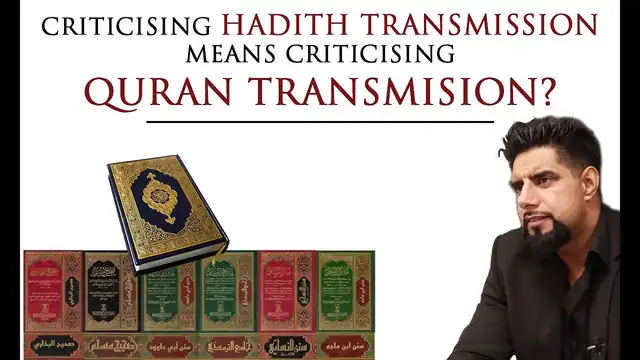 Play from 7:38
The video loads from YouTube only when you press play. Click a time in the transcript to seek.
Watch this part
Open on YouTube at 7:38The player starts at 7:38, the beginning of this part.
This segment7:38 to 12:47 · 5 min 09 sGeneral teaching
What this part covers
machinesummary, machine-writtenHadith were fabricated for many reasons: pious intentions, false memories, malice, commercial interests, and political and sectarian aims on all sides.
In more detail
Mufti Abu Layth sets out the motives people have had for fabricating teachings. Some were well-meaning, such as inventing merits of Hajj, with some saying they lied for the Prophet rather than against him; others came from false memories. Others were malicious attempts to corrupt the faith, or vested interests, such as a fabricated hadith on the merits of eating aubergines. He says many teachings were fabricated for political or sectarian ends, to stir uprising against the Umayyad state, which he says many Shia did by pushing the messianic idea of the Mahdi, or to consolidate the state, such as a hadith about a great battle of India appearing when the Umayyads wanted to conquer India. A brief disconnection interrupts the stream.
Position stated
Mufti Abu Layth says some people fabricated teachings with good intentions, saying they lied for the Prophet rather than against him.
“believe it or not people have done this it's like some of them used to say that we don't fabricate again the profit we fabricate for the profit”
Category: historical claim
Kind: general teachingTranscript
machine7:38 to 12:47 · click a time to seek · dotted terms open the glossary
something like here's a book right it's not a book like you just read like I'm just reading this book it was a recitation which meant it had a rhythmic essence to it so people would recite and we know that the Quran was preserved by memory so people would recite the Quran they would read it in in this Allah they would read it in during Ramadan in taraweeh it was being conveyed it was just being taught and this is how it
permeates through the communities it was just part and parcel of the living tradition of Islam now we have to pause that the pause posit people buzzing now we're going to come to this question of people who corrupt a message right so when people decide to interpolate when people decide to add to fabricate to manufacture a message there may be many motivations behind this many motivations
amongst them for examples there could be good there could be beneficent believe it or not they could be kind of like kind-hearted motivation so people think I know I'm going to invent a teaching I think more Muslims should do hatch for example so I'm going to invent something about the benefits for Hajj and believe it or not people have done this it's like some of them used to say that we don't fabricate again the profit we fabricate for the profit
Lenexa aleyhi next people la who we don't lie against him we life for him yeah one to go for this this are not nice so this is what some people were doing right so they were so there's many reasons why people fabricate things they bring things in it could be that there's misunderstanding they could be false memories so these are all kind or benevolent kind of non humph I mean I don't know if that's the right word but
let's say if we call them you know kind hearted kind of manufacturing of of Islamic teachings it could be because people have got a good intention it could be because it's a false memory a person actually thinks oh here wasn't this also part of the teaching and he gets it wrong that could be then they could be negative you know like malignant kind of intentions bad intentions where people are they want to corrupt a faith they want to kind of mess it up for people all they want
people so that could be one reason they want to corrupt the faith they wanna or that they have a personal vested interest so somebody wants to I don't know somebody they sell vegetables or to buy their vegetables so they start saying do you know that that Islam encourages eating vegetables now that's believe it or not actually happened as well you had somebody who fabricated a hadith to do with bad engine buzzing John is what we call in Auto bayman
you apologize for the disconnection disconnect their way back so there were people who invented hadith to say that we invented teachings to say anybody who
eats the aubergine a plant has will have such in such a reward you know the being and the merits of the bingham but this is so sometimes there's a vested interest sometimes there's political interests so people's sectarian so there's a lot of teachings that were fabricated to to create an uprising against the State against the Omega dynasty for example which a lot of the Shia people did and hence they really pushed the whole messianic vision that there will be a messiah that will
come and a maddie will come and all these things and then there were a lot of teachings fabricated to consolidate the state so the omega dynasty came up with a lot of rulings that would help them like when they wanted to take over india it's it's very convenient that all of a sudden is a hadith that the prophet said all the great battle of india so these things were just teachings of convenience so there's a lot of reasons why people fabricate something so now this is important that we clarify that now let's just pause that for a moment
it's come back to come back to the working working board here people what is the problem I ask you what is the problem or the challenge is a better word with trying to push your false teachings into the floor and what do you think would be the problem if if you were a person pretend you are a person who is intentionally because if we take the the worst-case scenario first we can deal with the other cases but by extension easily so those people who are
Paragraphs overlapping 7:38 to 12:47. Full text on the recording page.
Cite this segment
Stable id, transcript version and tier are part of the citation. Every change to a transcript is logged.Mufti Abu Layth Archive, segment 2019-09-28-S02, auto-transcribed, may contain errors. https://muftiabulayth.org/r/nndcs2uhoqe/s/2/ (accessed 1 November 2026)
- APA 7
Mufti Abu Layth. (2019, September 28). Why people fabricated hadith: good intentions, false memories, money and politics [Video, segment 2019-09-28-S02, auto-transcribed, may contain errors]. Mufti Abu Layth Archive. Retrieved November 1, 2026, from https://muftiabulayth.org/r/nndcs2uhoqe/s/2/
- Chicago author-date
Mufti Abu Layth. 2019. "Why people fabricated hadith: good intentions, false memories, money and politics." Video, segment 2019-09-28-S02, auto-transcribed, may contain errors. Mufti Abu Layth Archive. Recorded September 28, 2019. Accessed November 1, 2026. https://muftiabulayth.org/r/nndcs2uhoqe/s/2/
- BibTeX
@misc{abulayth-2019-09-28-S02,
  author = {Mufti Abu Layth},
  title = {{Why people fabricated hadith: good intentions, false memories, money and politics}},
  year = {2019},
  month = {9},
  date = {2019-09-28},
  howpublished = {\url{https://muftiabulayth.org/r/nndcs2uhoqe/s/2/}},
  url = {https://muftiabulayth.org/r/nndcs2uhoqe/s/2/},
  organization = {Mufti Abu Layth Archive},
  urldate = {2026-11-01},
  note = {Segment 2019-09-28-S02, auto-transcribed, may contain errors}
}
Something wrong here?
Tell us what is wrong and it will be checked against the recording. Nothing changes until a person has reviewed it.
Sending a note needs JavaScript, which is off or unavailable in this browser. Nothing has been sent.
No name, email address or account is asked for or stored, and the inbox does not store your IP address. For rate limiting it keeps an unreadable fingerprint of your connection for 48 hours, and our database provider's own logs record connections as every website's do. Only your note, its kind, the page and the moment in the recording are kept, for review.