
Recordings › Jannah & Jahannum: Their Reality Between Literalism and Symbolism -Mufti Abu Layth · 2 Jul 2018 › Segment 1 of 1
Are the descriptions of paradise in the Quran meant literally?
muftis akhirah akhira aakhirah akhirat hereafter janna jannat jahannam jahanam jahannum koran quraan al-quran aya ayat ayaat aayah aayat ummah umma ummatIs the Quran's imagery of paradise literal or an incentive?
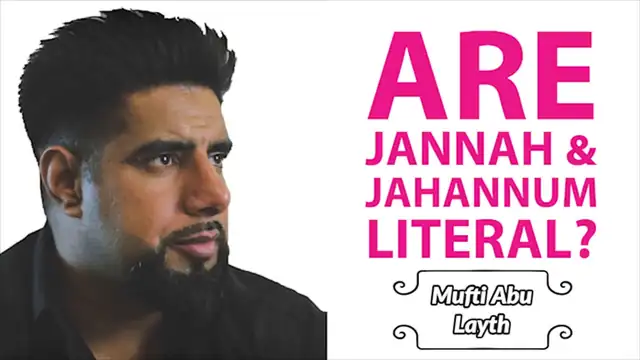 Play from 0:00
The video loads from YouTube only when you press play. Click a time in the transcript to seek.
Watch the answer
Open on YouTube at 0:00The player starts at 0:00, where the answer begins.
This segment0:00 to 5:03 · 5 min 03 sGeneral teaching
The answer in brief
machinesummary, machine-writtenThe afterlife is real, but he believes the Quran's imagery of paradise was an encouragement suited to its first audience rather than a literal description. Anyone who takes it literally is free to do so.
In more detail
Picking up a question about something he said earlier, Mufti Abu Layth explains that he believes, as Muslims do, that there will be an afterlife, but asks whether imagery such as servant boys and rivers of alcohol, milk and honey is literal. In his understanding it was an incentivising method for the first recipient community, which later Muslims may not find attractive, and he cites the Prophet's saying that no human can conceive of Jannah. After a partly inaudible exchange about the verse on clear and ambiguous verses, he grants that one could place this under the mutashabihat, summarises views of what the mutashabihat are, and says he would generally not restrict it but feels Jannah, which means garden, was understood by people. He remarks that Muslims have shifted toward a Christian-like picture of heaven in the clouds, says he has no problem with anyone who takes the imagery literally though he does not personally, and distinguishes the literal concept of an afterlife from its descriptions, whose nature nobody knows. The transcript ends mid-sentence.
Question as read aloud · questioner not identifiedIs the imagery of paradise in the Quran real, or just to incentivise people?
- The question was reconstructed from Mufti Abu Layth's restatement; the questioner's own words are not in the recording
Position stated
Mufti Abu Layth says the afterlife itself is literal but he does not personally believe the Quran's imagery of paradise is, thinking it was just an encouragement.
“I don't personally believe it I think it was just an encouragement the”
Category: teaching
Kind: general teachingTranscript
machine0:00 to 5:03 · click a time to seek · dotted terms open the glossary
that was a good question that is the kuraki you know like I said and I think some people I don't know if they got an I don't know actually the reaction I think maybe I don't know how people took it but I said look in Islam in the Quran we went Allah speaks of things like heaven and hell all these literal the way I don't mean is the afterlife gonna happen I said that I do believe and Muslims believe that there's gonna be an afterlife but the imagery that's given in the Quran like let's say of little of like servant boys walking around and rivers of alcohol and stuff like this is this
imagery real or is this just to kind of incentivize people so in my understanding this was more an incentivizing method for the first recipient community who would have found a strong attraction in that later Muslims may or may not find an attraction in that so you could say well to me a river of honey is meaningless I would never want to jump in a river of honey what the hell would I want to do that for but I mean to some people that may have been alluring to me like saying if there's a river of milk well great I mean okay fair enough but we're not that
attracted to milk or even alcohol people like if you're brought up with a kind of detest towards alcohol you wouldn't really want a need for a river of alcohol so what my point of saying that was this is just this imagery in the Quran because the Prophet himself said look no human can ever conceptualize Jannah but here you are you have got concept so what does that mean so that meant that this was more just something to incentivize people in my
understanding Oh like ayah ayah you
see I'm not saying this is not a shabiha okay in the quran this verse that allah says look there's some parts of this book that are very clear and some parts which which i'm gonna share be hurt okay fair enough you could put this under that motor okay let me just correct what I meant then Allah says and some people almost become obsessed with the motor sure be hard and these people have got a sickness in their heart now what is the mutashabihat now some people have said it's things like Alif LAAM Meem and these letters which nobody understands some people have said oh it's to do with the attributes of God you know and we say God has a hand or God has a foot or
something like this some people have said no it could be other verses I would be I would feel that look a lot in restricting we don't need to restrict it this question of is Jenna from the mutashabiha generally I would probably feel it isn't but if you got obsessed with the detail then maybe it could become like that but generally I would feel that Jenna like people understood because Jenna actually means garden that and it's interesting how our shift as well over time has gone from that understanding to the more Christian kind of like heaven in the clouds and stuff like but to the earlier observes about
the garden it wasn't actually called about the sama and stuff the heavens what we translate as the summer wats the heavens actually isn't heaven in Arabic heaven is Jenna that is somehow earth the skies but people we've got we kind of over the centuries inherited this Western understanding of heaven and stuff but my point is that look okay if somebody wanted to take that literally I have no problem with that I don't say that he has to be only like Elijah's trying to encourage people but I don't personally believe it I think it was just an encouragement the
description not the concept so the concept is literal that there is an afterlife like when a person dies life doesn't stop there is an afterlife what is that afterlife like is it gonna be body is it gonna be soul is it going to be consciousness is it going to be how is it nobody knows so this imagery that was given was just something for some people to relate to now the the truth is one the sages speak of it by many names that's to quote some Hindu scripture balance out my
Paragraphs overlapping 0:00 to 5:03. Full text on the recording page.
Cite this segment
Stable id, transcript version and tier are part of the citation. Every change to a transcript is logged.Mufti Abu Layth Archive, segment 2018-07-02-S01, auto-transcribed, may contain errors. https://muftiabulayth.org/r/kdsbnntrjko/s/1/ (accessed 1 November 2026)
- APA 7
Mufti Abu Layth. (2018, July 2). Are the descriptions of paradise in the Quran meant literally? [Video, segment 2018-07-02-S01, auto-transcribed, may contain errors]. Mufti Abu Layth Archive. Retrieved November 1, 2026, from https://muftiabulayth.org/r/kdsbnntrjko/s/1/
- Chicago author-date
Mufti Abu Layth. 2018. "Are the descriptions of paradise in the Quran meant literally?" Video, segment 2018-07-02-S01, auto-transcribed, may contain errors. Mufti Abu Layth Archive. Recorded July 2, 2018. Accessed November 1, 2026. https://muftiabulayth.org/r/kdsbnntrjko/s/1/
- BibTeX
@misc{abulayth-2018-07-02-S01,
  author = {Mufti Abu Layth},
  title = {{Are the descriptions of paradise in the Quran meant literally?}},
  year = {2018},
  month = {7},
  date = {2018-07-02},
  howpublished = {\url{https://muftiabulayth.org/r/kdsbnntrjko/s/1/}},
  url = {https://muftiabulayth.org/r/kdsbnntrjko/s/1/},
  organization = {Mufti Abu Layth Archive},
  urldate = {2026-11-01},
  note = {Segment 2018-07-02-S01, auto-transcribed, may contain errors}
}
Something wrong here?
Tell us what is wrong and it will be checked against the recording. Nothing changes until a person has reviewed it.
Sending a note needs JavaScript, which is off or unavailable in this browser. Nothing has been sent.
No name, email address or account is asked for or stored, and the inbox does not store your IP address. For rate limiting it keeps an unreadable fingerprint of your connection for 48 hours, and our database provider's own logs record connections as every website's do. Only your note, its kind, the page and the moment in the recording are kept, for review.