
Recordings › Mufti Abu Layth & Ustadh AbdusShakur Brooks: A discussion on Maliki Fiqh · 9 May 2014 › Segment 1 of 7
Is the face part of a woman's 'awrah in the Maliki school?
salat salaah namaz salaat namaaz as-salah al-salah salawat hadeeth ahadith ahaadeeth hadis hadees ahaadith saheeh sahih hadith saheeh hadith sound hadith authentic tafsir tafseer exegesis tafasir tafaseer madhab mazhab school of law madhahib mazahib madhaahib maaliki malikite malikiyyah hanafite hanafiyyah hanafi school muftis haraam forbidden wajib waajib wajibat fard farz faraid fard ayn fard kifayah fardh sunna sunnat sunan prophetic practice saheeh muslim imam muslim muslim ibn al-hajjaj jahannam jahanam jahannum koran quraan al-quran surah sura soorah surat suwar soora fitna fitan strife trial niqab niqaab burqa burka purdah parda awra satrIs a woman's face 'awrah in the Maliki school?
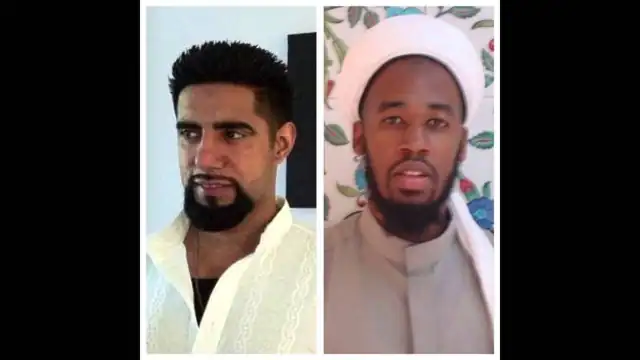 Play from 0:00
The video loads from YouTube only when you press play. Click a time in the transcript to seek.
Watch this part
Open on YouTube at 0:00The player starts at 0:00, the beginning of this part.
This segment0:00 to 6:22 · 6 min 22 sA view quoted in order to be discussed, not a position held
What this part covers
machinesummary, machine-writtenOne speaker argues that neither the Maliki nor the Hanafi school counts the face as 'awrah, so covering it is at most a precaution against fitnah.
In more detail
In a recorded conversation, Mufti Abu Layth and his guest, Ustadh Abdus Shakur Brooks, discuss face covering; the captions are poor and it is often unclear which of the two is speaking. One speaker asks whether the other distinguishes between two terms used in the Maliki commentaries (the words are lost in the captions); the reply is that the face veil is usually discussed under 'awrah and in the chapter on prayer, with some saying a woman should cover if there is fitnah. One speaker says that by default neither the Maliki nor the Hanafi madhhab counts the face as 'awrah, that covering it is not proven by the Quran and Sunnah, and that the condition 'if there is fitnah' shows it is a safeguarding measure. That speaker cites the hadith in Sahih Muslim of the Prophet turning a young man's face away from a woman he kept looking at, arguing that had covering been obligatory the Prophet would have said so, before the connection drops.
- Guest speech overlaps this segment
- Low audio confidence in the transcript
Position stated
This segment presents a view in order to discuss or respond to it. It is recorded as quoted, never as held, and no position is attributed from it.
Kind: a view quoted in order to be discussed, not a position held Speakers: host and guest; guest speech is labelled and excluded from positionsTranscript
machine0:00 to 6:22 · click a time to seek · dotted terms open the glossary
A guest speaks in this segment. Guest speech is labelled and is excluded from the positions layer.
This segment states a view in order to discuss it. It is recorded as a quoted view, not as a position held.
the question I was gonna ask you you know in you know in uh in Dr dear's quote Yeah uh in or even yeah yeah the difference between and right have you paid attention to any of the differences between the usage of the term okay I mean what what are you what would you be kind of alluding to what type of differences are we speaking about no like do do you distinguish between the two of them from in the Maliki books for example if you go into if you go into basically any commentary
whether it's whether it's whether it's even um what's the other one the one of okay if you you you you see comes a few pages later M go back when you go back you see the what book are you referring to yeah so when you go when you go four four five pages back in in yeah any commentary any commentary because the m is going to be disgusted disussed and then when you turn a couple Pages then you're going to
get okay so what what distinction are you kind of highlighting ask no I'm asking I'm asking you like the distinction have you ever came up do you do you recognize any distinction between the two I mean the the thing is that usually where you will get uh they will discuss the Mas of in as like what they call you know where you will be kind of uh uh where the woman would be kind of covering over her nose and kind of leaving the eyes and the the kind of nikab as we have it now they will usually discuss that in either like the
old section or especially in the Salah as the the and the and other people have kind of highlighted now then where people have said um things like if there is FNA which some have kind of highlighted that and they've said or you know if there was and stuff like this if that's the distinction that you mean is that the distinction that you mean or no I'm referring to the distinction of the fact you see when you look at the for example
mentions right okay he mentions that and then he mentions that it's a right but the goes I mean they they both mention it as yeah now now why are they mentioning that as is important like what okay the of that before even the Maliki started to bring this have you came across anywhere else where this ill is coming and why it's explained why are I mean I tell you who mentions it very well is also in his he goes over the I mean the whole book is just based on a and the whole
thing about looking and And he as well I mean he'll go over all of these type of things and highlight these opinions and explain the same type of thing it's that you see by default you see that Maliki ma by default doesn't recognize the face as part of the a now neither does the Han by default U now there's some differences amongst the how they see things in the Han but these two Ms see that by default the woman's face is not part of the now what that means is that by Quran and
Sunnah it is not proven that she has to cover the face and in fact it's actually perhaps even proven the contrary uh now where people then speak about s like if there was F now in that case a woman should cover the face now many have said that many have uh they've said that look if there's FNA and stuff like this and and obviously these are now safeguarding measures the the fact that they even highlight to if there is FNA demonstrate that they are recognizing that by the this is not part of it yeah
everybody yeah I would say that's that see that's exactly what it is now so they say which means right so technically speaking we we we wouldn't say if there is FNA we would say if there's then even if there's then that FNA would occur but they don't say that if there's yeah is referring to not because you're only fearing it you're not you're not saying it is we don't say you see if that's the case then you see that would contradict the Hadith in sah Muslim about when the
prophet Sall alaihi wasallam is uh with and he's staring at the woman and he keeps eyeing her up and down up and down he mentions in the and and he keeps going up and down looking at it and the prophet just moves his face and when they go he says and he questions the prophet why did you do that and he says well I just feared that maybe the Shan you know I saw shab and a shaba and maybe that the Shan would kind of play tricks with their minds now if this was an obligation then the prophet would have clarified the point that this is actually Haram that since there's
even of or that you know like this element of this like building on this van I'm not I suppose unless you mean uh hello can you hear me hello hello
Paragraphs overlapping 0:00 to 6:22. Full text on the recording page.
Cite this segment
Stable id, transcript version and tier are part of the citation. Every change to a transcript is logged.Mufti Abu Layth Archive, segment 2014-05-09-S01, auto-transcribed, may contain errors. https://muftiabulayth.org/r/hcscudhd8bu/s/1/ (accessed 1 November 2026)
- APA 7
Mufti Abu Layth. (2014, May 9). Is the face part of a woman's 'awrah in the Maliki school? [Video, segment 2014-05-09-S01, auto-transcribed, may contain errors]. Mufti Abu Layth Archive. Retrieved November 1, 2026, from https://muftiabulayth.org/r/hcscudhd8bu/s/1/
- Chicago author-date
Mufti Abu Layth. 2014. "Is the face part of a woman's 'awrah in the Maliki school?" Video, segment 2014-05-09-S01, auto-transcribed, may contain errors. Mufti Abu Layth Archive. Recorded May 9, 2014. Accessed November 1, 2026. https://muftiabulayth.org/r/hcscudhd8bu/s/1/
- BibTeX
@misc{abulayth-2014-05-09-S01,
  author = {Mufti Abu Layth},
  title = {{Is the face part of a woman's 'awrah in the Maliki school?}},
  year = {2014},
  month = {5},
  date = {2014-05-09},
  howpublished = {\url{https://muftiabulayth.org/r/hcscudhd8bu/s/1/}},
  url = {https://muftiabulayth.org/r/hcscudhd8bu/s/1/},
  organization = {Mufti Abu Layth Archive},
  urldate = {2026-11-01},
  note = {Segment 2014-05-09-S01, auto-transcribed, may contain errors}
}
Something wrong here?
Tell us what is wrong and it will be checked against the recording. Nothing changes until a person has reviewed it.
Sending a note needs JavaScript, which is off or unavailable in this browser. Nothing has been sent.
No name, email address or account is asked for or stored, and the inbox does not store your IP address. For rate limiting it keeps an unreadable fingerprint of your connection for 48 hours, and our database provider's own logs record connections as every website's do. Only your note, its kind, the page and the moment in the recording are kept, for review.