
Recordings › Monday Nights with Mufti #196 | Q&A Unscripted & Unrestricted! 😉 | Mufti Abu Layth · 5 Jan 2021 › Segment 12 of 35
Was the woman who refused the Prophet in Bukhari's divorce chapter his wife?
hadeeth ahadith ahaadeeth hadis hadees ahaadith muftis surah sura soorah surat suwar soora ulama ulema ulamaa nikah nikkah nikaah nikah nama nikahnama talaaq triple talaq talakThe woman who refused the Prophet in Bukhari's book of divorce, and institutionalised scholars
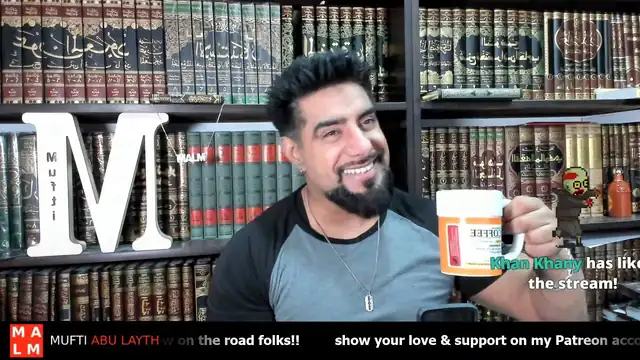 Play from 48:31
The video loads from YouTube only when you press play. Click a time in the transcript to seek.
Watch the answer
Open on YouTube at 48:31The player starts at 48:31, where the answer begins.
This segment48:31 to 54:29 · 5 min 58 sGeneral teaching
The answer in brief
machinesummary, machine-writtenThe chapter's reports are confused and defenders strain to reconcile them; he says hadith scholars, like doctors, were institutionalised in their field.
In more detail
A super chat asks whether, since the hadith of the woman who refused the Prophet's advance is in the book of talaq, she was his wife. Mufti Abu Layth says there is much confusion: the chapter has three hadith, one in which the Prophet says give yourself to me and she replies that a queen does not give herself to a low-born man, which defenders read as a proposal of marriage, and a next one showing an advance in which he tries to touch her, after which some say it was a different woman. He says he rates scholars such as Ibn Hajar but that they were invested in the field and could not bulldoze it. He compares them at length to doctors institutionalised in their training, who will not think of amino acids or growth hormone for recovery as some bodybuilders do, and says scholars invested in a field were likewise institutionalised, with only occasional ones thinking out of the box.
Question as read aloud · questioner not identifiedIn a previous video you cited a hadith of the Prophet entering the home of a woman who refused his advance. But does the fact that the hadith is in the book of talaq mean she was his wife?
Position stated
Mufti Abu Layth says that most scholars of Islam in the past who were invested in a particular field were institutionalised by it and did not critique it the way an outsider does, though a few thought out of the box.
“Those who were invested in a particular field were institutionalized by that field. They don't critique it the same way as somebody that's looking at it from outside of the box does.”
Category: method
Kind: general teachingTranscript
machine48:31 to 54:29 · click a time to seek · dotted terms open the glossary
There it is. A little a while ago in a previous video, you cited a hadith the prophet entering the home of a woman who refused his advance. But does the fact that the hadith is in the book of tal means she was his wife? Now mahab that's a good question. Now I do mention that in my bkari gate video that there is a lot of confusion. So that chapter has three hadith in it.
So one of them is the prophet saying give yourself to me and she insults the prophet by saying does a uh a queen give herself to like you know basically she uses a word like the low life of society she says does is does a queen do that like should I give myself to you so the scholars say well this was by give yourself to me this was a proposal so the prophet was proposing opposing marriage.
They argue those who support this hadith. Then they get stuck because the next hadith demonstrates an advance that the prophet tries to touch her. So they then say, well, some of them say, well, oh, this is a different woman. Ah, if Hajar and his games as well
is not at times, you know, he's you know what it is. Look, there's it's not that I don't I rate these scholars and I love them, but you have to ex understand the power structures at play. These people are too, you know, they're heavily invested in this field. They can't bulldoze it down everything.
See, they are part of that structure. It's like it's like this like you see if you go to a doctor now a doctor is institutionalized. He's been he's part of this institution of you know pharmarmacology, pharmaceuticals, the whole industry. It ties in to his education.
That's how he's been taught. That's how he understands things that look if this happens then we do this. If this and there's science behind it but they won't think differently like a doctor will not for example uh a doctor won't start saying things like um oh you know this is happening.
How about if we look at certain amino acids? Amino acids now play a huge role in the functioning of your body. And in fact, on certain occasions, certain seizures and certain things can actually be as a result of a deficit of certain amino acids. Now, you have essential body, you know, essential amino acids and you have others, but doctors generally won't think like that.
they will resort to the kind of manual um and the procedures and the protocol that they've been institutionalized into. They're not going to just start thinking out of the box. Uh because that many years of an institutionalization does that to you. You know, even if you've I mean even when I've uh in the past spoken to some doctor friends, they don't think like that. They don't think like oh well uh you know could certain other things could certain other vitamins or could certain can you take other procedures into practice?
Um they it's not their way of thinking even when dealing with injuries. It's interesting how bodybuilders, for example, a lot of them have many techniques on how to rehabilitate from, you know, this certain steroids or things that they will use that will uh rebuild injury, a growth hormone for example, and the result it will have on recovering from injury.
Now, a doctor would never prescribe something like that for recovering from an injury because it's not that they don't know what growth hormone is, but that's not their procedural u method that they've been taught. They've not been taught to think like that. So, they will say, "No, well, I don't you know, where are the well, we haven't been taught to administer growth hormone in these injuries or things like this.
we've been told to do such and such and such and such. So, Muhamadi, these scholars of Islam in the past were no different. Those who were invested in a particular field were institutionalized by that field. They don't critique it the same way as somebody that's looking at it from outside of the box does. So, occasionally there were some scholars that did critique things.
They thought out of the box, but the majority of them were part of the institutions. I hope that makes sense. All right. So, uh, somebody said it has terrible side effects. Uh, I don't know what you're talking about, but if you're talking about GH, I would say you clearly don't know what you're talking about.
Anyway, but this is not I'm not promoting such things. I'm just giving an example of how people who have actual injuries recover so rapidly uh when they sometimes use treatments that are out of the box because that's an area where people just focus on these kind of injuries. And the medical profession doesn't work in that way because it it's not catered to those specific injuries.
Paragraphs overlapping 48:31 to 54:29. Full text on the recording page.
Cite this segment
Stable id, transcript version and tier are part of the citation. Every change to a transcript is logged.Mufti Abu Layth Archive, segment 2021-01-05-S12, auto-transcribed, may contain errors. https://muftiabulayth.org/r/eo90sv4jvho/s/12/ (accessed 1 November 2026)
- APA 7
Mufti Abu Layth. (2021, January 5). Was the woman who refused the Prophet in Bukhari's divorce chapter his wife? [Video, segment 2021-01-05-S12, auto-transcribed, may contain errors]. Mufti Abu Layth Archive. Retrieved November 1, 2026, from https://muftiabulayth.org/r/eo90sv4jvho/s/12/
- Chicago author-date
Mufti Abu Layth. 2021. "Was the woman who refused the Prophet in Bukhari's divorce chapter his wife?" Video, segment 2021-01-05-S12, auto-transcribed, may contain errors. Mufti Abu Layth Archive. Recorded January 5, 2021. Accessed November 1, 2026. https://muftiabulayth.org/r/eo90sv4jvho/s/12/
- BibTeX
@misc{abulayth-2021-01-05-S12,
  author = {Mufti Abu Layth},
  title = {{Was the woman who refused the Prophet in Bukhari's divorce chapter his wife?}},
  year = {2021},
  month = {1},
  date = {2021-01-05},
  howpublished = {\url{https://muftiabulayth.org/r/eo90sv4jvho/s/12/}},
  url = {https://muftiabulayth.org/r/eo90sv4jvho/s/12/},
  organization = {Mufti Abu Layth Archive},
  urldate = {2026-11-01},
  note = {Segment 2021-01-05-S12, auto-transcribed, may contain errors}
}
Something wrong here?
Tell us what is wrong and it will be checked against the recording. Nothing changes until a person has reviewed it.
Sending a note needs JavaScript, which is off or unavailable in this browser. Nothing has been sent.
No name, email address or account is asked for or stored, and the inbox does not store your IP address. For rate limiting it keeps an unreadable fingerprint of your connection for 48 hours, and our database provider's own logs record connections as every website's do. Only your note, its kind, the page and the moment in the recording are kept, for review.